
Catalogue Search | MBRL


Are you sure you want to remove the book from the shelf?

{{itemTitle}}
1,220
result(s) for
"Symbolic interaction"
Sort by:


Contributions from European Symbolic Interactionists: Conflict and Cooperation
The papers in this volume were presented at the third conference of the European Society for the Study of Symbolic Interaction (SSSI). The theme of the 2012 conference was \"Conflict, Cooperation and Transformation in Everyday Life\". The fifteen papers presented across this volume and volume 45 cover a diverse range of topics, which are divided into two main categories: 'Reflections on Methods' and (interactions of) 'Conflict and Cooperation', this volume focuses on the latter.The papers in this volume present a wide variety of qualitative methods and themes, such as sex-work in Poland, urban public places in the Netherlands, dancing during lunch break in Sweden, self-change in Papua New Guinea, immigration in Malta and the body online.Contributing authors to this volume and the previous come from Belgium, Canada, Sweden, The US, The Netherlands, and Germany, suggesting the thriving diversity of European SSSI in terms of its research themes and methods.
eBook

40th Anniversary of Studies in Symbolic Interaction
To mark 40 volumes of Studies in Symbolic Interaction, this volume includes a special introduction from Series Editor, Norman K. Denzin. This 40th volume advances critical discourse on several fronts at the same time, including a report from the First Contemporary Ethnography Across the Disciplines hui, Waikato, New Zealand; New Empirical Studies by D. Coates, J. Johnson, D. Altheide, C. J. Schneider and D. Trotter, R. J. Berger, C. Corroto, J. Flad, and R. Quinney, and B. Jarrett (respectively): new religious movements, the California School of Symbolic Interaction, Terrorism and the National Security University, the 2011 Vancouver Riot, The Terrains of Medical Diagnosis and Treatment, and mediation processes. In a separate section to highlight the diverse and challenging aspects of symbolic interactionism; Ryan Turner asks if animals have selves? Michael Katovich and Robert Young and Carol Thompson use Turners article as a springboard for insightful commentary on the selves of other animals and the selves of humans.
eBook

Radical Interactionism and Critiques of Contemporary Culture
This volume includes contributions from experts such as Gil Musolf, Michael Katovich, Joseph Kotarba, Norbert Wiley, Alina Pop, Marco Marzano, John Pruit, Amanda Pruit, Carol Rambo, Norman Conti, Laura Rosenberg, Krzysztof Konecki, Erick Laming, Christopher J. Schneider, Stacey Hannem, Robert Perinbanayagam, Veronica Manlow, and Christopher Ferree to provide a robust and interdisciplinary critique of contemporary culture.
For its breadth and depth of research, this volume of Studies in Symbolic Interaction is essential reading for researchers and students across the social sciences interested in current symbolic interactionist thought and contemporary readings of social situations.
eBook

Interacting with objects : language, materiality, and social activity
This chapter develops an ethnomethodologically-informed view regarding the sociality of objects, building upon Garfinkel's various descriptions of object constitution. We examine a particular case of diagnostic reasoning produced in the course of carrying out a surgical procedure at a teaching hospital. Our interest is in the methods employed by the surgeons in resolving certain incongruities in the case as it presents itself. Through an occasioned process of inquiry, the case at hand comes to be seen in a new light. This revised clinical picture is the oriented object under consideration here and it is produced as a discovered matter. We describe it as an instructed object to emphasise that perception is a kind of action and can too be taught. For us, as for Garfinkel, instruction is a fundamental feature of how social order is created and shared understanding sustained. In the analysed example, the methods by which a new appreciation of the case is achieved are public and inspectable. Instructional settings are, in this way, 'perspicuous sites' for investigating how \"a world of meant objects\" is produced.
eBook

Generic Processes in Aligning the Multiple Bases of Identity
Identity theory distinguishes three bases of identity—role, group, and person—but studies have typically focused on one identity at a time. The interrelationship among the multiple bases of identity remains understudied. This study examines the multiple bases of identity individuals engage on their way to becoming ministry students. The results reveal the advantage of examining the multiple bases of identity as subcultural processes, the utility of qualitative research for expanding the empirical scope of identity theory, and the possibility of employing structural symbolic interactionist concepts within a processual symbolic interactionist agenda.
Journal Article

Symbolic Interactionist Takes on Music
Participants from Couch-Stone Symposium 2014 have contributed to this volume on three themes; reflecting a natural progression in scope of symbolic interactionist work in music: moving from observations of the individual to observation of organizations and interdisciplinary observations of music from scholars in related disciplines.
eBook
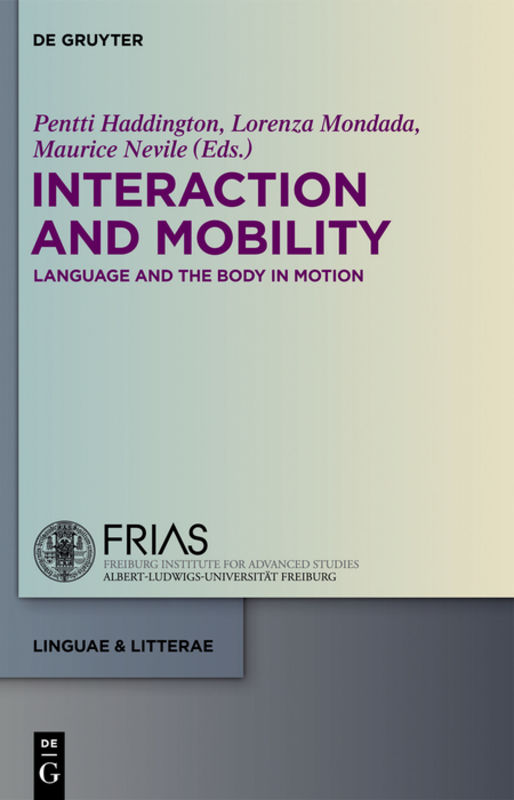
Interaction and Mobility
How do people interact when they are on the move? How do people interact in order to be mobile? How do people coordinate the mobility of others? How does mobility feature in social interaction? 'Multimodal interaction' and 'mobility' are of increasing interest to scholars across disciplines. Interaction and mobility is the first book to study these aspects comprehensively. It provides cutting-edge research by international scholars who use video-recordings of real-life everyday interactions for studying in close detail human social interaction in such diverse multimodal settings as airplanes, cars, traffic control centres, dance schools, museums and other public places, and as part of such activities as instructing, navigating, identifying an enemy on the battlefield, organising a meeting, playing videogames, shopping, performing and dancing. Together, these studies highlight features of social interaction, including language, embodied conduct, and spatial and material orientation, for being mobile, for interacting on the move, so that mobility becomes a ubiquitous feature of our lives. This book is a valuable resource to anyone interested in multimodal interaction and mobility.
eBook
Crash course sociology. Major sociological paradigms
This week we introduce sociology's three major theoretical paradigms, and some of the advantages and disadvantages of each paradigm.
Streaming Video
Crash course sociology. Education in society
Today we'll explore the history of education as a social institution, with a specific focus on how the US organizes its educational system. We'll look at education through the lenses of some sociological paradigms: structural functionalist approaches (including some of the manifest and latent functions associated with education), and a symbolic interactionist approach to education that shows us how self-fulfilling prophecies in educational settings contribute to differences in academic outcomes for students.
Streaming Video