
Catalogue Search | MBRL


Are you sure you want to remove the book from the shelf?

{{itemTitle}}
15
result(s) for
"Sympathy Congresses."
Sort by:
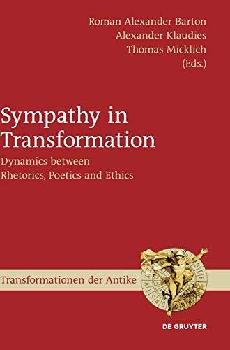
Sympathy in transformation : dynamics between rhetorics, poetics and ethics
\"There is little doubt that sympathy plays a pivotal role in aesthetic as well as moral experience, yet also little agreement on how to describe this connection and its long history. This volume investigates the changes in the concept of sympathy as well as its rhetorical, poetical and ethical functions from antiquity to the threshold of Romanticism. The focus is on sympathy's development from a cosmological principle expressing the coherence, correspondence, and unity of all things into a theoretical key concept of intersubjectivity informing moral philosophy, criticism and literature. Thus, Sympathy in Transformation offers important insights into the many ways in which, when sympathy migrates into diverse discourses in Early Modernity, its ancient origins dwindle out of sight, while some of its central elements re-emerge in a surprising manner.\"--Back cover.
Book

Exogenous shocks and electoral outcomes
Do voters react to shocks that are beyond the control of politicians? We consider the case of the assassination of a senior politician in India, in the middle of an election. We find that Congress(I), the party of the assassinated leader, gained significantly from this event through increased vote shares and improved likelihood of victory. Sympathy towards Congress(I) and changed perceptions about governing abilities of the contesting parties in the post-assassination environment played crucial roles in determining the final outcomes of the election. Our results imply that even in environments where voters are expected to make their decisions based on prior performance of parties, an unanticipated, random, exogenous event can affect voting behaviour.
Journal Article

The Impossible Contract: The Political and Private Marriage of Nelson and Winnie Mandela
Winnie and Nelson Mandela had one of the most iconic political marriages in history. For most commentators, this was a one-sided marriage in which Nelson was by far the more significant actor and Winnie was the burden he had to bear. However, it is not possible to conceive of the public persona of Nelson Mandela after his imprisonment on Robben Island without also understanding Winnie's role, not merely as upholder of the family name but also in terms of the ways in which she built an independent career out of her position as Nelson's wife. This article reads the marriage at two levels. First, it argues that there were two actors in the marriage, both central to its narrations and both with political ideas and ambitions. Winnie Mandela was building a genealogy of heroic nationalism for herself from at least the 1960s, in parallel with that of her husband, and her rise to political status was both dependent on the marriage and at odds with its demands. Understanding Winnie as an actor, treating her own biography as seriously as that of Nelson, changes the way in which the marriage is read politically. Second, it draws on the small archive of letters between the spouses that are publicly available to show the ways in which Nelson's benevolent, patriarchal (albeit loving and compassionate) approach to his wife contrasted with her increasing independence and political power. The separation caused by almost three decades of imprisonment had done more than impose a physical and emotional absence. Their politics, too, had taken extremely divergent paths in which she became a representative of radical politics while he was positioned as reconciliatory visionary.
Journal Article


The art of sympathy in fiction : forms of ethical and emotional persuasion
By taking an interdisciplinary approach - with methods drawn from narratology, aesthetics, social psychology, education, and the empirical study of literature - The Art of Sympathy in Fiction will interest scholars in a variety of fields. Its focus is the sympathetic effects of stories, and the possible ways these feelings can contribute to what has been called the \"moral imagination.\" Part I examines the dynamics of readers' beliefs regarding fictional characters and the influence of those impressions on the emotions that readers experience. The book then turns its attention to sympathy, providing a comprehensive definition and considering the ways in which it operates in life and in literature. Part I concludes with a discussion of the narratological and rhetorical features of fictional narratives that theoretically elicit sympathy in readers. Part II applies these theories to four stories that persuade readers to sympathize with characters who seem unsympathetic. Finally, based on empirical findings from the responses of adolescent readers, Part III considers pedagogical approaches that can help students reflect on emotional experiences that result from reading fiction.
eBook

FORUM: When Empathy Failed: Using Critical Oral History to Reassess the Collapse of U.S.-Soviet Détente in the Carter-Brezhnev Years
Drawing on \"critical oral history\" conferences held after the demise of the Soviet Union, this article seeks to explain why the detente in U.S-Soviet relations collapsed at the end of the 1970s. Both the U.S. president, Jimmy Carter, and the Soviet Communist Party leader, Leonid Brezhnev, had sought to improve bilateral ties, but instead they found that the relationship deteriorated and then broke down altogether after the Soviet invasion of Afghanistan. The article suggests that neither side had a sufficient appreciation of how the other side perceived the relationship. The authors argue that the critical oral history helped officials on both sides to develop a sense of empathy for how the other side viewed its own interests and objectives. Empathy does not imply any sympathy; instead, it merely entails an effort to understand the other side's perceptions and goals. Presenting excerpts from an oral history conference, the authors argue that greater empathy in the policymaking process might have helped to avoid an outcome that neither side desired. [PUBLICATION ABSTRACT]
Journal Article

‘CHOU GAGS CRITICS IN BANDOENG’ or How the Media Framed Premier Zhou Enlai at the Bandung Conference, 1955
At the Asian-African Conference at Bandung, Indonesia, in April 1955, the world's press concentrated its gaze on Premier Zhou Enlai of the People's Republic of China. Premier Zhou's every gesture, interaction and statement was scrutinized for evidence that his motivations at Bandung were antagonistic to Western interests. This preoccupation with the motivations of the Chinese was, however, no new phenomenon. By 1955, literary tropes of the 'Yellow Peril' had been firmly established in the Western imagination and, after 1949, almost seamlessly made their transition into fears of infiltrating communist Chinese 'Reds'. The first half of this paper explores the historical roots of the West's perceptions of the Chinese, through the literary works of Daniel Defoe to the pulp fiction of Sax Rohmer's Dr Fu Manchu series, which ran from 1917 to 1959. It then examines how this negative template was mobilised by the print media at the height of the Cold War to characterize Premier Zhou Enlai, not only as untrustworthy, but also as antagonistically anti-Western. This reading of representations of Premier Zhou at Bandung, as well as the literary tropes propagated in support of eighteenth and nineteenth-century imperial expansion, exposes a history of Western (mis) interpretations of China, and sheds light upon the media network's role in constructing a Chinese enemy in the mid-1950s.
Journal Article

Jurka Vićbič: A Question of Alternative Biography
Jurka Vićbič (2 [15] June 1905-4 January 1975) was a prolific Belarusian poet, writer, regional historian, and journalist. A person of turbulent destiny as a déclassé element in Soviet Belarus and Russia due to his gentry origin, he lived through World War II in Nazi-occupied Belarus. The writer then emigrated to the West but remained deeply attached to his motherland, Belarus. This is reflected in the many Belarusian themes in his literary works, from describing the misery of day-to-day life in Belarusian villages and townships to political subjects, including the suppression of the Belarusians by the Russian and Polish regimes. As such, Jewish themes were naturally prominent in Vićbič's writings. Belarus was the only country in the world where Yiddish was a state language (1919-1938). Vićbič's works accord deep sympathy to this largest ethnic minority in Belarus, which suffered the same poverty, indignity, and oppression as the rest of the Belarusian population before and after the Bolshevik takeover. Like most of his countrymen and émigrés of his times, Vićbič considered anti-Semitism to have been brought to Belarus by foreign powers. However, because of his personal circumstances during World War II, some critics stigmatize him as a Judeophobe while others regard him as a Judeophile. Since this topic has been the key controversy in discussions of his life and works, Vićbič's position merits a thorough examination. The present study demonstrates that Vićbič's literary legacy from different stages of his life points to his unwavering respect and sympathy for all of his Belarusian countrymen, irrespective of their ethnicity and faith.
Journal Article

Disadvantage Al Gore in election 2000: Coverage of issues and candidate attributes, including the canadidate as campaigner, on newspaper and television news Web sites
Content analysis examines network television as well as national, regional, and chain newspaper internet news during the 2000 U.S. presidential \"e-conventions\" and finds a focus on candidate attributes including those related to the campaign. At his Republican convention, George Bush received positive coverage on character attributes as well as foreign and domestic policy issues, including those relating to race, which exemplified compassion or \"heart\" as some coverage gushed.
Journal Article

The Sino-Japanese War and the American Committee for Non-Participation in Japanese Aggression
The outbreak of war between China and Japan in July 1937 initiated a period of global conflict that ultimately led to the Japanese attack on Pearl Harbor. Yet at the time, the impact of the Sino-Japanese War on the American people was limited. The American response to the war was in line with the non-interventionist outlook that had characterized American opinion since the rejection of the League of Nations in 1920. When polled in September 1937 on their sympathies in the conflict, 43 percent of Americans favored China and just 2 percent Japan. Yet American attitudes were most clearly represented
Book Chapter