Catalogue Search | MBRL


Are you sure you want to remove the book from the shelf?

{{itemTitle}}
2,533
result(s) for
"Syria Foreign relations."
Sort by:


Pax Syriana: Elite Politics in Postwar Lebanon
The recent political history of Lebanon has been defined by the legacy of war. While much has been written about the tragedy of the civil war, this title is the first book focused on the evolution of the postwar political scene.
eBook

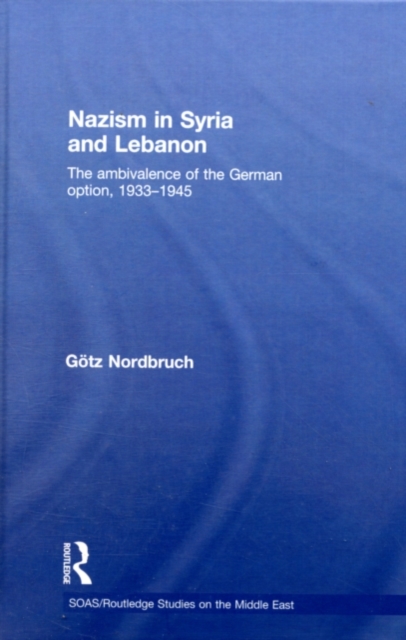
Nazism in Syria and Lebanon
The increasingly vibrant political culture emerging in Lebanon and Syria in the 1930s and early 1940s is key to the understanding of local approaches towards the Nazi German regime. For many contemporary observers in Beirut and Damascus, Nazism not only posed a risk to Europe, but threatened to take root in Arab societies as well.
In the first publication to reconstruct Lebanese and Syrian encounters with Nazism in the context of an evolving local political culture and to base its analysis on a comprehensive review of Arab, French and German sources, Götz Nordbruch examines the reactions to the rise of Nazism in the countries under French mandate, spanning from fascination and endorsement to the creation of antifascist networks.
Against a background of public discourses, local politics and the shifting regional and international settings, this book interprets public assessments of and contact with the Nazi regime as part of an intellectual quest for orientation in the years between the break-up of the Ottoman Empire and national independence.
Götz Nordbruch is research associate at the IREMAM, Aix-en-Provence, France. His research interests include the history of Arab-European relations and the development of modern Arab political culture. He is currently working on Arab students in interwar Europe.
Introduction i. Nazism and the Mandates: Approaches to the Subject and Research Questions ii. Parties, Public, and the Civic Order: The Historical Context of Lebanon and Syria during the Interwar Years 1. Struggles for a New Order: The Rise of the Nazi Regime and the Levantine Mandates (1933-1936) 1.1 Nazism in the Local Press: Crisis, Challenge, and the Longing for a ‘New Dawn’ 1.2 Approaching Nazism: Local Politics between Beirut, Damascus, Paris and Berlin 2. Nazism and the Levant – Nazism in the Levant: Between Treaty Negotiations and World War II (1936-1939) 2.1 Mobilizing the Youth and the Fascist Experiment 2.2 Nationalist Struggles and the German Option: Nazi Germany as Friend and Foe 2.3 Echoes of Nazism in Intellectual Discourses: Community, Revival, and the Enemies of the Nation 3. Repercussions of World War II: Facing the Axis in the Levant (1939-1941) 3.1 On the Eve of War: Echoes of German Aggressions in the Mandates 3.2 Local Politics between Britain, Free France, and the Axis: Resistance, Accommodation and Collaboration 4. Nazism in Retreat: The Fading of an Option and the Battle for Independence (1941-1945) 4.1 Collaboration in Exile, New Allies, and the Struggles for Power 4.2 The Search for a Post-Colonial Order: The Rise of Ideology-Guided Politics and the German Defeat 4.3 The International Arena: Arab Unity, the Atlantic Charter and the Struggle against Zionism 5. The Levant in May 1945: The Defeat of Nazism and Hopes for Independence Conclusion
\"The book provides an exemplary analysis of the changing intellectual trends while debunking many of the theories about the influence of Nazi thought on Arab nationalist ideology in the interwar period in Syria and Lebanon. It will be useful for specialists in the field as well as graduate students who have a strong grounding in the history of Syria and Lebanon between 1933 and 1945.\" - Betty S. Anderson, Boston University, International Journal of Middle East Studies, 44:1, (2012)
\"This is an important addition to a spate of scholarly work that has appeared in recent years, and in which the assumption that throughout the 1930s and 1940s the Middle East was swamped by waves of admiration for or, at the very least, identification with fascism and Nazism is reexamined. (...) Nordbruch's is an excellent and systematic piece of research, based on a thorough study of the press and other, contemporary material.\"
Eyal Zisser, Bustan: The Middle East Book Review 1 (2010)
\"makes extensive use of newspapers from the French Mandate territories, integrating them very persuasively with detailed readings of the French colonial and German archives to produce a survey of Arab–Nazi relations in Syria and Lebanon that has both breadth and depth. The result is a nuanced and fair picture that gives preference neither to the voices supporting Nazism nor to those who rejected it. The conclusions are therefore not clear-cut but delineate a broad range of visions of the meaning that modern totalitarian rule, such as that in Nazi Germany, could have for the creation of a modern Levantine society.\"
Peter Wien, International Journal of Middle East Studies, 2 (2010)
\"The number of books dealing with Arab relations to Nazism - or with the weakness of these relations - is limited. (...) Recently, the German scholar Goetz Nordbruch published a book that is more comprehensive and detailed than previous studies in this field. He deals, from the perspective of Arab-Nazi German relations, with thoughts, parties and the press in Syria and Lebanon, highlighting aspects of the history of these countries that have so far remained in the dark.\"
Hazem Saghiyeh, al-Ittihad, 14 March 2009
\"provides a comprehensive and balanced picture of the political debates in the two French mandates. In addition to the plentitude of material that is made accessible, and that also renders visible the nuances [within the debates], this work proves again empirically one important point: Arab societies were from a political point of view no less diverse than those in Europe. (...) Not only can Goetz Nordbruch's book be considered as a brilliant study of the history of the Second World War and the reception of fascism in the Levante; it is also an important contribution to understand the political context in the region between the end of the war and the foundation of Israel.\"
Thomas Schmidinger, Österreichische Zeitschrift für Politikwissenschaft, 2 (2009)
eBook

Erdoğan's war : a strongman's struggle at home and in Syria
\"Recep Tayyip Erdoğan, Turkey's pugnacious president, is now the country's longest-serving leader. On his way to the top, he has fought many wars. This book tells the story of those battles against domestic enemies through the lens of the Syrian conflict, which has become part and parcel of Erdoğan's fight to remain in power. Turkey expert Gönül Tol traces Erdoğan's ideological evolution from a conservative democrat to an Islamist and a Turkish nationalist, and explores how this progression has come to shape his Syria policy, changing the course of the war. She paints a vivid picture of the president's constantly shifting strategy to consolidate his rule, showing that these shifts have transformed Turkey's role in post-uprising Syria from an advocate of democracy, to a power fanning the flames of civil war, to an occupier. From the first days of Erdoğan's rule through the failed coup against him, via the Kurdish peace process, the Arab uprisings and the refugee crisis, this compelling, authoritative book tells the story of one man's quest to remain in power--tying together the fates of two countries, and changing them both forever.\"--Publisher description.
Book

The Consequences of Syria
In The Consequences of Syria, Lee Smith analyzes the current U.S. administration's stance on Syria, questioning whether it will build the foundations of a new Middle East or usher in an era of instability that will affect the entire world. The author contends that the many apparent shifts in the administration's Syria policy were part of a messaging campaign intended to camouflage President Obama's determination to stay out of the Syrian conflict. Smith concludes that the next White House will have to deal with a region that contains more violence, betrayed allies, emboldened adversaries, and an Iran almost on the verge of a nuclear breakout that will further destabilize a vital strategic region.
eBook

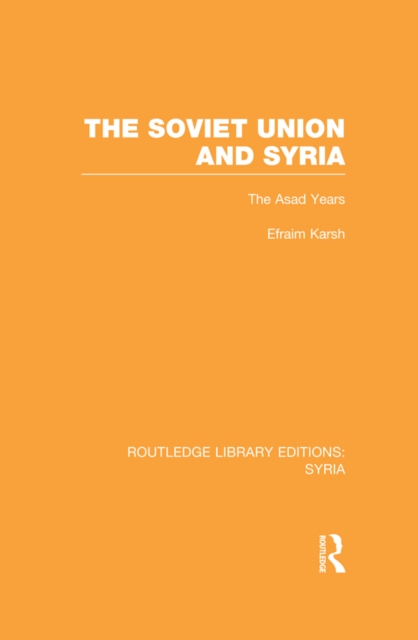
The Soviet Union and Syria (RLE Syria)
This Chatham House Paper examines the nature of Soviet relations with Syria, assessing the commitments made and the gains reaped by Moscow and Damascus in the economic, military and political spheres. After discussing Soviet interests in the region in general and with regard to Syria in particular, the author traces the evolution of the relationship between Moscow and its major Middle Eastern ally since Asad came to power in 1970.
While the study argues that huge Soviet military aid has intensified the pro-Soviet alignment of Syrian policy, it contends that Asad’s perception of his country’s national interests has also played a large part in shaping the relationship. The author concludes that both sides have gained from what is an interdependent relationship. If Damascus remains almost wholly dependent on Soviet military aid, regional constraints give Syria some leverage over Moscow. Without Moscow’s support Syria might perhaps not have played such a leading role in the region; without Damascus the Soviet Union might have found itself on the sidelines of the Arab-Israeli conflict.
1. Introduction 2. Cooperation and Conflict 3. Crisis over Lebanon 4. Towards a Bilateral Treaty 5. From Crisis to War 6. From Brezhnev to Gorbachev 7. Conclusions
eBook