
Catalogue Search | MBRL


Are you sure you want to remove the book from the shelf?

{{itemTitle}}
4
result(s) for
"Syria History 1260-1516."
Sort by:

Crowds and Sultans : Urban Protest in Late Medieval Egypt and Syria
During the fifteenth century, the Mamluk sultanate that had ruled Egypt and Syria since 1249-50 faced a series of sustained economic and political challenges to its rule, from the effects of recurrent plagues to changes in international trade routes. Both these challenges and the policies and behaviors of rulers and subjects in response to them left profound impressions on Mamluk state and society, precipitating a degree of social mobility and resulting in new forms of cultural expression. These transformations were also reflected in the frequent reports of protests during this period, and led to a greater diffusion of power and the opening up of spaces for political participation by Mamluk subjects and negotiations of power between ruler and ruled. Rather than tell the story of this tumultuous century solely from the point of view of the Mamluk dynasty, Crowds and Sultans places the protests within the framework of long-term transformations, arguing for a more nuanced and comprehensive narrative of Mamluk state and society in late medieval Egypt and Syria. Reports of urban protest and the ways in which alliances between different groups in Mamluk society were forged allow us glimpses into how some medieval Arab societies negotiated power, showing that rather than stoically endure autocratic governments, populations often resisted and renegotiated their positions in response to threats to their interests. This rich and thought-provoking study will appeal to specialists in Mamluk history, Islamic studies, and Arab history, as well as to students and scholars of Middle East politics and government and modern history.
Book
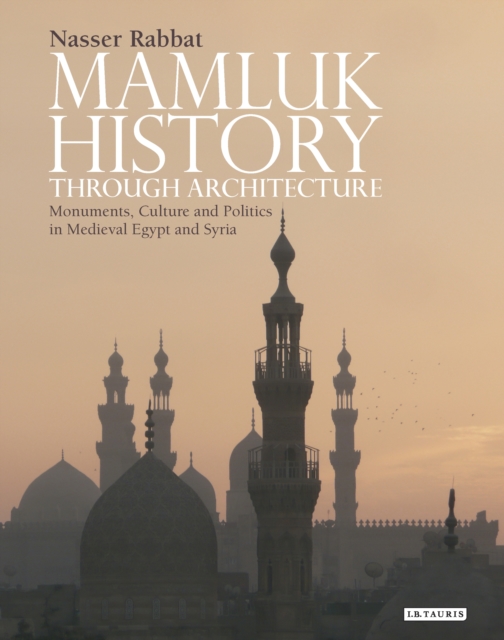
Mamluk History Through Architecture
The most enduring testament to the Mamluk Sultanate is its architecture. Not only do Mamluk buildings embody one of the most outstanding medieval architectural traditions, Mamluk architecture is actually a key to the social history of the period. Analysing Mamluk constructions as a form of communication and documentation as well as a cultural index, “Mamluk History Through Architecture” shows how the buildings mirror the complex - and historically unique - military, political, social and financial structures of Mamluk society. With this original and authoritative study, Nasser Rabbat offers an innovative approach to the history of the Mamluks - through readings of the spectacular architecture of the period. Drawing on examples from throughout both Egypt and Syria, from the Citadel and Al-Azhar Mosque of Cairo to the Mausoleum of al-Zahir Baybars in Damascus, Rabbat demonstrates how Mamluk architecture served to reinforce visually the spirit of the counter-Crusade, when the Muslim world rebounded from the setbacks of the First Crusade. Both holistically and in case studies, Rabbat demonstrates how history is inscribed into and reflected by a culture’s artefacts.
This is a groundbreaking work in the study of architecture and social history in the Middle East and beyond.
eBook


The Mamluks in Egyptian and Syrian politics and society
This volume is a collection of studies by leading historians on central aspects of the Mamluk Empire of Egypt and Syria (1250-1517), and of Ottoman Egypt (16th-18th century) where the Mamluks survived under the Ottoman suzerainty.
eBook