
Catalogue Search | MBRL


Are you sure you want to remove the book from the shelf?

{{itemTitle}}
6
result(s) for
"Syrianus"
Sort by:

Is Being a Genus? Syrianus' Criticism of Aristotle
Abstract
In Metaphysics B 3 Aristotle sets out a famous argument for the thesis that being is not a genus. In his commentary on Metaphysics B, Syrianus criticizes this argument and explains in what sense being is to be regarded as a genus. I reconstruct both Syrianus' criticisms and his own view. I bring out ways in which they can help us rethink key assumptions of Aristotle's ontology and shed light both on Syrianus' critical attitude towards Aristotle and on some of Syrianus' main views in metaphysics.
Journal Article

The School of Libanius in Late Antique Antioch
This book is a study of the fourth-century sophist Libanius, a major intellectual figure who ran one of the most prestigious schools of rhetoric in the later Roman Empire. He was a tenacious adherent of pagan religion and a friend of the emperor Julian, but also taught leaders of the early Christian church like St. John Chrysostom and St. Basil the Great. Raffaella Cribiore examines Libanius's training and personality, showing him to be a vibrant educator, though somewhat gloomy and anxious by nature. She traces how he cultivated a wide network of friends and former pupils and courted powerful officials to recruit top students. Cribiore describes his school in Antioch--how students applied, how they were evaluated and trained, and how Libanius reported progress to their families. She details the professional opportunities that a thorough training in rhetoric opened up for young men of the day. Also included here are translations of 200 of Libanius's most important letters on education, almost none of which have appeared in English before.
Cribiore casts into striking relief the importance of rhetoric in late antiquity and its influence not only on pagan intellectuals but also on prominent Christian figures. She gives a balanced view of Libanius and his circle against the far-flung panorama of the Greek East.
eBook
The Nature of the Scholia on Plato's Phaedrus
Abstract
While we know that the interpretation of the 'soul's pilot' (Phaedrus 247c7-8) found in Hermias' Scholia on Plato's Phaedrus differs considerably from that of Syrianus and Proclus, this difference has not shifted the prevailing opinion that the Scholia are a faithful transcript of Syrianus' lectures on the Phaedrus. I argue, however, that the difference over the soul's pilot is only the first in a series of elements which are difficult, if not impossible, to ascribe to Syrianus. This, I believe, is compelling evidence that the Scholia contain the ideas of both Syrianus and Hermias.
Journal Article

RECONSTRUCTING ANCIENT CONSTRUCTIONS OF THE ORPHIC THEOGONY : ARISTOTLE, SYRIANUS AND MICHAEL OF EPHESUS ON ORPHEUS’ SUCCESSION OF THE FIRST GODS
In the last decades Orphic scholarship has found itself in rather fortunate circumstances: there have been not only spectacular finds such as the Derveni Papyrus and the so-called Orphic Gold Tablets, but these texts together with all the other fragments ascribed to the authoritative author-figure Orpheus have been made accessible in the new and extensive edition by Alberto Bernabé (2004–7). Understandably, recent discussions have focussed especially on the new material. Nevertheless, much work remains to be done on those fragments with which we have long been familiar. The present study puts a new complexion on a text long taken as evidence for an Orphic theogony.
Journal Article
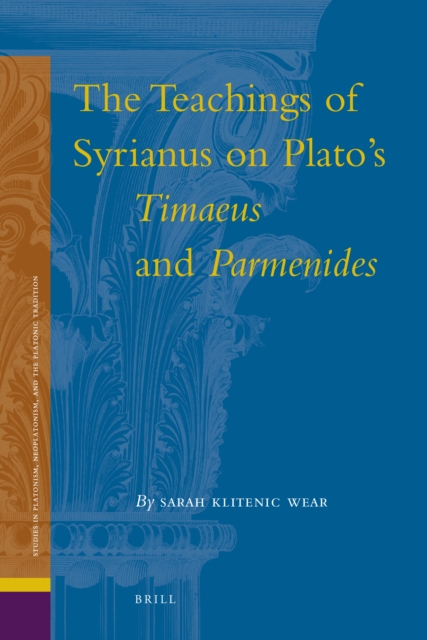
The Teachings of Syrianus on Plato's Timaeus and Parmenides
This books delves into the major tenets of Syrianus' philosophical teachings on the Timaeus and Parmenides based on the testimonia of Proclus, as found in Proclus' commentaries on Plato's Timaeus and Parmenides, and Damascius, as reported in his On First Principles and commentary on Plato's Parmenides.
eBook

Aristotle
This definitive biography shows that Aristotle's philosophy is best understood on the basis of a firm knowledge of his life and of the school he founded. First published in Italian, and now translated, updated, and expanded for English readers, this concise chronological narrative is the most authoritative account of Aristotle's life and his Lyceum available in any language. Gathering, distilling, and analyzing all the evidence and previous scholarship, Carlo Natali, one of the world's leading Aristotle scholars, provides a masterful synthesis that is accessible to students yet filled with evidence and original interpretations that specialists will find informative and provocative.
Cutting through the controversy and confusion that have surrounded Aristotle's biography, Natali tells the story of Aristotle's eventful life and sheds new light on his role in the foundation of the Lyceum. Natali offers the most detailed and persuasive argument yet for the view that the school, an important institution of higher learning and scientific research, was designed to foster a new intellectual way of life among Aristotle's followers, helping them fulfill an aristocratic ideal of the best way to use the leisure they enjoyed. Drawing a wealth of connections between Aristotle's life and thinking, Natali demonstrates how the two are mutually illuminating.
For this edition, ancient texts have been freshly translated on the basis of the most recent critical editions; indexes have been added, including a comprehensive index of sources and an index to previous scholarship; and scholarship that has appeared since the book's original publication has been incorporated.
eBook