
Catalogue Search | MBRL


Are you sure you want to remove the book from the shelf?

{{itemTitle}}
17,315
result(s) for
"Systematic theology"
Sort by:

The Eucharistic Form of God
This study presents Hans Urs von Balthasar's theology of the Eucharist and shows its significance for contemporary sacramental theology.
Anyone who seeks to offer a systematic account of Hans Urs von Balthasar's theology of the Eucharist and the liturgy is confronted with at least two obstacles. First, his reflections on the Eucharist are scattered throughout an immense and complex corpus of writings. Second, the most distinctive feature of his theology of the Eucharist is the inseparability of his sacramental theology from his speculative account of the central mysteries of the Christian faith. In The Eucharistic Form of God, the first book-length study to explore Balthasar's eucharistic theology in English, Jonathan Martin Ciraulo brings together the fields of liturgical studies, sacramental theology, and systematic theology to examine both how the Eucharist functions in Balthasar's theology in general and how it is in fact generative of his most unique and consequential theological positions. He demonstrates that Balthasar is a eucharistic theologian of the highest caliber, and that his contributions to sacramental theology, although little acknowledged today, have enormous potential to reshape many discussions in the field.
The chapters cover a range of themes not often included in sacramental theology, including the doctrine of the Trinity, the Incarnation, and soteriology. In addition to treating Balthasar's own sources—Origen, Gregory of Nyssa, Pascal, Catherine of Siena, and Bernanos—Ciraulo brings Balthasar into conversation with contemporary Catholic sacramental theology, including the work of Louis-Marie Chauvet and Jean-Yves Lacoste. The overall result is a demanding but satisfying presentation of Balthasar's contribution to sacramental theology. The audience for this volume is students and scholars who are interested in Balthasar's thought as well as theologians who are working in the area of sacramental and liturgical theology.
eBook

A Collection of Insights Flowing from the Book of Mormon
This collection of insights about the Book of Mormon adds to and complements the author's legal publications about freedom of conscience, evidence and comparative constitutional law. The book includes insights distilled from contemporary anthropology, careful analysis of the doctrine of resurrection taught in the Book of Mormon, philosophical questions about the rule of law which inform life in contemporary society, and how reflection on the pervasive New Testament intertexuality in the Book of Mormon should increase the knowledge of modern readers. Important reading for scholars of religion and faith, and particularly those interested in understanding the beliefs and practices of member of The Church of Jesus Christ of latter-day Saints around the world.
eBook
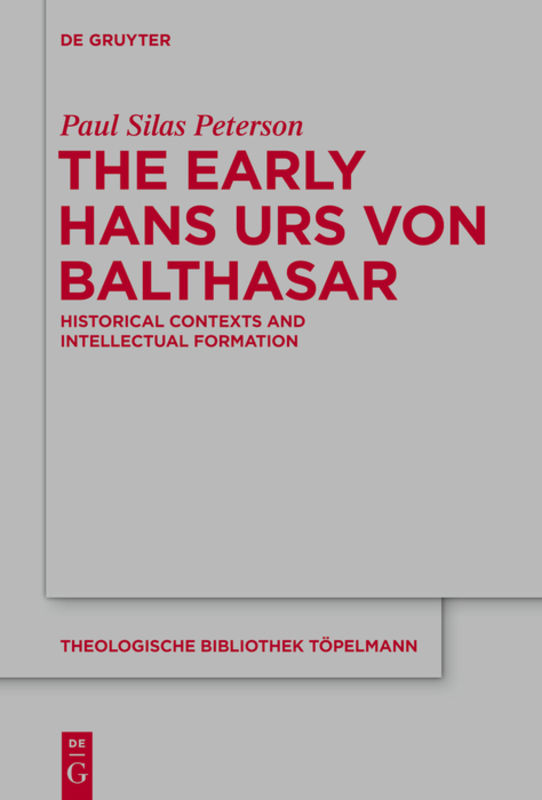
The Early Hans Urs von Balthasar
although Hans Urs von Balthasar's earliest publication is from 1925, and although he was a mature forty years old in 1945, there is a deficiency in the secondary literature regarding his early literature, its historical backgrounds and non-theological sources.
eBook

A Theology of Failure
Offers an account of Christian identity as failure
Everyone agrees that theology has failed; but the question of how to understand and respond to this failure is complex and contested. Against both the radical orthodox attempt to return to a time before the theology's failure and the deconstructive theological attempt to open theology up to the hope of a future beyond failure, Rose proposes an account of Christian identity as constituted by, not despite, failure. Understanding failure as central to theology opens up new possibilities for confronting Christianity's violent and kyriarchal history and abandoning the attempt to discover a pure Christ outside of the grotesque materiality of the church.
The Christian mystical tradition begins with Dionysius the Areopagite's uncomfortable but productive conjunction of Christian theology and Neoplatonism. The tensions generated by this are central to Dionysius's legacy, visible not only in subsequent theological thought but also in much twentieth century continental philosophy as it seeks to disentangle itself from its Christian ancestry. A Theology of Failure shows how the work of Slavoj Žižek represents an attempt to repeat the original move of Christian mystical theology, bringing together the themes of language, desire, and transcendence not with Neoplatonism but with a materialist account of the world. Tracing these themes through the work of Dionysius and Derrida and through contemporary debates about the gift, violence, and revolution, this book offers a critical theological engagement with Žižek's account of social and political transformation, showing how Žižek's work makes possible a materialist reading of apophatic theology and Christian identity. The first major reckoning of Zizek's relation to Christian theology.Rose builds upon Zizek's work, while remaining deeply critical at key moments.
eBook

Trinity and Organism
This book explores the organic motif found throughout the writings of the Dutch Calvinist theologian Herman Bavinck (1854-1921). Noting that Bavinck uses this motif at key points in the most important loci of theology; Christology, general and special revelation, ecclesiology and so forth; it seems that one cannot read him carefully without particular attention to his motif of choice: the organic. By examining the sense in which Bavinck views all of reality as a beautiful balance of unity-in-diversity, James Eglinton draws the reader to Bavinck's constant concern for the doctrine of God as Trinity. If God is the Father, the Son and the Holy Spirit, Bavinck argues, the creation must be more akin to an organism than a machine. Trinity and organism are thus closely linked concepts.
Eglinton critiques and rejects the 'two Bavincks' (one orthodox and the other modern) hermeneutic so commonplace in discussions of Bavinck's theology. Instead, this book argues for a reunited Herman Bavinck as a figure committed to the participation of historic orthodox theology in the modern world.
eBook
Paul Tillichs \Systematische Theologie\
Paul Tillichs Systematische Theologie (1951–1963) gehört zu den wichtigsten und einflussreichsten theologischen Werken des 20. Jahrhunderts. In ihr fasst er den Ertrag seines theologisch-philosophischen Denkens von vier Jahrzehnten zusammen. Obwohl Tillich sein Hauptwerk in den USA geschrieben hat, liegen die Anfänge seines systematisch-theologischen Denkens in seiner deutschen Zeit. Bereits 1913 konzipierte er einen Entwurf einer Systematischen Theologie, und 1925 begann er in Marburg eine Dogmatik-Vorlesung, die 1926 in Dresden fortgesetzt wurde. Der komplexe Entstehungszusammenhang, die problem- und debattengeschichtlichen Voraussetzungen, die sich in der Systematischen Theologie niederschlagen, stellen an den Leser hohe Anforderungen. Diese zusammen mit dem Text von Tillichs Hauptwerk zu erschließen, ist die Zielsetzung dieses Buches. Es bietet einen werk- und problemgeschichtlich angelegten Kommentar zur Systematischen Theologie.
Die Systematische Theologie ist als Neuauflage in der Reihe De Gruyter Texte erschienen; hier geht es zu Band 1/2 und Band 3.
eBook


The Late (Wild) Augustine
A rare scholarly attempt to focus on the last decade of Augustine's life, this volume highlights the themes and concerns that occupied the aged bishop of Hippo and led him to formulate some of his central notions in the most radical fashion.
eBook

The Method of Christian Theology
In The Method of Christian Theology, Rhyne Putman guides readers through the essential \"first words\" of systematic theology. Written for entry-level theology students, this book gives clear suggestions about how to use theological sources, how to reason through difficult problems, and how to apply theological reflection to paper writing and preaching. By studying the foundations of theology, readers will be better equipped to serve God's people in whatever ministry they are called to.
eBook

Carlo Passaglia on Church and Virgin
In Carlo Passaglia on Church and Virgin, Valfredo Maria Rossi offers an account of the Trinitarian ecclesiology and Mariology of Carlo Passaglia (1812-1887), one of the most neglected but brilliant theologian of the nineteenth century.
eBook