
Catalogue Search | MBRL


Are you sure you want to remove the book from the shelf?

{{itemTitle}}
114,984
result(s) for
"TELEPHONE SYSTEM"
Sort by:


The mobile connection : the cell phone's impact on society
Has the cell phone forever changed the way people communicate? The mobile phone is used for \"real time coordination while on the run, adolescents use it to manage their freedom, and teens \"text to each other day and night. The mobile phone is more than a simple technical innovation or social fad, more than just an intrusion on polite society. This book, based on world-wide research involving tens of thousands of interviews and contextual observations, looks into the impact of the phone on our daily lives. The mobile phone has fundamentally affected our accessibility, safety and security, coordination of social and business activities, and use of public places. Based on research conducted in dozens of countries, this insightful and entertaining book examines the once unexpected interaction between humans and cell phones, and between humans, period. The compelling discussion and projections about the future of the telephone should give designers everywhere a more informed practice and process, and provide researchers with new ideas to last years. *Rich Ling (an American working in Norway) is a prominent researcher, interviewed in the new technology article in the November 9 issue of the New York Times Magazine. *A particularly \"good read\", this book will be important to the designers, information designers, social psychologists, and others who will have an impact on the development of the new third generation of mobile telephones. *Carefully and wittily written by a senior research scientist at Telenor, Norway's largest telecommunications company, and developer of the first mobile telephone system that allowed for international roaming.
eBook
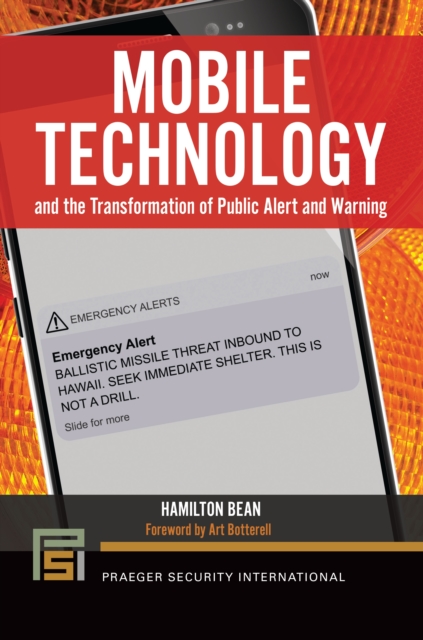
Mobile Technology and the Transformation of Public Alert and Warning
This timely book provides the inside story of the development of mobile public alert and warning technology in the United States and addresses similar systems being used in Australia, Canada, Japan, and the Netherlands. This book provides a comprehensive account of how mobile-smartphone systems are transforming the practice of public alert and warning in the United States. Recent events have vaulted mobile alert and warning technology to the forefront of public debates concerning the hazards of the digital age. False alarms of ballistic missile attacks on Hawaii and Japan, the non-use of mobile alerts during the Northern California wildfires, and the role this technology plays in supporting police manhunts and counterterrorism efforts have prompted reconsideration of how these systems are used. Drawing upon interviews with officials, executives, experts, and citizens, the book provides an in-depth analysis of the events and contexts influencing the trajectory of mobile public alert and warning and charts a course for its improvement. The book first introduces readers to the high stakes involved in the transformation of public alert and warning, explaining how new research is revealing the benefits, limitations, and risks of mobile technology in the disaster communication context. Three case studies then illustrate issues of risk, trust, and appropriateness in mobile public alert and warning.
eBook

Practical Mobile Forensics
Mobile phone forensics is the science of retrieving data from a mobile phone under forensically sound conditions. This book is an update to Practical Mobile Forensics, Second Edition and it delves into the concepts of mobile forensics and its importance in today's world.
eBook


Small Cell Networks
This comprehensive resource explores state-of-the-art advances in the successful deployment and operation of small cell networks. A broad range of technical challenges, and possible solutions, are addressed, including practical deployment considerations and interference management techniques, all set within the context of the most recent cutting-edge advances. Key aspects covered include 3GPP standardisation, applications of stochastic geometry, PHY techniques, MIMO techniques, handover and radio resource management, including techniques designed to make the best possible use of the available spectrum. Detailed technical information is provided throughout, with a consistent emphasis on real-world applications. Bringing together world-renowned experts from industry and academia, this is an indispensable volume for researchers, engineers and systems designers in the wireless communication industry.
eBook

Connected
This is the true story of how, against all odds, a remote Mexican pueblo built its own autonomous cell phone network-without help from telecom companies or the government. Anthropologist Roberto J. González paints a vivid and nuanced picture of life in a Oaxaca mountain village and the collective tribulation, triumph, and tragedy the community experienced in pursuit of getting connected. In doing so, this book captures the challenges and contradictions facing Mexico's indigenous peoples today, as they struggle to wire themselves into the 21st century using mobile technologies, ingenuity, and sheer determination. It also holds a broader lesson about the great paradox of the digital age, by exploring how constant connection through virtual worlds can hinder our ability to communicate with those around us.
eBook
Fundamentals of Network Planning and Optimisation 2G/3G/4G
Updated new edition covering all aspects of network planning and optimization This welcome new edition provides comprehensive coverage of all aspects of network planning in all the technologies, from 2G to 5G, in radio, transmission and core aspects.
eBook

Ultra-Dense Networks for 5G and Beyond
<p><b>OFFERS COMPREHENSIVE INSIGHT INTO THE THEORY, MODELS, AND TECHNIQUES OF ULTRA-DENSE NETWORKS AND APPLICATIONS IN 5G AND OTHER EMERGING WIRELESS NETWORKS</b> <p>The need for speed—and power—in wireless communications is growing exponentially. Data rates are projected to increase by a factor of ten every five years—and with the emerging Internet of Things (IoT) predicted to wirelessly connect trillions of devices across the globe, future mobile networks (5G) will grind to a halt unless more capacity is created. This book presents new research related to the theory and practice of all aspects of ultra-dense networks, covering recent advances in ultra-dense networks for 5G networks and beyond, including cognitive radio networks, massive multiple-input multiple-output (MIMO), device-to-device (D2D) communications, millimeter-wave communications, and energy harvesting communications. <p>Clear and concise throughout,<i> Ultra-dense Networks for 5G and Beyond: Modelling, Analysis, and Applications</i> offers comprehensive coverage on such topics as network optimization; mobility, handoff control, and interference management; and load balancing schemes and energy saving techniques. It delves into the backhaul traffic aspects in ultra-dense networks and studies transceiver hardware impairments and power consumption models in ultra-dense networks. The book also examines new IoT, smart-grid, and smart-city applications, as well as novel modulation, coding, and waveform designs. <ul> <li>One of the first books to focus solely on ultra-dense networks for 5G</li> <li>Covers advanced architectures, self-organizing protocols, resource allocation, user-base station association, synchronization, and signalling</li> <li>Examines the current state of cell-free massive MIMO, distributed massive MIMO, and heterogeneous small cell architectures</li> <li>Offers network measurements, implementations, and demos</li> <li>Looks at wireless caching techniques, physical layer security, cognitive radio, energy harvesting, and D2D communications in ultra-dense networks</li> </ul> <p><i>Ultra-dense Networks for 5G and Beyond: Modelling, Analysis, and Applications</i> is an ideal reference for those who want to design high-speed, high-capacity communications in advanced networks, and will appeal to postgraduate students, researchers, and engineers in the field.
eBook