
Catalogue Search | MBRL


Are you sure you want to remove the book from the shelf?

{{itemTitle}}
218
result(s) for
"TERTIARY EDUCATION REFORM"
Sort by:

The challenge of establishing world-class universities
Governments are becoming increasingly aware of the important contribution that high performance, world-class universities make to global competitiveness and economic growth. There is growing recognition, in both industrial and developing countries, of the need to establish one or more world-class universities that can compete effectively with the best of the best around the world. Contextualizing the drive for world-class higher education institutions and the power of international and domestic university rankings, this book outlines possible strategies and pathways for establishing globally competitive universities and explores the challenges, costs, and risks involved. Its findings will be of particular interest to policy makers, university leaders, researchers, and development practitioners.
eBook

Legal frameworks for tertiary education in Sub-Saharan Africa : the quest for institutional responsiveness
The performance of tertiary educational institutions is heavily influenced by their governance arrangements, management structures, accountability mechanisms, and regulatory environments. 'Legal Frameworks for Tertiary Education in Sub-Saharan Africa' analyzes 70 examples of tertiary education legislation and individual statutes of selected public institutions in 24 Sub-Saharan African countries. It identifies the range of formal governance and management practices for university educational systems set forth in these legal documents. These factors are fundamental for determining the responsiveness, adaptability, and flexibility of tertiary education systems, and ultimately the capacity of these systems to manage change and maintain relevance under continually shifting circumstances. Overall, the analysis finds general tendencies to increase institutional autonomy, to strengthen accountability mechanisms, to shift from appointment to elective representation in the filling of higher governance and management positions, and to expand university links with civil society, the private sector, and regional and international institutions.
eBook

Modernizing China's Tertiary Education Sector: Enhanced Autonomy or Governance in the Shadow of Hierarchy?
The Chinese government has acknowledged that in order to turn Chinese universities into world class institutions, it will have to grant them a greater degree of autonomy. However, the reforms that have been introduced to achieve this goal run counter to a long tradition of central government oversight. The question now presenting itself is how much actual control government has devolved to universities. The qualitative evidence presented in this paper, obtained through interviews with university presidents and Party secretaries, not only confirms that, as one might expect, Chinese universities continue to operate “in the shadow of hierarchy,” but also and more importantly that formal efforts to devolve authority are being rendered ineffective by informal pressures and control mechanisms. Discussion reflects on the state of play in Chinese public administration studies, and urges public policy researchers examining devolution in China to account for both formal reforms and everyday “lived experiences.” 中国政府认识到要创建世界一流大学需要给大学授予一定程度自主权, 但是为实现这一目标的改革与中国传统的政府治理模式背道而驰, 这里呈现的问题是政府到底授予大学多大的自主权?本论文采访了目前在职的中国大学校长和党委书记, 基于这些质性数据我们判定中国大学不但仍然行驶在统治阶级的阴影下, 而且更为重要的是即使形式上政府有授权也被实际上大学行政层面非正式的压力和控制机制所抵消。最后讨论反思了中国公共治理研究目前的状态, 同时我们鼓励目前中国公共政策的研究者研究中国政府给管辖机构授权时要把正式的改革和相关行政官员每天鲜活的治理活动都考虑进去。
Journal Article

Tertiary education in Colombia
The challenges of the future lie with confronting traditional limitations within a rapidly changing environment. This transformation has already occurred in advanced economies and increasingly so in Latin America. Colombia's great challenge is how to become an active member of this new global society, the information and knowledge society. This sector study, Tertiary Education in Colombia: Paving the Way for Reform, suggests potential strategies and recommendations that would move the Tertiary Education sector forward by providing the flexibility to become more responsive to demands from society, from students, and from the labor-market. The first section of the education sector work describes the current tertiary education system. The second section provides an economic perspective and argues that the country faces two main obstacles to expansion: rationed number of available places and stifled demand in private higher education. The third and final section contains strategies and policy recommendations that support the Government's policy by focusing upon four core issues: (i) ensuring clear and progressive governance, (ii) inducing and assuring quality, (iii) promoting strategic levels of education and fields of study, and (iv) providing finance for equitable and expanded access.
eBook

Bias-aware teaching, learning and assessment
With the spotlight on diversity and inclusion, this book offers university teachers informed and practical strategies for raising awareness of bias in teaching, learning and assessment practices and provides approaches to eliminate, limit and mitigate the negative effects of bias on university students.
eBook

Enabling critical pedagogy in higher education
An essential introduction to critical pedagogy for all those working within higher education, re-examining the concept and exploring its practical application at an institutional level, within the curriculum, within assessment, through learning and teaching, and in the spaces in-between. Contents: Cover -- Half-title -- Dedication -- Acknowledgments -- Title page -- Copyright information -- Table of contents -- Meet the authors and series editors -- Book summary -- Chapter 1 An introduction to critical pedagogy -- What is it? -- Why is it important? -- Why now? -- The structure of the book -- Principles, aims and approaches of critical pedagogy -- Principles -- Education is inherently political -- Knowledge should relate to and develop from the lived experience of participants -- Knowledge should be co-created between all participants in the learning process. Aims of critical pedagogy -- To develop critical thinkers who create new knowledge -- For people to become aware of their, and others', oppressions -- For people to make connections between personal experiences and wider societal forces -- Approaches in critical pedagogy -- Emphasising the importance of democracy and equality in learning environments -- Emphasising a co-created flexible curriculum using authentic materials, generative themes and finding teachable moments -- Flexible curriculum and using authentic materials -- Generative themes -- Teachable moments. Emphasising the importance of cultivating hope and symbolic resistance -- Conclusion: how critical pedagogy can be enabled -- a step process -- Step one: change how you teach and your relationship with students -- Step two: push the structure as far as you can and build alliances -- Step three: be seen as a pedagogic expert, internally and externally -- Useful texts -- Chapter 2 Critical pedagogy and curriculum -- Introduction -- Applying critical pedagogy to the curriculum -- The controlling hand of curriculum -- Conclusion -- Useful texts -- Chapter 3 Critical pedagogy and assessment. Introduction -- Making assessment compatible with critical pedagogy -- Characteristics of authentic assessment within critical pedagogy -- It should be centred on dialogic interactions so that the roles of teacher and learner are shared and all voices are validated -- Foster an integrated approach to theory and practice, or what Freire would term praxis -- theory in action -- It should value and validate the experience students bring to the classroom -- Reinterpret the complex ecology of relationships in the classroom to avoid oppressive power relations. Create a negotiated curriculum, including assessment, equally owned by teachers and students -- Conclusion -- Useful texts -- Chapter 4 Critical pedagogy and learning and teaching -- Introduction -- De-constructing the lecture -- Respecting the knowledge in the room -- Tutor groups: flipping the flipped classroom -- Deconstructing the conference and the academic seminar -- Conclusion -- Useful texts -- Chapter 5 Critical pedagogy and the spaces in between -- Introduction -- Critiquing the institution -- Power within critical pedagogy groups.
eBook

Co-creating learning and teaching
Co-creation of learning and teaching, where students and staff collaborate to design curricula or elements of curricula, is an important pedagogical idea within higher education, key to meaningful learner engagement and building positive student-staff relationships. Drawing on literature from schools' education, and using a range of examples from universities worldwide, this book highlights the benefits of classroom-level, relational, dialogic pedagogy and co-creation. It includes a focus on the classroom as the site of co-creation, examples of practice and practical guidance, and a unique perspective in bringing together the concept of co-creation with relational pedagogy within higher education learning and teaching.
Critical Practice in Higher Education provides a scholarly and practical entry point for academics into key areas of higher education practice. Each book in the series explores an individual topic in depth, providing an overview in relation to current thinking and practice, informed by recent research. The series will be of interest to those engaged in the study of higher education, those involved in leading learning and teaching or working in academic development, and individuals seeking to explore particular topics of professional interest. Through critical engagement, this series aims to promote an expanded notion of being an academic - connecting research, teaching, scholarship, community engagement and leadership - while developing confidence and authority.
eBook

Conversations to change teaching
This book highlights the importance of academic staff having focused conversations about teaching. The emphasis is on using this approach to build individual and team capacity and to bring about institutional change. It emphasises the distributed nature of expertise in teaching which exists at all levels in universities and how conversation can be harnessed to develop and share this. Drawing on research related to dialogue, coaching, communities of practice and building learning organisations, the text identifies simple yet effective ways to engage in learning conversations, develop educational practice, and achieve institutional goals.Critical Practice in Higher Education provides a scholarly and practical entry point for academics into key areas of higher education practice. Each book in the series explores an individual topic in depth, providing an overview in relation to current thinking and practice, informed by recent research. The series will be of interest to those engaged in the study of higher education, those involved in leading learning and teaching or working in academic development, and individuals seeking to explore particular topics of professional interest. Through critical engagement, this series aims to promote an expanded notion of being an academic - connecting research, teaching, scholarship, community engagement and leadership - while developing confidence and authority.
eBook

The Teacher Educator's Handbook
Professional learning and development for all teacher educators through stories of practice and carefully structured coaching questions.
This book provides all teacher educators, wherever they are based, with key opportunities for professional learning and development, especially in relation to the new initial teacher education (ITE) core content framework and the new early career framework. A range of detailed narratives about practice have been written by teacher educators, for teacher educators, and are carefully curated by the author to draw out key learning points, including a range of coaching questions. Of interest for individuals and groups of teacher educators, and especially those working in partnerships, the book also contains research- and practice-informed guidance that can be used in professional development sessions.
eBook
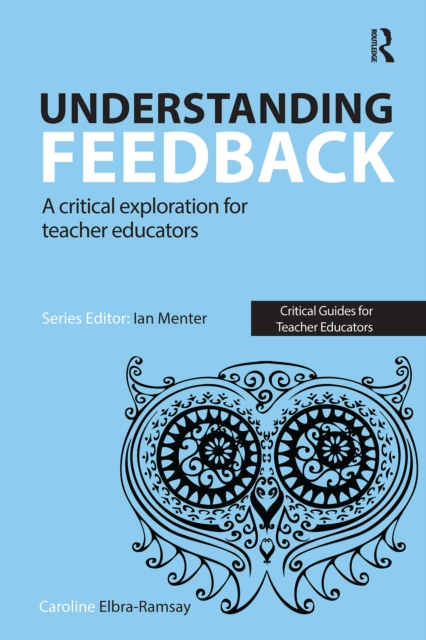
Understanding Feedback
A critical text on feedback and assessment for all teacher educators.
Feedback can be key to learning, but its potential value is not always fulfilled in practice. Developing a more nuanced understanding of feedback is particularly crucial in the ITE sector where ITE students receive feedback as learners but also give feedback to their pupils, and teacher educators need to provide feedback to their students and also guide them to give effective feedback to their pupils.
This book explores what feedback means in the ITE sector and more broadly within education. It discusses the relational, pedagogical and moral dimensions of feedback conceptualized by student teachers, drawing on research data and supporting teacher educators considering the implications for their own practice. It includes discussion of placement and academic assessment / feedback practice as well as referencing the Teachers' Standards, the Core Framework for ITT and recommendations from the Carter Review.
eBook