
Catalogue Search | MBRL


Are you sure you want to remove the book from the shelf?

{{itemTitle}}
2,066
result(s) for
"TRADE ROUTES"
Sort by:


Berenike and the ancient maritime spice route
The legendary overland silk road was not the only way to reach Asia for ancient travelers from the Mediterranean. During the Roman Empire’s heyday, equally important maritime routes reached from the Egyptian Red Sea across the Indian Ocean. The ancient city of Berenike, located approximately 500 miles south of today’s Suez Canal, was a significant port among these conduits. In this book, Steven E. Sidebotham, the archaeologist who excavated Berenike, uncovers the role the city played in the regional, local, and “global” economies during the eight centuries of its existence. Sidebotham analyzes many of the artifacts, botanical and faunal remains, and hundreds of the texts he and his team found in excavations, providing a profoundly intimate glimpse of the people who lived, worked, and died in this emporium between the classical Mediterranean world and Asia.
eBook


The Deadly Life of Logistics
In a world in which global trade is at risk, where warehouses and airports, shipping lanes and seaports try to guard against the likes of Al Qaeda and Somali pirates, and natural disaster can disrupt the flow of goods, even our \"stuff\" has a political life. The high stakes of logistics are not surprising, Deborah Cowen reveals, if we understand its genesis in war.
InThe Deadly Life of Logistics, Cowen traces the art and science of logistics over the last sixty years, from the battlefield to the boardroom and back again. Focusing on choke points such as national borders, zones of piracy, blockades, and cities, she tracks contemporary efforts to keep goods circulating and brings to light the collective violence these efforts produce. She investigates how the old military art of logistics played a critical role in the making of the global economic order-not simply the globalization of production, but the invention of the supply chain and the reorganization of national economies into transnational systems. While reshaping the world of production and distribution, logistics is also actively reconfiguring global maps of security and citizenship, a phenomenon Cowen charts through the rise of supply chain security, with its challenge to long-standing notions of state sovereignty and border management.
Though the object of corporate and governmental logistical efforts is commodity supply,The Deadly Life of Logisticsdemonstrates that they are deeply political-and, considered in the context of the long history of logistics, deeply indebted to the practice of war.
eBook
The trade in papers marked with non-Latin characters : documents and history. Volume 1 = Le commerce des papiers à marques à caractères non-latins : documents et histoire. Volume 1
\"The nine contributions in The Trade in Papers Marked with non-Latin Characters initiated by Anne Regourd (ed.) approach global history through the paper trade. They cover, in addition to a paper used in 14th C Persia, papers used in Africa (Ethiopia, Nigeria, Tunisia) and Asia (the Ottoman Levant, Mecca, Persia, Russia, and Yemen) during the 19th-20th C. Primarily based on paper examination and quantitative data, the book invites us to treat papers as a source, and provides tools to determine the production of manuscripts in space and time for the area of interest. This methodology offers new insights on the competition between suppliers to the various markets particularly in respect of the emergence of import-export trading companies\"-- Provided by publisher.
Book

Roman Seas
This book offers an archaeological analysis of maritime economy and connectivity in the Roman east. That seafaring was fundamental to prosperity under Rome is beyond doubt, but a tendency to view the grandest long-distance movements among major cities against a background noise of small-scale, short-haul activity has tended to flatten the finer and varied contours of maritime interaction and coastal life into a featureless blue Mediterranean. Drawing together maritime landscape studies and network analysis, this work takes a bottom-up view of the diverse socioeconomic conditions and seafaring logistics that generated multiple structures and scales of interaction. The material record of shipwrecks and ports along a vital corridor from the southeast Aegean across the northeast Mediterranean provides a case study of regional exchange and communication based on routine sails between simple coastal facilities. Rather than a single well-integrated and persistent Mediterranean network, multiple discrete and evolving regional and interregional systems emerge. This analysis sheds light on the cadence of economic life along the coast, the development of market institutions, and the regional continuities that underpinned integration—despite certain interregional disintegration—into Late Antiquity. Through this model of seaborne interaction, the study advances a new approach to the synthesis of shipwreck and other maritime archaeological and historical economic data, as well as a path through the stark dichotomies that inform most paradigms of Roman connectivity and trade.
eBook


Channelling Mobilities
The history of globalisation is usually told as a history of shortening distances and acceleration of the flows of people, goods and ideas. Channelling Mobilities refines this picture by looking at a wide variety of mobile people passing through the region of the Suez Canal, a global shortcut opened in 1869. As an empirical contribution to global history, the book asks how the passage between Europe and Asia and Africa was perceived, staged and controlled from the opening of the Canal to the First World War, arguing that this period was neither an era of unhampered acceleration, nor one of hardening borders and increasing controls. Instead, it was characterised by the channelling of mobilities through the differentiation, regulation and bureaucratisation of movement. Telling the stories of tourists, troops, workers, pilgrims, stowaways, caravans, dhow skippers and others, the book reveals the complicated entanglements of empires, internationalist initiatives and private companies.
eBook
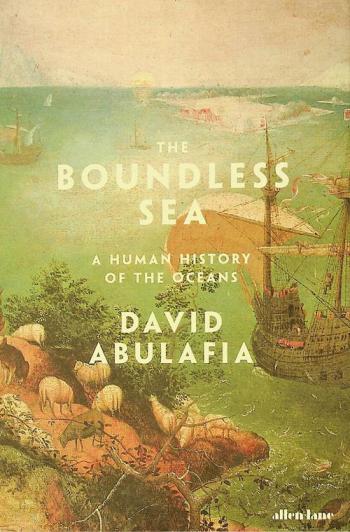
The boundless sea : a human history of the oceans
David Abulafia's new book guides readers along the world's greatest bodies of water to reveal their primary role in human history. The main protagonists are the three major oceans-the Atlantic, the Pacific, and the Indian-which together comprise the majority of the earth's water and cover over half of its surface. Over time, as passage through them gradually extended and expanded, linking first islands and then continents, maritime networks developed, evolving from local exploration to lines of regional communication and commerce and eventually to major arteries. These waterways carried goods, plants, livestock, and of course people-free and enslaved-across vast expanses, transforming and ultimately linking irrevocably the economies and cultures of Africa, Europe, Asia, and the Americas.

The Geography of Trade
From the mid-20th century onwards, consolidated study of the merchant archives from the Old Assyrian trading colony at Kaneš (Kültepe) has not only transformed our understanding of the social, economic and political dynamics of the Bronze Age Near East, but also overturned many preconceived notions of what constitutes pre-modern trade. Despite this disciplinary impact and archaeological investigations at Kültepe and elsewhere, our understanding of this phenomenon has remained largely text-based and therefore of limited analytical scope, both spatially and contextually. This book re-assesses the Old-Assyrian trade network in Upper Mesopotamia and Central Anatolia during the Middle Bronze Age (c. 1970 – 1700 BC) by combining in some analytical detail the archaeology (e.g. material culture, settlement data, etc.) of the region both on its own terms and via a range of spatial approaches. The author offers a comparative and spatial perspective on exchange networks and economic strategies, continuity and discontinuity of specific trade circuits and routes, and the evolution of political landscapes throughout the Near East in the Middle Bronze Age.
eBook