
Catalogue Search | MBRL


Are you sure you want to remove the book from the shelf?

{{itemTitle}}
131
result(s) for
"TRUE CRIME / Espionage."
Sort by:

State Crime
Current media and political discourse on crime has long ignored crimes committed by States themselves, despite their greater financial and human toll. For the past two decades, scholars have examined how and why States violate their own laws and international law and explored what can be done to reduce or prevent these injustices. Through a collection of essays by leading scholars in the field, State Crime offers a set of cases exemplifying state criminality along with various methods for controlling governmental transgressions. With topics ranging from crimes of aggression to nuclear weapons to the construction and implementation of social controls, this volume is an indispensable resource for those who examine the behavior of States and those who study crime in its varied forms.
eBook

Spy Satellites and Other Intelligence Technologies that Changed History
Much has been said and written about the failure of U.S. intelligence to prevent the terrorist attacks on September 11, 2001, and its overestimation of Iraq's weapons of mass destruction under Saddam Hussein. This book focuses instead on the central role that intelligence-collection systems play in promoting arms control and disarmament.
Ambassador Thomas Graham Jr. and Keith Hansen bring more than fifty combined years of experience to this discussion of the capabilities of technical systems, which are primarily based in space. Their history of the rapid advancement of surveillance technology is a window into a dramatic reconceptualization of Cold War strategies and policy planning. Graham and Hansen focus on the intelligence successes against Soviet strategic nuclear forces and the quality of the intelligence that has made possible accurate assessments of WMD programs in North Korea, Iran, and Libya. Their important insights shed a much-needed light on the process of verifying how the world harnesses the proliferation of nuclear arms and the continual drive for advancements in technology.
eBook

Perjury
When the Hiss-Chambers case first burst on the scene in 1948, its main characters and events seemed more appropriate to spy fiction than to American reality. The major historical authority on the case, Perjury was first published in 1978. Now, in its latest edition, Perjury links together the old and new evidence, much of it previously undiscovered or unavailable, bringing the Hiss-Chambers's amazing story up to the present.
eBook

Executive Secrets
A frank and refreshing evaluation of several Chief Executives,
their Directors of Central Intelligence, and even some lower in the
hierarchy, Executive Secrets shines light on the development and
execution of foreign policy through the understanding of the tools
available, of which covert action may be least known and
understood. This book is a great tool for the press, the public,
and many political appointees in the National Security System. A
History Book Club Selection with a foreword by Mark Bowden, author
of Black Hawk Down.
eBook

A Need to Know
In scenes eerily parallel to the culture of fear inspired by our current War on Terror, A Need to Know explores the clandestine history of a CIA family defined, and ultimately destroyed, by their oath to keep toxic secrets during the Cold War. When Bud Goodall's father mysteriously died, his inheritance consisted of three well-worn books: a Holy Bible, The Great Gatsby, and a diary. But they turned his life upside down. From the diary Goodall learned that his father had been a CIA operative during the height of the Cold War, and the Bible and Gatsby had been his codebooks. Many unexplained facets of Bud's childhood came into focus with this revelation.The high living in Rome and London. The blood-stained stiletto in his jewelry case. Bud, as a child, was always told he never had \"a need to know.\" Or did he? Now, as an adult and a university professor, Goodall attempts to fill in the missing pieces of his Cold War childhood by uncovering a lifetime of family secrets. Who were his parents? What did his father do on those business trips when he was \"working for the government?\" What betrayal turned a heroic career of national service into a nightmare of alcoholism, depression, and premature death for both of his parents? Slowly, inexorably, Goodall unearths the chilling secrets of a CIA family in A Need to Know. 2006 Best Book Award, National Communication Association Ethnography Division
eBook

Intelligence Analysis for Tomorrow
The intelligence community (IC) plays an essential role in the national security of the United States. Decision makers rely on IC analyses and predictions to reduce uncertainty and to provide warnings about everything from international diplomatic relations to overseas conflicts. In today's complex and rapidly changing world, it is more important than ever that analytic products be accurate and timely. Recognizing that need, the IC has been actively seeking ways to improve its performance and expand its capabilities.
In 2008, the Office of the Director of National Intelligence (ODNI) asked the National Research Council (NRC) to establish a committee to synthesize and assess evidence from the behavioral and social sciences relevant to analytic methods and their potential application for the U.S. intelligence community. In Intelligence Analysis for Tomorrow: Advances from the Behavioral and Social Sciences , the NRC offers the Director of National Intelligence (DNI) recommendations to address many of the IC's challenges.
Intelligence Analysis for Tomorrow asserts that one of the most important things that the IC can learn from the behavioral and social sciences is how to characterize and evaluate its analytic assumptions, methods, technologies, and management practices. Behavioral and social scientific knowledge can help the IC to understand and improve all phases of the analytic cycle: how to recruit, select, train, and motivate analysts; how to master and deploy the most suitable analytic methods; how to organize the day-to-day work of analysts, as individuals and teams; and how to communicate with its customers.
The report makes five broad recommendations which offer practical ways to apply the behavioral and social sciences, which will bring the IC substantial immediate and longer-term benefits with modest costs and minimal disruption.
eBook

Cargo of Lies
Beeby argues that Canadian authorities were woefully unprepared for the subtleties of wartime counter-espionage, and that their mishandling of the case had long-term consequences that affected relations with their intelligence partners throughout the Cold War.
eBook
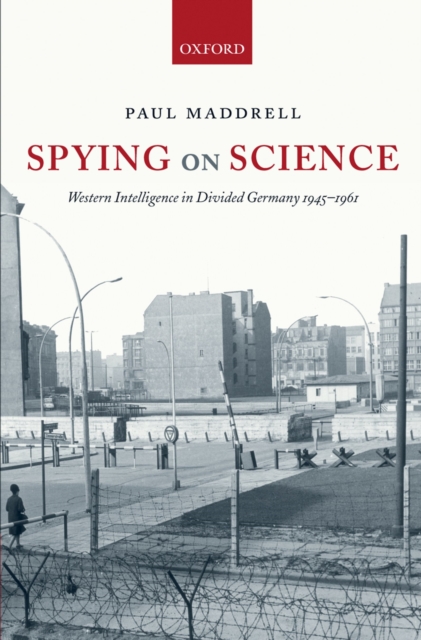
Spying on science : Western intelligence in divided Germany, 1945-1961
The years 1945-61 saw the greatest transformation in weaponry that has ever taken place, as atomic and thermonuclear bombs, intercontinental ballistic missiles and chemical and biological weapons were developed by the superpowers. It was also a distinct era in Western intelligence collection. These were the years of the Germans. Mass interrogation in West Germany and spying in East Germany represented the most important source of intelligence on Soviet war-related science, weapons development and military capability until 1956 and a key one until 1961. This intelligence fuelled the arms race and influenced Western scientific research, weapons development, and intelligence collection. Using intelligence and policy documents held in British and US archives and records of the Ministry of State Security (MfS) of the former German Democratic Republic (GDR), this book studies the scientific intelligence-gathering and subversive operations of the British, US, and West German intelligence services in the period to date. East Germany's scientific potential was contained by inducing leading scientists and engineers to defect to the West, and the book shows that the US government's policy of ‘containment’ was more aggressive than has hitherto been accepted. It also demonstrates that the Western secret services' espionage in the GDR was very successful, even though the MfS and KGB achieved triumphs against them. George Blake twice did appalling damage to MI6's spy networks. The book reveals the identity of the most distinguished scientist to spy for the CIA as yet uncovered.
eBook
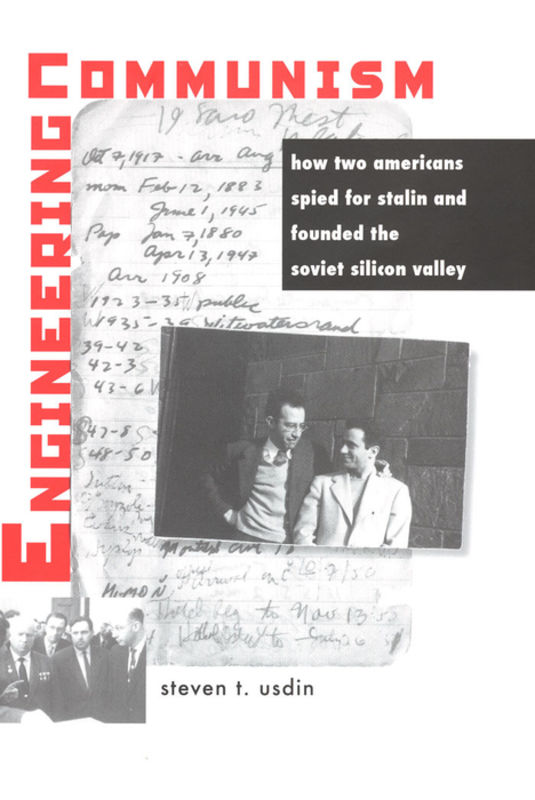
Engineering Communism
E
ngineering Communismis the fascinating story of Joel Barr and Alfred Sarant, dedicated Communists and members of the Rosenberg spy ring, who stole information from the United States during World War II that proved crucial to building the first advanced weapons systems in the USSR. On the brink of arrest, they escaped with KGB's help and eluded American intelligence for decades.
Drawing on extensive interviews with Barr and new archival evidence, Steve Usdin explains why Barr and Sarant became spies, how they obtained military secrets, and how FBI blunders led to their escape. He chronicles their pioneering role in the Soviet computer industry, including their success in convincing Nikita Khrushchev to build a secret Silicon Valley.
The book is rich with details of Barr's and Sarant's intriguing andexciting personal lives, their families, as well as their integration into Russian society.Engineering Communismfollows the two spies through Sarant's death and Barr's unbelievable return to the United States.
eBook
Intelligence Analysis
The U.S.intelligence community (IC) is a complex human enterprise whose success depends on how well the people in it perform their work.Although often aided by sophisticated technologies, these people ultimately rely on their own intellect to identify, synthesize, and communicate the information on which the nation's security depends.
eBook