
Catalogue Search | MBRL


Are you sure you want to remove the book from the shelf?

{{itemTitle}}
354
result(s) for
"Tacitus"
Sort by:


The History of Make-Believe
A theoretically sophisticated and illuminating reading of Tacitus, especially theHistories, this work points to a new understanding of the logic of Roman rule during the early Empire. Tacitus, in Holly Haynes' analysis, does not write about the reality of imperial politics and culture but about the imaginary picture that imperial society makes of these concrete conditions of existence-the \"making up and believing\" that figure in both the subjective shaping of reality and the objective interpretation of it. Haynes traces Tacitus's development of thisfingere/crederedynamic both backward and forward from the crucial year A.D. 69. Using recent theories of ideology, especially within the Marxist and psychoanalytic traditions, she exposes the psychic logic lurking behind the actions and inaction of the protagonists of theHistories. Her work demonstrates how Tacitus offers penetrating insights into the conditions of historical knowledge and into the psychic logic of power and its vicissitudes, from Augustus through the Flavians. By clarifying an explicit acknowledgment of the difficult relationship betweenresandverba,in theHistories,Haynes shows how Tacitus calls into question the possibility of objective knowing-how he may in fact be the first to allow readers to separate the objectively knowable from the objectively unknowable. Thus, Tacitus appears here as going further toward identifying the object of historical inquiry-and hence toward an \"objective\" rendering of history-than most historians before or since.
eBook

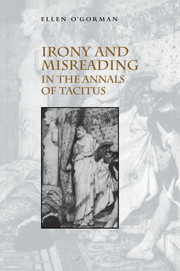
Irony and Misreading in the Annals of Tacitus
This 2000 book examines Tacitus' Annals as an ironic portrayal of Julio-Claudian Rome, through close analysis of passages in which characters engage in interpretation and misreading. By representing the misreading of signifying systems - such as speech, gesture, writing, social structures and natural phenomena - Tacitus obliquely comments upon the perversion of Rome's republican structure in the new principate. Furthermore, this study argues that the distinctively obscure style of the Annals is used by Tacitus to draw his reader into the ambiguities and compromises of the political regime it represents. The strain on language and meaning both portrayed and enacted by the Annals in this way gives voice to a form of political protest to which the reader must respond in the course of interpreting the narrative.
eBook


Coercizione, intimidazioni, violenze di genere in Tacito: la paura delle donne in età giulio-claudia fra pregiudizi e indifferenza storiografica
The contribution focuses on the relationship between women and fear in Tacitus’ reconstruction of the Julio-Claudian age, pointing out that it seems to take on significance in two directions. In addition to the passages that bring out the capacity of women, or at least of some of them, to arouse fear or to appear fearsome for their enterprising behaviour, from others it is possible to deduce the impact of fear on women subjected to coercive impositions, delimitations of freedom linked to incriminations of various kinds, intimidation arising from their relations with the power of their relatives and even physical violence. In spite of the punctuality in the recounting of these episodes, one nevertheless notes the historian’s tendency to gloss over women’s emotional reactions in these circumstances, according to a perspective that often seems to reflect resistance to accepting their active presence on the public scene and involvement in political events, while at the same time expressing repudiation of behaviour contrary to the moral principles prescribed by earlier tradition for female conduct
Journal Article

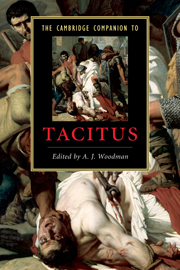
The Cambridge Companion to Tacitus
Tacitus is universally recognised as ancient Rome's greatest writer of history, and his account of the Roman Empire in the first century AD has been fundamental in shaping the modern perception of Rome and its emperors. This Companion provides a new, up-to-date and authoritative assessment of his work and influence which will be invaluable for students and non-specialists as well as of interest to established scholars in the field. First situating Tacitus within the tradition of Roman historical writing and his own contemporary society, it goes on to analyse each of his individual works and then discuss key topics such as his distinctive authorial voice and his views of history and freedom. It ends by tracing Tacitus' reception, beginning with the transition from manuscript to printed editions, describing his influence on political thought in early modern Europe, and concluding with his significance in the twentieth century.
eBook

The Cambridge companion to Tacitus
\"Tacitus is universally recognised as ancient Rome's greatest writer of history, and his account of the Roman Empire in the first century AD has been fundamental in shaping the modern perception of Rome and its emperors. This Companion provides a new, up-to-date and authoritative assessment of his work and influence which will be invaluable for students and non-specialists as well as of interest to established scholars in the field. First situating Tacitus within the tradition of Roman historical writing and his own contemporary society, it goes on to analyse each of his individual works and then discuss key topics such as his distinctive authorial voice and his views of history and freedom. It ends by tracing Tacitus' reception, beginning with the transition from manuscript to printed editions, and concluding with his significance in the twentieth century, particularly his influence on political thought in early modern Europe\"--Provided by publisher.
Book

The Invention of Racism in Classical Antiquity
There was racism in the ancient world, after all. This
groundbreaking book refutes the common belief that the ancient
Greeks and Romans harbored \"ethnic and cultural,\" but not racial,
prejudice. It does so by comprehensively tracing the intellectual
origins of racism back to classical antiquity. Benjamin Isaac's
systematic analysis of ancient social prejudices and stereotypes
reveals that some of those represent prototypes of racism--or
proto-racism--which in turn inspired the early modern authors who
developed the more familiar racist ideas. He considers the
literature from classical Greece to late antiquity in a quest for
the various forms of the discriminatory stereotypes and social
hatred that have played such an important role in recent history
and continue to do so in modern society.
Magisterial in scope and scholarship, and engagingly written,
The Invention of Racism in Classical Antiquity further
suggests that an understanding of ancient attitudes toward other
peoples sheds light not only on Greco-Roman imperialism and the
ideology of enslavement (and the concomitant integration or
non-integration) of foreigners in those societies, but also on the
disintegration of the Roman Empire and on more recent imperialism
as well. The first part considers general themes in the history of
discrimination; the second provides a detailed analysis of
proto-racism and prejudices toward particular groups of foreigners
in the Greco-Roman world. The last chapter concerns Jews in the
ancient world, thus placing anti-Semitism in a broader context.
eBook