
Catalogue Search | MBRL


Are you sure you want to remove the book from the shelf?

{{itemTitle}}
2,464
result(s) for
"Tamil language"
Sort by:
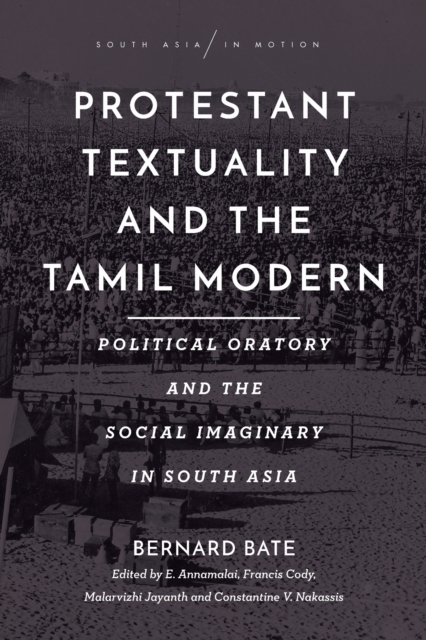
Protestant textuality and the Tamil modern : political oratory and the social imaginary in South Asia
Throughout history, speech and storytelling have united communities and mobilized movements. Protestant Textuality and the Tamil Modern examines this phenomenon in Tamil-speaking South India over the last three centuries, charting the development of political oratory and its influence on society. Supplementing his narrative with thorough archival work, Bernard Bate begins with Protestant missionaries' introduction of the sermonic genre and takes the reader through its local vernacularization. What originally began as a format of religious speech became an essential political infrastructure used to galvanize support for new social imaginaries, from Indian independence to Tamil nationalism. Completed by a team of Bate's colleagues, this ethnography marries linguistic anthropology to performance studies and political history, illuminating new geographies of belonging in the modern era.
eBook
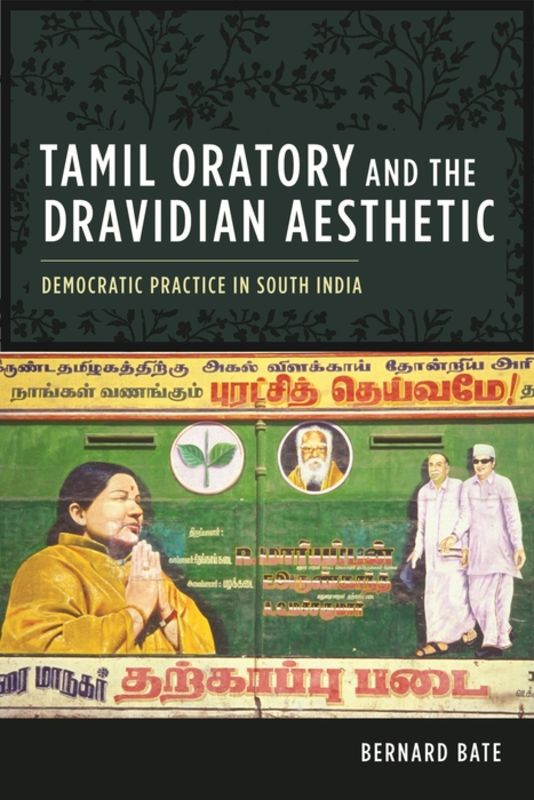
Tamil Oratory and the Dravidian Aesthetic
This is a book about the newness of old things. It concerns an oratorical revolution, a transformation of oratorical style linked to larger transformations in society at large. It explores the aesthetics of Tamil oratory and its vital relationship to one of the key institutions of modern society: democracy. Therefore this book also bears on the centrality of language to the modern human condition.
Though Tamil oratory is a relatively new practice in south India, the Dravidian (or Tamil nationalist) style employs archaic forms of Tamil that suggest an ancient mode of speech. Beginning with the advent of mass democratic politics in the 1940s, a new generation of politician adopted this style, known as \"fine,\" or \"beautiful Tamil\" (centamil), for its distinct literary virtuosity, poesy, and alluring evocation of a pure Tamil past.
Bernard Bate explores thecentamilphenomenon, arguing that the genre's spectacular literacy and use of ceremonial procession, urban political ritual, and posters, praise poetry are critical components in the production of a singularly Tamil mode of political modernity: a Dravidian neoclassicism. From his perspective, thecentamilrevolution and Dravidian neoclassicism suggest that modernity is not the mere successor of tradition but the production of tradition, and that this production is a primary modality of modernity, a new newness-albeit a newness of old things.
eBook

DravidianCodeMix: sentiment analysis and offensive language identification dataset for Dravidian languages in code-mixed text
This paper describes the development of a multilingual, manually annotated dataset for three under-resourced Dravidian languages generated from social media comments. The dataset was annotated for sentiment analysis and offensive language identification for a total of more than 60,000 YouTube comments. The dataset consists of around 44,000 comments in Tamil-English, around 7000 comments in Kannada-English, and around 20,000 comments in Malayalam-English. The data was manually annotated by volunteer annotators and has a high inter-annotator agreement in Krippendorff’s alpha. The dataset contains all types of code-mixing phenomena since it comprises user-generated content from a multilingual country. We also present baseline experiments to establish benchmarks on the dataset using machine learning and deep learning methods. The dataset is available on Github and Zenodo.
Journal Article

Study of automatic text summarization approaches in different languages
Nowadays we see huge amount of information is available on both, online and offline sources. For single topic we see hundreds of articles are available, containing vast amount of information about it. It is really a difficult task to manually extract the useful information from them. To solve this problem, automatic text summarization systems are developed. Text summarization is a process of extracting useful information from large documents and compressing them into short summary preserving all important content. This survey paper hand out a broad overview on the work done in the field of automatic text summarization in different languages using various text summarization approaches. The focal centre of this survey paper is to present the research done on text summarization on Indian languages such as, Hindi, Punjabi, Bengali, Malayalam, Kannada, Tamil, Marathi, Assamese, Konkani, Nepali, Odia, Sanskrit, Sindhi, Telugu and Gujarati and foreign languages such as Arabic, Chinese, Greek, Persian, Turkish, Spanish, Czeh, Rome, Urdu, Indonesia Bhasha and many more. This paper provides the knowledge and useful support to the beginner scientists in this research area by giving a concise view on various feature extraction methods and classification techniques required for different types of text summarization approaches applied on both Indian and non-Indian languages.
Journal Article

An Automatic Tamil Speech Recognition system by using Bidirectional Recurrent Neural Network with Self-Organizing Map
Speech recognition is one of the entrancing fields in the zone of computer science. Exactness of speech recognition framework may decrease because of the nearness of noise exhibited by the speech signal. Consequently, noise removal is a fundamental advance in automatic speech recognition (ASR) system. ASR is researched for various languages in light of the fact that every language has its particular highlights. Particularly, the requirement for ASR framework in Tamil language has been expanded broadly over the most recent couple of years. In this work, bidirectional recurrent neural network (BRNN) with self-organizing map (SOM)-based classification scheme is suggested for Tamil speech recognition. At first, the input speech signal is pre-prepared by utilizing Savitzky–Golay filter keeping in mind the end goal to evacuate the background noise and to improve the signal. At that point, Multivariate Autoregressive based highlights by presenting discrete cosine transformation piece to give a proficient signal investigation. And in addition, perceptual linear predictive coefficients likewise separated to enhance the classification accuracy. The feature vector is shifted in measure, for picking the right length of feature vector SOM utilized. At long last, Tamil digits and words are ordered by utilizing BRNN classifier where the settled length feature vector from SOM is given as input, named as BRNN-SOM. The experimental analysis demonstrates that the suggested conspire accomplished preferable outcomes looked at over exist deep neural network–hidden Markov model algorithm regarding signal-to-noise ratio, classification accuracy, and mean square error.
Journal Article