
Catalogue Search | MBRL


Are you sure you want to remove the book from the shelf?

{{itemTitle}}
632
result(s) for
"Tantra"
Sort by:

The Ethnography of Tantra
This is the first collection of essays to approach the topic of Tantric Studies from the vantage point of ethnography and lived religion, moving beyond the centrality of written texts and giving voice to the everyday life and livelihoods of a multitude of Tantric actors. Bringing together a team of international scholars whose contributions range across diverse communities and traditions in South Asia, Southeast Asia, and the Himalayan region, the book connects distant shores of Tantric scholarship and lived Tantric practices. The contributors unpack Tantra’s relationship to the body, ritual performance, sexuality, secrecy, power hierarchies, death, magic, and healing, while doing so with vigilant sensitivity to decolonization and the ethics of fieldwork. Through diverse ethnographies of Tantra and attention to lived experiences and life stories, the book challenges normative definitions of Tantra and maps the variety of Tantric traditions, providing comparative perspectives on Tantric societies across regions and religious backgrounds. The accessible tone of the ethnographic case studies makes this an ideal book for undergraduate or graduate audiences working on the topic of Tantra.
eBook
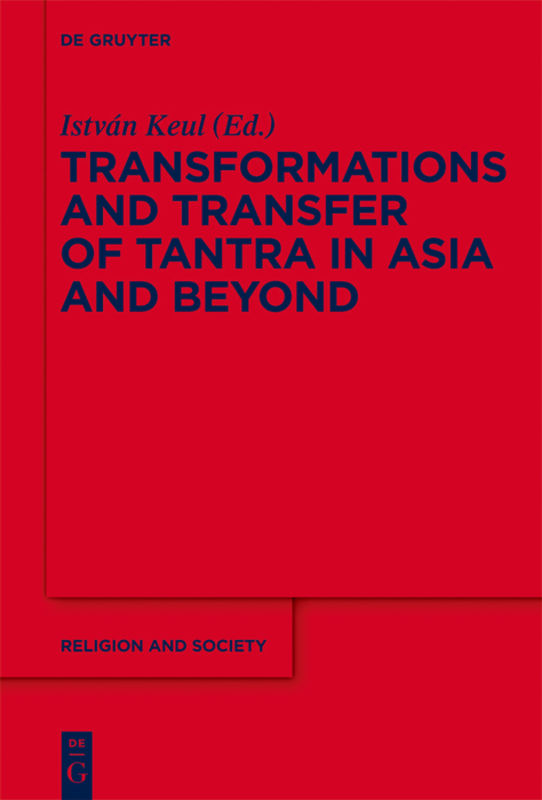
Transformations and Transfer of Tantra in Asia and Beyond
The essays in this volume, written by specialists working in the field of tantric studies, attempt to trace processes of transformation and transfer that occurred in the history of tantra from around the seventh century and up to the present. The volume gathers contributions on South Asia, Tibet, China, Mongolia, Japan, North America, and Western Europe by scholars from various academic disciplines, who present ongoing research and encourage discussion on significant themes in the growing field of tantric studies. In addition to the extensive geographical and temporal range, the chapters of the volume cover a wide thematic area, which includes modern Bengali tantric practitioners, tantric ritual in medieval China, the South Asian cults of the mother goddesses, the way of Buddhism into Mongolia, and countercultural echoes of contemporary tantric studies.
eBook

From Anekānta-vāda to Sarva-tantra-sva-tantra: Pluralism About Views and Philosophical Systems
This article discusses the unique practice of many philosophers in classical India to write on several philosophical and religious systems, each time adopting a sympathetic point of view for a different tradition. The article describes the development of this phenomenon in the context of interreligious debates between Buddhists, Jains, and Brahmins in the course of three distinct historical periods, transitioning from pluralism about views to pluralism about philosophical systems and culminating in the ideal of sarva-tantra-sva-tantra, a polyvocal philosopher and a polymath. Contrary to such approaches as nihilism, agnosticism, skepticism, and dogmatism, pluralism about views and systems was an attempt to justify the acceptance of several competing schools of thought. The article demonstrates that varieties of pluralism about views and systems played a role in forming and broadening philosophical alliances to defeat religious rivals, but also enhanced the scholarly reputation of erudite thinkers capable of “proving and refuting any system by will.”
Journal Article

Amṛtasiddhi A Posteriori: An Exploratory Study on the Possible Impact of the Amṛtasiddhi on the Subsequent Sanskritic Vajrayāna Tradition
Recent research into source materials for haṭhayoga (Birch, Mallinson, Szántó) has revealed that the physical techniques and esoteric anatomy traditionally associated with Śaiva practitioners likely found a genesis within Vajrayāna Buddhist communities. The physiology and practices for longevity described in the 11th-or-12th-century Amṛtasiddhi are easily traced in the development of subsequent physical yoga, but prior to the discovery of the text’s Buddhist origin, analogues to a haṭhayoga esoteric anatomy found in Vajrayāna sources have been regarded as coincidental. This paper considers both the possibility that the Amṛtasiddhi, or a tradition related to it, had a lasting impact on practices detailed in subsequent tantric Buddhist texts and that this haṭhayoga source text can aid in interpreting unclear passages in these texts.
Journal Article

MagicMantras: Bhaktamar Mantra Healing Between Jainism and the Spiritual Marketplace
This article addresses Bhaktamar Mantra Healing (BMH), a healing practice based on a popular Jain stotra. After a preliminary discussion of Tantra and Tantric elements in Jainism, BMH is introduced as the most recent layer in a complex tradition that grew around the Bhaktāmar Stotra and conceptualized as a “Tantric reconfiguration”: a relatively recent creative blending of Jain devotional and Tantric elements with some new influences resulting in a systematized, democratized, and (to an extent) commodified brand of spiritual healing available on the spiritual marketplace. It then proceeds to examine BMH’s significant digital media presence to demonstrate how information provided on the effectiveness and mechanics of mantra healing reveals a complex interplay of shifting religious, spiritual, and scientific narratives and how functional differences between different digital media forms impact upon the prevalence of these different narratives. Ultimately, the article argues that approaching BMH as a Tantric reconfiguration emerging from an encounter of a Jain practice with consumer culture is helpful to make sense of what sets BMH apart from other uses of Jain mantras and of the importance of the digital space BMH has made for itself.
Journal Article
We Don’t Need the Guru: Shambhala Facebook Group and (Re)Creating Vajrayāna Buddhism
The Shambhala Facebook group created a space for individuals to reimagine their religious teachings and practices without the Tibetan Tantric Buddhist student-teacher relationship, which received much criticism after Shambhala’s spiritual leader, Sakyong Mipham Rinpoche, had been accused of sexual abuse by some of his students. This article examines how digital space contributes to Shambhala members’ negotiations of religious authorities through their communications and membership on the Shambhala Facebook group, for example, by establishing meditation groups that incorporate Shambhala teachings but not the student-teacher relationship. The collection of posts and comments on the Shambhala Facebook group show how the communication processes utilized by this online social group are an example of relational authority, or what Heidi A. Campbell describes as “a negotiation of reciprocity and agency between different parties.”
Journal Article

Reclaiming Yoga as a Practice of Female Empowerment
Womb yoga is a women’s yoga practice developed in the UK from the observation that male bodies and experiences are privileged in mainstream yoga. Based on modern postural yoga, womb yoga integrates the philosophy and mythology of śakta tantra in reference to scholarly texts and reinterprets tantric traditions in line with Anglo-American Goddess spirituality. Through body practice, chanting, visualization, and ritual, female cyclic experiences and the different stages of women’s lives are approached as gateways to the divine and as opportunities for spiritual empowerment. In addition, by offering a seasonal understanding of the menstrual cycle and establishing energetic resonances between natural elements and the body, womb yoga fosters experiences of cosmic connection and communion. The study is based on ethnographic research, combining participant observation and in-depth interviews. It details the practice of womb yoga and the experiences it engenders among participants, and discusses its feminist potential.
Journal Article

Imaginative Realization in the Vijñānabhairava Tantra
Among the religious traditions that developed in ancient India, the Tantric tradition offers one of the most vigorous efforts at vindicating the powers of the imagination. A key term in this context is bhāvanā, literally the “act of bringing something into being”, used to indicate a disciplined cultivation of the mind’s natural capacity to form images. This brief article addresses the meaning of bhāvanā in the Vijñānabhairava Tantra (VBh), a short scripture written in the spirit of the Śaiva Tantric Trika tradition around the first half of the 9th century CE. In this text, as the article shows, bhāvanā is understood not only as a human faculty but now also as a divine power with important ontological and soteriological implications. In this way, the centrality of the imagination common to many Tantric texts reaches a remarkable zenith in the VBh, anticipating the view of later influential thinkers such as Abhinavagupta and Kṣemarāja (10th-11th centuries).
Entre las tradiciones religiosas que se desarrollaron en la antigua India, si hay una que vindicó la imaginación, ésa es la tradición tántrica. Al respecto, el término clave es bhāvanā, literalmente, el “acto de hacer que algo cobre existencia”, usado para indicar un cultivo disciplinado de la capacidad natural de la mente para formar imágenes. Este artículo analiza el significado de bhāvanā en el Vijñānabhairava Tantra (VBh), breve escritura redactada hacia el siglo IX en el seno de la tradición śaiva tántrica conocida como Trika. En este texto, bhāvanā es concebida no sólo como una facultad humana sino además como un poder divino con profundas implicaciones ontológicas y soteriológicas. De este modo, la centralidad que la imaginación tiene en muchos textos tántricos alcanza una cúspide en el VBh, anticipando la perspectiva de influyentes pensadores posteriores como Abhinavagupta y Kṣemarāja (siglos X-XI).
Journal Article
Advayavajra's Naiātmyāp rakāśa : A Critical Edition
This article presents a critical edition of and commentary on the
, a Buddhist tantric ritual manual (
) composed by the eleventh-century scholar and
Advayavajra/Maitrīpāda. The text teaches meditations on Nairātmyā, the central
of the Hevajra system, while also incorporating distinctive elements of Advayavajra's philosophy and system of tantric practice. An introduction to the edition examines the figure of Nairātmyā and her associated corpus of texts. It also situates the
within Advayavajra's broader oeuvre and identifies traces in this text of the author's intellectual and religious ecosystem, particularly in light of his textual borrowings from Ratnākaraśānti.
Journal Article
The God Who Is Visible to All: Healing and Sun Worship in Śrīvidyā Tantra
The aim of this paper is to discuss sun worship and healing practices in Samayācāra Śrīvidyā, a Hindu tantric tradition. Thus, I use anthropological and philological perspectives to show how the contemporary Samayācāra Śrīvidyā guru of Śrī Lalitāmbikā and his disciples redefine healing and use sun-related meditations to energize and rejuvenate the human body. This paper shows how contemporary Tantric religiosity is multidimensional in nature and promises protection from disease and an overall better quality of life. Conversely, I endeavor to show how the Śrī Lalitāmbikā temple combines solar healing with tantric practices that lead to a reconnection with the divine and offer the ultimate dimension of healing, i.e., spiritual immortality.
Journal Article