
Catalogue Search | MBRL


Are you sure you want to remove the book from the shelf?

{{itemTitle}}
8
result(s) for
"Tasso, Torquato, 1544-1595 -- Criticism and interpretation"
Sort by:

The Romance Epics of Boiardo, Ariosto, and Tasso
InThe Romance Epics of Boiardo, Ariosto, and Tasso, Jo Ann Cavallo attempts a new interpretation of the history of the renaissance romance epic in northern Italy, focusing on the period's three major chivalric poets. Cavallo challenges previous critical assumptions about the trajectory of the romance genre, especially regarding questions of creative imitation, allegory, ideology, and political engagement.
In tracing the development of the romance epic against the historical context of the Ferrarese court and the Italian peninsula, Cavallo moves from a politically engaged Boiardo, whose poem promotes the tenets of humanism, to an individualistic Tasso, who opposed the repressive aspects of the counter-reformation culture he is often thought to represent. Ariosto is read from the vantage of his predecessor Boiardo, and Cavallo describes his cynicism and later mellowing attitude toward the real-world relevance of his and Boiardo's fiction.The Romance Epics of Boiardo, Ariosto, and Tassois the first critical study to bring together the three poets in a coherent vision that maps changes while uncovering continuities.
eBook

The Quest for Epic
Translated here for the first time into English, Sergio Zatti'sThe Quest for Epicis a selection of studies on the two major poets of the Italian Renaissance, Ludovico Ariosto and Torquato Tasso, by one of the most important literary critics writing in Italy today. An original and challenging work,The Quest for Epicdocuments the development of Italian narrative from the chivalric romance at the end of the fifteenth century to the genre of epic in the sixteenth century.
Zatti focuses on Ariosto'sOrlando Furioso, written in the early 1500s, and progresses to Tasso'sJerusalem Delivered, written at the end of the century, but also touches briefly on Boiardo, Ariosto's great predecessor at the Estense court in Ferrara, as well as on Pulci, Trissino, and many other Italian writers of the period. Zatti highlights the critical debates over narrative form in the sixteenth century that become signposts on the way to literary modernity and the eventual rise of the modern novel. Albert Russell Ascoli's introduction provides context by mapping Zatti's criticism and situating it among Italian and Anglo-American literary critical studies, making a case for the contribution this book will have for English-language readers.
eBook
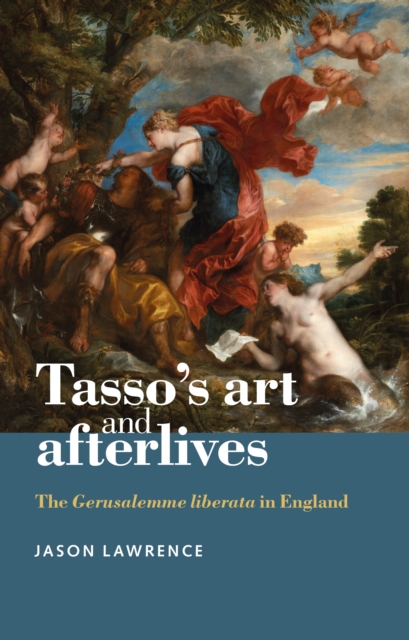
Tasso's art and afterlives
This interdisciplinary study examines the literary, artistic and
biographical afterlives in England of the great sixteenth-century
Italian poet Torquato Tasso, from before his death to the end of
the nineteenth century. Focusing on the lasting impact of his once
famous poem Gerusalemme liberata across a spectrum of
arts, it aims to stimulate a revival of interest in a neglected
poetic masterpiece and its author, some fifty years after the last
account of the poet in English. The influence of Tasso's poem is
traced and analysed in the literary works of Spenser, Milton,
Shakespeare and Daniel, and consideration is also given to its
impact on the visual and musical arts in England, in works by Van
Dyck, Poussin and Handel. A second strand focuses on English
responses to Tasso's troubled life in the eighteenth and nineteenth
centuries, exemplified in Byron's memorable impersonation of the
poet's voice in The Lament of Tasso .
eBook

The Ballata and the “Free” Madrigal in the Second Half of the Sixteenth Century
In a seminal article of some forty years ago, Don Harrán identified a style of free madrigal poetry that showed some elements of fourteenth-century forms. He called it the ballata-madrigal. In scholarship since that time, however, it has not been fully recognized that the ballata-madrigal by no means disappeared from the poetic repertoire in the second half of the century, as has commonly been believed. In fact, in the second half of the sixteenth century, the poetic and musical madrigal continued to be heavily influenced by elements of the poetic form of the fourteenth-century ballata.
This article looks first at the shape of poetic madrigals in numerous literary publications of the second half of the century, in order to assert that the ballata-madrigal was recognized by many of the most important poets of the time—including Giovanni Battista Pigna, Torquato Tasso, and Giovanni Battista Guarini—as a separate and important subgenre of themadrigale libero. It then looks at musical settings of ballata-madrigals across the last four decades of the century in order to assert that many of the most important composers of the time—Giaches de Wert, Marc'Antonio Ingegneri, Luzzasco Luzzaschi, Luca Marenzio, and Claudio Monteverdi—recognized and reacted to the distinctive formal aspects of this particular poetic genre. Various hypotheses for further testing of the importance and range of this poetic and musical genre are put forward at the close of the article.
Journal Article

Tasso's Enchantress, Tasso's Captive Woman
This essay offers two discoveries concerning Tasso's poetics. First, it identifies in the Discourses on the Heroic Poem a critique of allegory on both aesthetic and moral grounds, one that explains Jerusalem Delivered's abandonment of the \"temptress-turned-hag\" motif. Second, it demonstrates that Armida and Erminia are closely linked to the \"captive woman\" topos used by Jerome and Boccaccio to justify Christian adaptations of pagan literature and rhetoric. It is the hermeneutic dimension of this motif that allows Tasso plausibly to convert these beautiful pagan women (and the poetic pleasures they embody) to the exigencies of Christian epic.
Journal Article
Tasso's God: Divine Action in \Gerusalemme Liberata\
This essay examines a subject largely ignored in Tasso criticism: the role of supernatural powers in the epic action of the \"Liberata\". Tasso introduces divine characters, notably God and Satan, at several crucial moments. The presence in the epic plot of an intervening God who is at once partisan and omnipotent brings to the fore certain narrative and theological problems; these problems are not Tasso's alone, but inhere in the attempt to construct a Christian supernatural on the classical epic model. The divine action of the \"Liberata\" sheds light on the religious ideology of the poem, and on an issue of broader significance: the uneasy marriage of monotheism and epic narrative.
Journal Article

Gabriello Chiabrera, letterato barocco
Before the Romantic writers overturned the judgment, for two centuries Gabriello Chiabrera (1552-1638) had been regarded as the most prominent poet of his age, the only to have successfully avoided the excesses and the bad taste epitomized in the word \"baroque.\" Responsible for this canonization were the members of the Arcadia poetical movement at the end of the seventeenth century, but Chiabrera himself put the premises of it, especially with his autobiography, a carefully devised brief narration which promotes the novelty of his literary practice, stressing the revolutionary aspects of his return to the Greek poets (Pindar, Anacreon, Sappho) and hiding the conspicuous debt he had made with the modern poets through whom he had discovered the Greeks, namely, the French authors of the Pleiade. In the Dialogues on the poetic art, all but one unpublished during his lifetime, Chiabrera exposes the cornerstones of his poetics: the renovation of the traditional genres of the Italian poetry through the use of rare but traditional versus; the introduction of new types of stanzas modelled on the Greek and Latin poems yet armonized with the old Italian tradition; the use of rythmical devices which could ease the musical setting of the poems. Unlike the other great poet of the century, Giambattista Marino, Chiabrera wants to abandon the established path of Petrarchism; to do so, he pursues all the methods available, and the final result of these efforts, most notably appreciable in his Canzonette (a genre he completely reshaped), achieve a new kind of poetry freed from the subserviance to conceits and overloaded metaphors. A different approach to the genre of the madrigal highlights Chiabrera's sharpest differences with his contemporaries. The metrical and technical attitude toward poetry is equally noticeable in the epic poems. While the first one, La Gotiade, shows the young poet still divided between the fascination of the epic model and the lyrical representation of the characters, in the other two poems, La Firenze and L'Amedeide, each of them published in different versions, Chiabrera tries to surpass Tasso's Gerusalemme Liberata by a more strict adherence to the epic rule of the unicity of the action.
Dissertation
Women and the Politics of Play in Sixteenth-Century Italy: Torquato Tasso's Theory of Games
In the early 1580s, Torquato Tasso (1544–95), hospitalized (or imprisoned) in Ferrara's Sant'Anna, wrote two versions of a dialogue on the theory of games in which a female interlocutor complains that men commonly lose to women out of an artificial sense of courtesy. In the second and much longer version, the Gonzaga secondo overo del giuoco (1582), he shifts the direction of his response to this condescending mannerism, offering a vision of women with the determination and potential to be true players. This article examines how Tasso made this change and speculates as to why, tying his treatment to the larger discourse on gender and play in sixteenth-century Italy and proposing that his solution represents a timely intersection of the theory of games, the agency of women, and the plight of a captive poet in Renaissance Italy.
Book Review