
Catalogue Search | MBRL


Are you sure you want to remove the book from the shelf?

{{itemTitle}}
3,003
result(s) for
"Teaching England."
Sort by:


Learning English and Chinese as foreign languages : sociocultural and comparative perspectives
Learning English and Chinese is becoming increasingly important to the prospects of young people. This book compares English as a Foreign Language teaching in Taiwan with Chinese as a Foreign Language education in England in order to highlight how classroom activities are embedded within multiple settings, including ethnic or other social group cultures, family and community resources and school visions or goals. The book illustrates how in Taiwan different ethnic groups recognise, access and value English language learning to varying extents. Its findings illuminate why some ethnic groups are highly motivated to learn English and are able to gain privileged economic positions in the job market. In England, access to Chinese is marked by social class, and the book argues that this could augment an 'educational apartheid' that already exists in language teaching in secondary schools, thereby exacerbating existing inequality.
eBook

Citizenship, nation, empire : the politics of history teaching in England, 1870-1930
Citizenship, nation, empire investigates the extent to which popular imperialism influenced the teaching of history between 1870 and 1930. It is the first book-length study to trace the substantial impact of educational psychology on the teaching of history, probing its impact on textbooks, literacy primers and teacher-training manuals. Educationists identified 'enlightened patriotism' to be the core objective of historical education. This was neither tub-thumping jingoism, nor state-prescribed national-identity teaching, but rather a carefully crafted curriculum for all children which fused civic as well as imperial ambitions. The book details contemporary debates about the purpose of history teaching and the influence of late-Victorian and Edwardian educational culture, and goes on to examine how pedagogical developments shaped the content of early-years reading books and textbooks through analysis of key themes including race, seafaring, gender and national identity. Special attention is paid to the significance of mass schooling in the formation of turn-of-the-twentieth-century cultures of hero worship, and the legacy of such developments for the 1920s. This volume will be of interest to those studying or researching aspects of English domestic imperial culture, especially those concerned with questions of childhood and schooling, citizenship, educational publishing and Anglo-British relations. Given that vitriolic debates about the politics of history teaching have endured into the twenty-first century, Citizenship, nation, empire is a timely study of the formative influences that shaped the history curriculum in English schools. --Provided by publisher.
Book

The foundation of hope
The Foundation of Hope is both a celebration and an analysis of the creation of Liverpool Hope University College in 1996 and of some of its achievements to date, during an exciting period in British higher education. The central focus is the student experience at Hope University College. Contributors also examine the way that teaching and research in theology have developed over the years and the important community regeneration work Hope University College carries out in various areas of Liverpool.
eBook

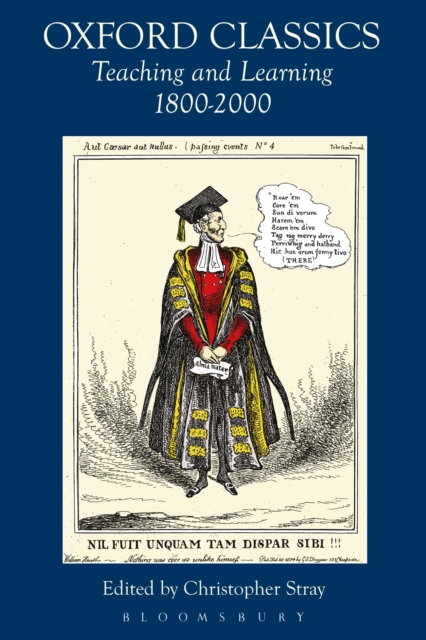
Oxford classics : teaching and learning, 1800-2000
Oxford, the home of lost causes, the epitome of the world of medieval and renaissance learning in Britain, has always fascinated at a variety of levels: social, institutional, cultural.Its rival, Cambridge, was long dominated by mathematics, while Oxford's leading study was Classics.
eBook

Learning languages in early modern England
In 1578, the Anglo-Italian author, translator, and teacher John Florio wrote that English was 'a language that wyl do you good in England, but passe Dover, it is woorth nothing'. This is a study of how English-speakers learnt a variety of continental vernacular languages in the period between 1480 and 1720. English was practically unknown outside of England, which meant that the English who wanted to travel and trade with the wider world in this period had to become language-learners.
Book
How Science Works
How Science Works provides student and practising teachers with a comprehensive introduction to one of the most dramatic changes to the secondary science curriculum. Underpinned by the latest research in the field, it explores the emergence and meaning of How Science Works and reviews major developments in pedagogy and practice.
With chapters structured around three key themes -why How Science Works, what it is and how to teach it - expert contributors explore issues including the need for curriculum change, arguments for scientific literacy for all, school students' views about science, what we understand about scientific methods, types of scientific enquiry, and, importantly, effective pedagogies and their implications for practice. Aiming to promote discussion and reflection on the ways forward for this new and emerging area of the school science curriculum, it considers:
teaching controversial issues in science
argumentation and questioning for effective teaching
enhancing investigative science and developing reasoned scientific judgments
the role of ICT in exploring How Science Works
teaching science outside the classroom.
How Science Works is a source of guidance for all student, new and experienced teachers of secondary science, interested in investigating how the curriculum can provide creativity and engagement for all school students.
eBook

The paradox of skills : widening participation, academic literacy & students' skills centres
The objectives underpinning the policies to expand and widen participation have impacted on university provision to help students improve their general literacy and academic writing skills. This book examines how and why Students' Skills Centres, (SSCs), gained such a hold in the sector, despite the contentious nature of the research evidence that challenges the notion of the applicability of generic writing skills.
Book
Constructing history 11-19
‘Constructing History 11-19 provides a diverse yet remarkably coherent array of case studies of constructivist history teaching. Its contributors—researchers, teachers, department heads—have a shared understanding of recent theory and research, and provide extended, close-to-the-ground narratives of active learning, supplemented by the voices of both students who participated and academic historians who observed. It is a welcome addition to a vibrant field’ — Professor Peter Seixas, Centre for the Study of Historical Consciousness, University of British Columbia. ‘This book is full of hidden treasures. It is written by a community of practitioners who are all experts in creating history teaching that stretches and engages students. The book is designed to inspire action. It does this as ideas flow through the pages generating in the history teacher thoughts of how to apply and adapt. This book creates ‘spin off’: actual process that hits our classrooms’ — Katy Allen, Head of History, Lancaster Girls' Grammar School. This book describes and exemplifies strategies for teaching history across the 11-19 age range in rigorous and enjoyable ways. It illustrates active learning approaches embedded in pupil-led enquiries, through detailed case studies which involve students in planning and carrying out historical enquiries, creating accounts and presenting them to audiences, in ways that develop increasingly sophisticated historical thinking. The case studies took place in a number of different localities and show how practising teachers worked with pupils during each year from Y6/7 to Y 13 to initiate, plan and implement enquiries and to present their findings in a variety of ways. Each case study is a practical example which teachers can use as a model and modify for their own contexts, showing how independent learning linked to group collaboration and peer assessment can enhance learning. Social constructivist theories of learning applied to historical thinking underpin the book, with particular emphasis on links between personalised and collaborative learning and e-learning.
eBook