
Catalogue Search | MBRL


Are you sure you want to remove the book from the shelf?

{{itemTitle}}
72,883
result(s) for
"Teaching Evaluation."
Sort by:


A Data-Based Assessment of Research-Doctorate Programs in the United States
Doctoral education, a key component of higher education in the United States, is performing well. It educates future professors, researchers, innovators, and entrepreneurs. It attracts students and scholars from all over the world and is being emulated globally. This success, however, should not engender complacency.
A Data-Based Assessment of Research-Doctorate Programs in the United States provides an unparalleled dataset that can be used to assess the quality and effectiveness of doctoral programs based on measures important to faculty, students, administrators, funders, and other stakeholders. This report features analysis of selected findings across six broad fields: agricultural sciences, biological and health sciences, engineering, physical and mathematical sciences, social and behavioral sciences, and humanities, as well as a discussion of trends in doctoral education since the last assessment in 1995, and suggested uses of the data. It also includes a detailed explanation of the methodology used to collect data and calculate ranges of illustrative rankings.
eBook


Reaching Students
The undergraduate years are a turning point in producing scientifically literate citizens and future scientists and engineers. Evidence from research about how students learn science and engineering shows that teaching strategies that motivate and engage students will improve their learning. So how do students best learn science and engineering? Are there ways of thinking that hinder or help their learning process? Which teaching strategies are most effective in developing their knowledge and skills? And how can practitioners apply these strategies to their own courses or suggest new approaches within their departments or institutions? Reaching Students strives to answer these questions.
Reaching Students presents the best thinking to date on teaching and learning undergraduate science and engineering. Focusing on the disciplines of astronomy, biology, chemistry, engineering, geosciences, and physics, this book is an introduction to strategies to try in your classroom or institution. Concrete examples and case studies illustrate how experienced instructors and leaders have applied evidence-based approaches to address student needs, encouraged the use of effective techniques within a department or an institution, and addressed the challenges that arose along the way.
The research-based strategies in Reaching Students can be adopted or adapted by instructors and leaders in all types of public or private higher education institutions. They are designed to work in introductory and upper-level courses, small and large classes, lectures and labs, and courses for majors and non-majors. And these approaches are feasible for practitioners of all experience levels who are open to incorporating ideas from research and reflecting on their teaching practices. This book is an essential resource for enriching instruction and better educating students.
eBook

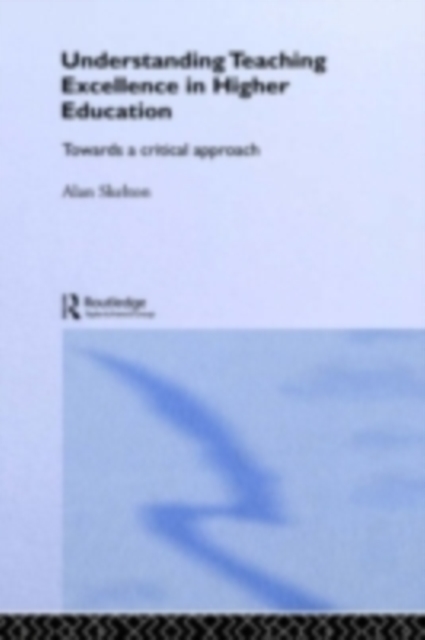
Understanding Teaching Excellence in Higher Education
What makes a university teacher 'excellent'? As debates rage about whether this is down to subject knowledge, communication skills, taking a research-led approach or being a technological whiz, this book provides the first in-depth examination of teaching excellence in higher education. Identifying and examining interpretations of teaching excellence, it considers what ‘excellent’ means and implies for practice.
Part 1: Beginnings 1. Introduction 2. A Critical Framework Part 2: Familiar Faces 3. Awards for Teachers 4. Institutions and Teaching Excellence 5. The Contribution of Subject Disciplines Part 3: Alternative Explorations 6. Local Knowledge: 'Ordinary' Teacher and Student Perceptions 7. Internationalisation and Inter-Cultural Learning 8. Seduced by Glitz and Glamour: Press Reporting of Teaching 9. Excellence 10. Professional Development and Teaching Excellence Part 4: Future Horizons 11. Lost in the Translation? 12. Research into Teaching Excellence in Higher Education
'Skelton writes with an engaging critical zeal, and his book will certainly help many talented, competent, and hardworking teachers in higher education in UK to understand why, and how, a few members of their profession become mysteriously singled out for recognition and reward as “excellent”, whilst they themselves do not.'
'Here we have a bold and original book that cruelly exposes some of the myth-making mechanisms that politicians and their handservants have clumsily sought to impose upon contemporary HE. Extremely well written and a model of clear organisation.'
- British Journal of Educational Technology Vol 38 No 1 2007
eBook


Student evaluations of teaching are an inadequate assessment tool for evaluating faculty performance
Literature is examined to support the contention that student evaluations of teaching (SET) should not be used for summative evaluation of university faculty. Recommendations for alternatives to SET are provided.
Journal Article


Systems for state science assessment
In response to the No Child Left Behind Act of 2001 (NCLB), Systems for State Science Assessment explores the ideas and tools that are needed to assess science learning at the state level. This book provides a detailed examination of K-12 science assessment: looking specifically at what should be measured and how to measure it.
Along with reading and mathematics, the testing of science is a key component of NCLB-it is part of the national effort to establish challenging academic content standards and develop the tools to measure student progress toward higher achievement. The book will be a critical resource for states that are designing and implementing science assessments to meet the 2007-2008 requirements of NCLB.
In addition to offering important information for states, Systems for State Science Assessment provides policy makers, local schools, teachers, scientists, and parents with a broad view of the role of testing and assessment in science education.
eBook