
Catalogue Search | MBRL


Are you sure you want to remove the book from the shelf?

{{itemTitle}}
98
result(s) for
"Technological innovations United States History 20th century."
Sort by:

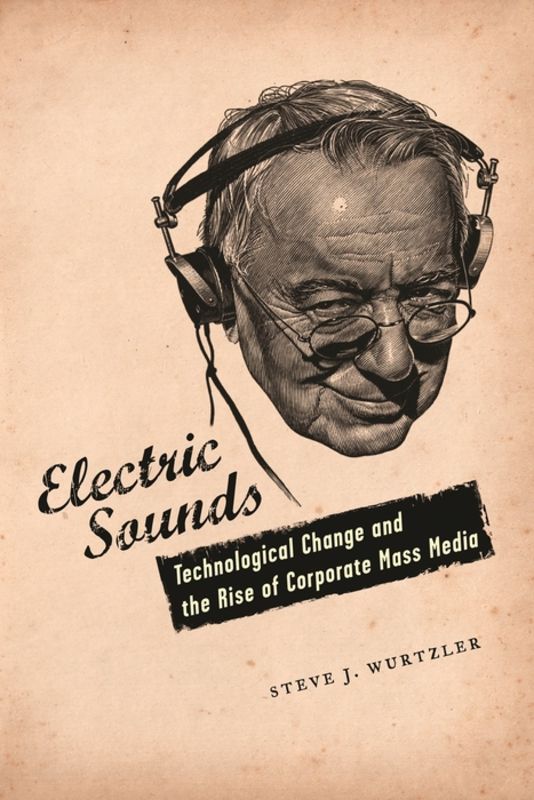
Electric Sounds
Electric Sounds brings to vivid life an era when innovations in the production, recording, and transmission of sound revolutionized a number of different media, especially the radio, the phonograph, and the cinema. The 1920s and 1930s marked some of the most important developments in the history of the American mass media: the film industry's conversion to synchronous sound, the rise of radio networks and advertising-supported broadcasting, the establishment of a federal regulatory framework on which U.S. communications policy continues to be based, the development of several powerful media conglomerates, and the birth of a new acoustic commodity in which a single story, song, or other product was made available to consumers in multiple media forms and formats. But what role would this new media play in society? Celebrants saw an opportunity for educational and cultural uplift; critics feared the degradation of the standards of public taste. Some believed acoustic media would fulfill the promise of participatory democracy by better informing the public, while others saw an opportunity for manipulation. The innovations of this period prompted not only a restructuring and consolidation of corporate mass media interests and a shift in the conventions and patterns of media consumption but also a renegotiation of the social functions assigned to mass media forms. Steve J. Wurtzler's impeccably researched history adds a new dimension to the study of sound media, proving that the ultimate form technology takes is never predetermined. Rather, it is shaped by conflicting visions of technological possibility in economic, cultural, and political realms. Electric Sounds also illustrates the process through which technologies become media and the ways in which media are integrated into American life.
eBook


Tungsten in Peace and War, 1918–1946
Tungsten is a rare ferrous metal whose ability to form molecular compounds with other elements has made it one of the essential elements in steelmaking, electronics, and various military technologies. This is the first comprehensive study of the use of tungsten and its role in modern technology, politics, and international trade. The book combines a detailed general overview of tungsten's uses in science and technology with a history of tungsten mining in the U.S. and elsewhere; international competition for tungsten supplies, especially between the two world wars of the twentieth century; and the complex national and international politics involved in supporting and protecting the U.S. tungsten supply and tungsten-mining industry. Tungsten in Peace and War, 1918–1946 is a significant addition to the history of technology and a revelation of the complex role that tungsten and other critical metals play in national and international politics and in the world economy.
eBook


Impossible Heights
The advent of the airplane and skyscraper in 1920s and '30s America offered the population an entirely new way to look at the world: from above. The captivating image of an airplane flying over the rising metropolis led many Americans to believe a new civilization had dawned. InImpossible Heights, Adnan Morshed examines the aesthetics that emerged from this valorization of heights and their impact on the built environment.
The lofty vantage point from the sky ushered in a modernist impulse to cleanse crowded twentieth-century cities in anticipation of an ideal world of tomorrow. Inspired by great new heights, American architects became central to this endeavor and were regarded as heroic aviators. Combining close readings of a broad range of archival sources, Morshed offers new interpretations of works such as Hugh Ferriss's Metropolis drawings, Buckminster Fuller's Dymaxion houses, and Norman Bel Geddes's Futurama exhibit at the 1939 New York World's Fair. Transformed by the populist imagination into \"master builders,\" these designers helped produce a new form of visuality: the aesthetics of ascension.
By demonstrating how aerial movement and height intersect with popular \"superman\" discourses of the time, Morshed reveals the relationship between architecture, art, science, and interwar pop culture. Featuring a marvelous array of never before published illustrations, this richly textured study of utopian imaginings illustrates America's propulsion into a new cultural consciousness.
eBook


Flying Down to Rio
In this book, author Rosalie Schwartz uses the 1933 RKORadio Pictures production Flying Down to Rio to examine the interplay of technology and popular culture that shaped a distinctive twentiethcentury sensibility. The musical comedy connected airplanes, movies, and tourism, ending spectacularly with chorus girls dancing on the wings of airplanes high above Rio de Janeiro, Brazil.
The Hollywood fantasy capped three decades during which airplanes and movies engendered new expectations and redefined peoples sense of wellbeing, their personal satisfactions, and their interpersonal relations. Wilbur and Orville Wright flew their airplane in 1903, at the same time that filmmakers began to project edited, filmed stories onto large screens. Spectators found entertainment value in both airplane competitions and motion pictures, and movie producers brought the thrill of aviators antics to a rapidly expanding audience. Meanwhile, air shows and competitions attracted large crowds of tourists. Mass tourism grew as a leisuretime activity, stimulated in part by travelogues and feature films. By 1930, the businessmen who envisioned transporting tourists to their destinations by airplane struggled to overcome the movieexaggerated association of flight with danger.
Schwartz weaves these threads into a story of human daring and persistence, political intrigue, and international competition. From Wilbur and Orville to Fred and Ginger, Schwartzs narrative follows the fortunes of aviation and movie pioneers and the foundations and growth of Pan American Airways and RKORadio Pictures, the two companies that came together in Flying Down to Rio.
By the end of the twentieth century, aviation, movies, and mass tourism had become powerful global industries, contributing to an internationally connected, entertainmentoriented culture. What was once unthinkable had now become expected.
eBook


From Torpedoes to Aviation
The central figure in the modernization of the U.S. Navy. The career of Washington Irving Chambers spans a formative period in the development of the United States Navy: He entered the Naval Academy in the doldrum years of obsolete, often rotting ships, and left after he had helped like-minded officers convince Congress and the public of the need to adopt a new naval strategy built around a fleet of technologically advanced battleships. He also laid the groundwork for naval aviation and the important role it would play in the modern navy. This work covers Chambers’s early naval career, his work at the new Office of Naval Intelligence, his participation in the Greeley Relief Expedition, and a survey for the projected isthmian canal through Nicaragua, before becoming the key advocate for naval modernization. As such, Chambers worked as a pioneering torpedo designer, supervised construction of the Maine, modernized the New York Navy Yard, and became a member of the first permanent faculty at the Naval War College. During his long career, Chambers not only designed torpedoes, but also several warships, including a prototype Dreadnought-style battleship and a host of small devices that ranged from torpedo guidance systems to the first catapult for launching airplanes from ships. At the close of his career, Chambers purchased the navy’s first aircraft and founded its air arm. Working with Glenn Curtiss, Chambers guided a coalition of aviation enthusiasts and pioneers who popularized naval aviation and demonstrated its capabilities. Chambers arranged the first take-off and landing of an airplane from a ship and other demonstrations of naval aviation. Combined with his tireless advocacy for modernization, these contributions secured a place in naval and aviation history for the innovator.
eBook