
Catalogue Search | MBRL


Are you sure you want to remove the book from the shelf?

{{itemTitle}}
223,544
result(s) for
"Technology China"
Sort by:


Unruly speech : displacement and the politics of transgression
Unruly Speech explores how Uyghurs in China and in the diaspora transgress sociopolitical limits with \"unruly\" communication practices in a quest for change. Drawing on research in China, the United States, and Germany, Saskia Witteborn situates her study against the backdrop of displacement and shows how naming practices and witness accounts become potent ways of resistance in everyday interactions and in global activism. Featuring the voices of Uyghurs from three continents, Unruly Speech analyzes the discursive and material force of place names, social media, surveillance, and the link between witnessing and the discourse on human rights. The book provides a granular view of disruptive communication: its global political moorings and socio-technical control. The rich ethnographic study will appeal to audiences interested in migration and displacement, language and social interaction, advocacy, digital surveillance, and a transnational China.
eBook
Innovate to Dominate
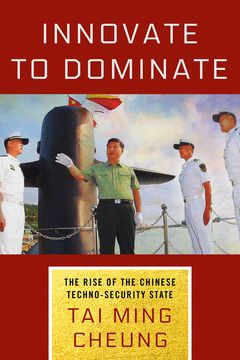
In Innovate to
Dominate , Tai Ming Cheung offers insight
into why, how, and whether China will overtake the United States to
become the world's preeminent technological and security
power . This examination of the means and ends of China's
quest for techno-security supremacy is required reading for anyone
looking for clues as to the long-term direction of the global
order. The techno-security domain, Cheung argues, is where national
security, innovation, and economic development converge, and it has
become the center of power and prosperity in the twenty-first
century. China's paramount leader Xi Jinping recognizes that
effectively harnessing the complex interactions among security,
innovation, and development is essential in enabling China to
compete for global dominance. Cheung offers a richly detailed
account of how China is building a potent techno-security state. In
Innovate to Dominate he takes readers from the strategic
vision guiding this transformation to the nuts-and-bolts of policy
implementation. The state-led top-down mobilizational model that
China is pursuing has been a winning formula so far, but the
sternest test is ahead as China begins to compete head-to-head with
the United States and aims to surpass its archrival by mid-century
if not sooner. Innovate to Dominate is a timely and
analytically rigorous examination of the key strategies guiding
China's transformation of its capabilities in the national,
technological, military, and security spheres and how this is
taking place. Cheung authoritatively addresses the burning
questions being asked in capitals around the world: Can China
become the dominant global techno-security power? And if so,
when?
eBook

Ancient Chinese inventions
China has given birth to numerous scientific and technological inventions, and for many centuries led the world in such innovations. Indeed, some of the most important inventions in the history of human civilization originated in China, not least the compass, gunpowder, paper and printing. This book provides an illustrated introduction to the many inventions to which China can lay claim.
Book

Chinese Industrial Espionage
This new book is the first full account, inside or outside government, of China's efforts to acquire foreign technology.
Based on primary sources and meticulously researched, the book lays bare China's efforts to prosper technologically through others' achievements. For decades, China has operated an elaborate system to spot foreign technologies, acquire them by all conceivable means, and convert them into weapons and competitive goods-without compensating the owners. The director of the US National Security Agency recently called it \"the greatest transfer of wealth in history.\"
Written by two of America's leading government analysts and an expert on Chinese cyber networks, this book describes these transfer processes comprehensively and in detail, providing the breadth and depth missing in other works. Drawing upon previously unexploited Chinese language sources, the authors begin by placing the new research within historical context, before examining the People's Republic of China's policy support for economic espionage, clandestine technology transfers, theft through cyberspace and its impact on the future of the US.
This book will be of much interest to students of Chinese politics, Asian security studies, US defence, US foreign policy and IR in general.
eBook


Historical dictionary of science and technology in modern China (Historical dictionaries of Asia, Oceania, and the Middle East)
The Historical Dictionary of Science and Technology in Modern China provides the most up-to-date information on science and technology in China from the late nineteenth century to the present. Special attention is given to the historical factors, scientists, and historical figures behind each scientific development. In particular, this book pays attention to the scientists who were persecuted to death or tortured during the Cultural Revolution (1966-1976), and whose scientific research was therefore tragically cut short. The historical dictionary provides information on science and technology in China from the late nineteenth century to the present including: a chronology;introduction; extensive bibliography;over 700 cross-referenced dictionary entries on major scientific and technological fields and sub-fields; entries on western scholars and educators who also impacted scientific achievements in China. This book is an excellent access point for students, researchers, and anyone wanting to know more about the science and technology in China.
eBook


Technology, Gender and History in Imperial China
What can the history of technology contribute to our understanding of late imperial China? Most stories about technology in pre-modern China follow a well-worn plot: in about 1400 after an early ferment of creativity that made it the most technologically sophisticated civilisation in the world, China entered an era of technical lethargy and decline. But how are we to reconcile this tale, which portrays China in the Ming and Qing dynasties as a dying giant that had outgrown its own strength, with the wealth of counterevidence affirming that the country remained rich, vigorous and powerful at least until the end of the eighteenth century? Does this seeming contradiction mean that the stagnation story is simply wrong, or perhaps that technology was irrelevant to how imperial society worked? Or does it imply that historians of technology should ask better questions about what technology was, what it did and what it meant in pre-modern societies like late imperial China?
In this book, Francesca Bray explores subjects such as technology and ethics, technology and gendered subjectivities (both female and male), and technology and statecraft to illuminate how material settings and practices shaped topographies of everyday experience and ideologies of government, techniques of the self and technologies of the subject. Examining technologies ranging from ploughing and weaving to drawing pictures, building a house, prescribing medicine or composing a text, this book offers a rich insight into the interplay between the micro- and macro-politics of everyday life and the workings of governmentality in late imperial China, showing that gender principles were woven into the very fabric of empire, from cosmology and ideologies of rule to the material foundations of the state and the everyday practices of the domestic sphere.
This authoritative text will be welcomed by students and scholars of Chinese history, as well as those working on global history and
eBook