
Catalogue Search | MBRL


Are you sure you want to remove the book from the shelf?

{{itemTitle}}
503
result(s) for
"Technology China History 20th century."
Sort by:


Science and Technology in Modern China, 1880s-1940s
Science and Technology in Modern China, 1880s-1940s looks at the transnational routes for the development of science and technology in the first pivotal decades of modern China.
eBook

Death in Beijing : murder and forensic science in Republican China
\"In this innovative and engaging history of homicide investigation in Republican Beijing, Daniel Asen explores the transformation of ideas about death in China in the first half of the twentieth century. In this period, those who died violently or under suspicious circumstances constituted a particularly important population of the dead, subject to new claims by police, legal and medical professionals, and a newspaper industry intent on covering urban fatality in sensational detail. Asen examines the process through which imperial China's old tradition of forensic science came to serve the needs of a changing state and society under these dramatically new circumstances. This is a story of the unexpected outcomes and contingencies of modernity, presenting new perspectives on China's transition from empire to modern nation state, competing visions of science and expertise, and the ways in which the meanings of death and dead bodies changed amid China's modern transformation\"-- Provided by publisher.
Book

Global Health for All
Global Health for All trains a critical lens on global health to share the stories that global health’s practices and logics tell about 20th and 21st century configurations of science and power. An ethnography on multiple scales, the book focuses on global health’s key epistemic and therapeutic practices like localization, measurement, triage, markets, technology, care, and regulation. Its roving approach traverses policy centers, sites of intervention, and innumerable spaces in between to consider what happens when globalized logics, circulations, and actors work to imagine, modify, and manage health. By resting in these in-between places, Global Health for All simultaneously examines global health as a coherent system and as a dynamic, unpredictable collection of modular parts.
eBook

Youth culture in China : from Red Guards to netizens
\"The lives and aspirations of young Chinese (those between 14 and 26 years old) have been transformed in the past five decades. By examining youth cultures around three historical points - 1968, 1988 and 2008 - this book argues that present-day youth culture in China has both international and local roots. Paul Clark describes how the Red Guards and the sent-down youth of the Cultural Revolution era carved out a space for themselves, asserting their distinctive identities, despite tight political controls. By the late 1980s, Chinese-style rock music, sports and other recreations began to influence the identities of Chinese youth, and in the twenty-first century, the Internet offers a new, broader space for expressing youthful fandom and frustrations. From the 1960s to the present, this book shows how youth culture has been reworked to serve the needs of the young Chinese\"-- Provided by publisher.
Book


Extensive Global Wetland Loss Over the Past Three Centuries
Wetlands have long been drained for human use, thereby strongly affecting greenhouse gas fluxes, flood control, nutrient cycling and biodiversity. Nevertheless, the global extent of natural wetland loss remains remarkably uncertain. Here, we reconstruct the spatial distribution and timing of wetland loss through conversion to seven human land uses between 1700 and 2020, by combining national and subnational records of drainage and conversion with land-use maps and simulated wetland extents. We estimate that 3.4 million km2 (confidence interval 2.9–3.8) of inland wetlands have been lost since 1700, primarily for conversion to croplands. This net loss of 21% (confidence interval 16–23%) of global wetland area is lower than that suggested previously by extrapolations of data disproportionately from high-loss regions. Wetland loss has been concentrated in Europe, the United States and China, and rapidly expanded during the mid-twentieth century. Our reconstruction elucidates the timing and land-use drivers of global wetland losses, providing an improved historical baseline to guide assessment of wetland loss impact on Earth system processes, conservation planning to protect remaining wetlands and prioritization of sites for wetland restoration.
Journal Article
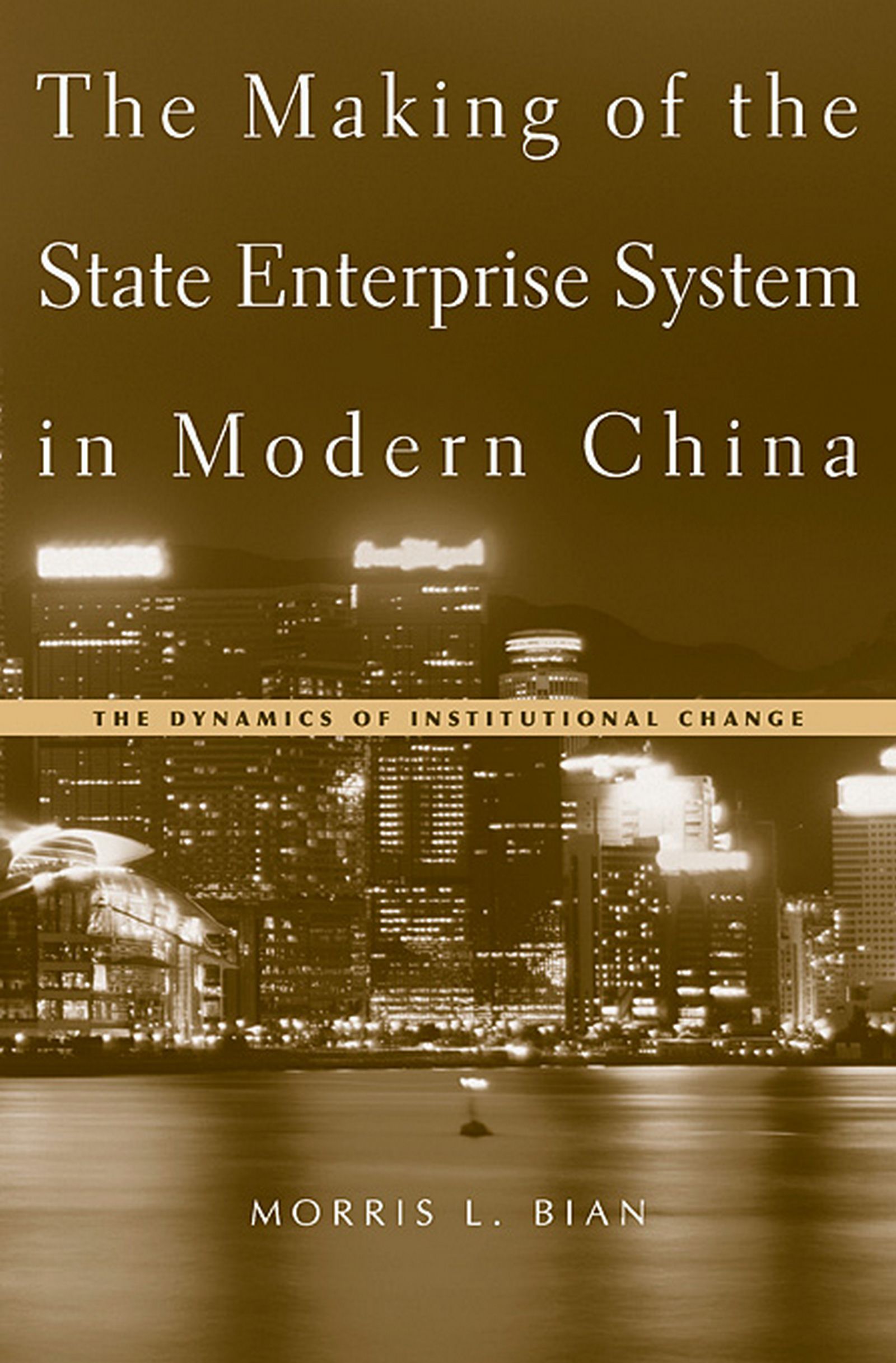
The making of the state enterprise system in modern China : the dynamics of institutional change
When, how, and why did the state enterprise system of modern China take shape? The conventional argument is that China borrowed its economic system and development strategy wholesale from the Soviet Union in the 1950s. In an important new interpretation, Morris Bian shows instead that the basic institutional arrangement of state-owned enterprise—bureaucratic governance, management and incentive mechanisms, and the provision of social services and welfare—developed in China during the war years 1937–1945.
Bian offers a new theory of institutional change that explains the formation of China's state enterprise system as the outcome of the sustained systemic crisis triggered by the Sino–Japanese war. This groundbreaking work combines critical analysis of government policies with case studies of little-studied enterprises in heavy industries and the ordnance industry. Drawing on extensive research in previously unavailable archives, Bian adds a valuable historical perspective to the current debate on how to reform China's sluggish and unprofitable state-owned firms.
eBook
Saving the nation
Economic modernity is so closely associated with nationhood that it is impossible to imagine a modern state without an equally modern economy. Even so, most people would have difficulty defining a modern economy and its connection to nationhood. In Saving the Nation, Margherita Zanasi explores this connection by examining the first nation-building attempt in China after the fall of the empire in 1911. Challenging the assumption that nations are products of technological and socioeconomic forces, Zanasi argues that it was notions of what constituted a modern nation that led the Nationalist nation-builders to shape China’s institutions and economy. In their reform effort, they confronted several questions: What characterized a modern economy? What role would a modern economy play in the overall nation-building effort? And how could China pursue economic modernization while maintaining its distinctive identity? Zanasi expertly shows how these questions were negotiated and contested within the Nationalist Party. Silenced in the Mao years, these dilemmas are reemerging today as a new leadership once again redefines the economic foundation of the nation.
eBook
Northern Hemisphere hydroclimate variability over the past twelve centuries
A very large set of proxy data is used to reconstruct Northern Hemisphere hydroclimate variability over the past twelve centuries, to benchmark climate model simulations of hydroclimate; the twentieth-century intensification of hydroclimate extremes seen in the model simulations is not supported by the proxy reconstruction.
Twelve centuries of hydroclimate variation
Future change in hydroclimate could be one of the more societally disruptive forms of climate change, but hemispheric variations in past hydroclimate are largely unknown, especially outside of tree-ring-based reconstructions. Fredrik Charpentier Ljungqvist and colleagues now assemble a suite of records — including tree rings, ice cores, peat, speleothems, lake and marine sediments, and documentary evidence — to reconstruct Northern Hemisphere hydroclimate variability during the past twelve centuries. The ninth, tenth, eleventh and twentieth centuries were comparatively wet, while conditions were drier from the twelfth to the nineteenth centuries. The reconstruction generally agrees with model simulations, until the twentieth century, when models simulate a much higher frequency of both dry and wet extremes than is seen in the data. The comparison suggests that models may be missing important processes, and that projections of changes in hydroclimatic conditions remain uncertain.
Accurate modelling and prediction of the local to continental-scale hydroclimate response to global warming is essential given the strong impact of hydroclimate on ecosystem functioning, crop yields, water resources, and economic security
1
,
2
,
3
,
4
. However, uncertainty in hydroclimate projections remains large
5
,
6
,
7
, in part due to the short length of instrumental measurements available with which to assess climate models. Here we present a spatial reconstruction of hydroclimate variability over the past twelve centuries across the Northern Hemisphere derived from a network of 196 at least millennium-long proxy records. We use this reconstruction to place recent hydrological changes
8
,
9
and future precipitation scenarios
7
,
10
,
11
in a long-term context of spatially resolved and temporally persistent hydroclimate patterns. We find a larger percentage of land area with relatively wetter conditions in the ninth to eleventh and the twentieth centuries, whereas drier conditions are more widespread between the twelfth and nineteenth centuries. Our reconstruction reveals that prominent seesaw patterns of alternating moisture regimes observed in instrumental data
12
,
13
,
14
across the Mediterranean, western USA, and China have operated consistently over the past twelve centuries. Using an updated compilation of 128 temperature proxy records
15
, we assess the relationship between the reconstructed centennial-scale Northern Hemisphere hydroclimate and temperature variability. Even though dry and wet conditions occurred over extensive areas under both warm and cold climate regimes, a statistically significant co-variability of hydroclimate and temperature is evident for particular regions. We compare the reconstructed hydroclimate anomalies with coupled atmosphere–ocean general circulation model simulations and find reasonable agreement during pre-industrial times. However, the intensification of the twentieth-century-mean hydroclimate anomalies in the simulations, as compared to previous centuries, is not supported by our new multi-proxy reconstruction. This finding suggests that much work remains before we can model hydroclimate variability accurately, and highlights the importance of using palaeoclimate data to place recent and predicted hydroclimate changes in a millennium-long context
16
,
17
.
Journal Article