
Catalogue Search | MBRL


Are you sure you want to remove the book from the shelf?

{{itemTitle}}
5,521
result(s) for
"Technology Study and teaching (Elementary)"
Sort by:


Integrating STEM teaching and learning into the K-2 classroom
Here's proof that STEM (science, technology, engineering, and mathematics) isn't just for the big kids! This book's 10 chapters are a mini-course on blending authentic, phenomena-driven, integrated STEM teaching and learning into busy K-2 classrooms. Based in both research and real-world experience, \"Integrating STEM Teaching and Learning Into the K-2 Classroom\" provides professional learning experiences that help you make connections between STEM topics and the everyday activities you're already doing with your students. The book answers the following questions: (1) How is K-2 STEM education different from what you're already doing, and how can you do it without squeezing more into your already-full schedule?; (2) What are the key elements in an integrated STEM classroom, and how do they work together?; and (3) How do you use STEM in concert with your core reading block? To show you how it all works in real life, the book provides descriptions of four completed projects from actual classrooms--projects with names like \"Baby Bear's Chair\" and \"A Pond Habitat.\" An easy-to-follow template shows you the process for developing your own STEM experiences. The final chapter describes how one district created a culture of STEM teaching and learning when education partners committed to working together toward a common goal. Researchers agree that STEM education is important in early childhood. \"Integrating STEM Teaching and Learning\" gives you the background and strategies to engage your young students in STEM without overloading your day--or overwhelming yourself.
eBook

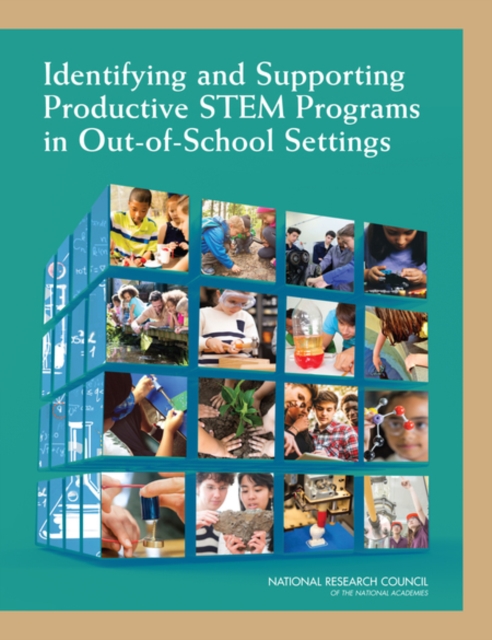
Identifying and Supporting Productive STEM Programs in Out-of-School Settings
More and more young people are learning about science, technology, engineering, and mathematics (STEM) in a wide variety of afterschool, summer, and informal programs. At the same time, there has been increasing awareness of the value of such programs in sparking, sustaining, and extending interest in and understanding of STEM. To help policy makers, funders and education leaders in both school and out-of-school settings make informed decisions about how to best leverage the educational and learning resources in their community, this report identifies features of productive STEM programs in out-of-school settings. Identifying and Supporting Productive STEM Programs in Out-of-School Settings draws from a wide range of research traditions to illustrate that interest in STEM and deep STEM learning develop across time and settings. The report provides guidance on how to evaluate and sustain programs. This report is a resource for local, state, and federal policy makers seeking to broaden access to multiple, high-quality STEM learning opportunities in their community.
eBook

Mastering primary design and technology
'Mastering Primary Design and Technology' introduces the primary design and technology curriculum and helps trainees and teachers learn how to plan and teach inspiring lessons that make design and technology learning irresistible.
Book

The Primary Science and Technology Encyclopedia
Unique in its field, The Primary Science Encyclopedia brings together in one indispensable reference volume over 250 entries covering a wide range of topics and ideas. The book provides clear descriptions, definitions and explanations of difficult scientific concepts, carefully chosen to reflect the needs of those involved in primary science education. In addition, this encyclopedia explains clearly how to teach scientific and technological ideas in a relevant and appropriate way. Extended entries are included on topics such as creativity, thinking skills and theories of learning and the book also provides insight into cross-curricular work, assessment and classroom organisation in the primary science classroom.
Compiled by authors with a wealth of experience in primary science and technology teaching, this book contains:
Over 250 entries;
Scientific definitions and pedagogical explanations;
Extensive commentaries of current issues in primary science;
A who's who of current and historical figures in the field of science and science education;
Annotated further reading lists.
This encyclopedia will be of interest to all teachers of 5 to 11-year-olds and anyone concerned with primary science and design and technology education.
Christopher Collier is Senior Lecturer in Primary Science at Bath Spa University and leads the BSU course for Primary Science Subject leaders.
Dan Davies is Head of Applied Research and Consultancy at Bath Spa University and founder of the Centre for Research in Early Scientific Learning.
Alan Howe has 16 years’ experience of working with trainee teachers in primary science and is Co-Programme Leader for undergraduate Education Studies at Bath Spa University.
Kendra McMahon is Senior Lecturer in Primary Science at Bath Spa University and is science coordinator for the Primary and Early Years PGCE course at BSU.
Introduction Encyclopaedia entries A – Z Extended and boxed entries Creativity Dialogic talk Learning (theories of learning) Science and design and technology (their relationship) Thinking skills Who’s who of some important current and historical figures in science Who’s who of some important inventors Our top 10 of influential people in primary science education Bibliography
eBook


NOW Classrooms, Grades 3-5
Part of the NOW Classrooms series.Developed specifically for grades 3-5, this resource presents classroom-ready lessons that support the ISTE Standards for Students (NET standards).
eBook

Sci-Book : STEPS to STEM student science notebook
\"A \"Sci-Book\" or \"Science Notebook\" serves as an essential companion to the science curriculum supplement, STEPS to STEM. As students learn key concepts in the seven \"big ideas\" in this program (Electricity & Magnetism; Air & Flight; Water & Weather; Plants & Animals; Earth & Space; Matter & Motion; Light & Sound), they record their ideas, plans, and evidence. There is ample space for students to keep track of their observations and findings, as well as a section to reflect upon the use of \"Science and Engineering Practices\" as set forth in the Next Generation Science Standards (NGSS). Using a science notebook is reflective of the behavior of scientists. One of the pillars of the Nature of Science is that scientists must document their work to publish their research results; it is a necessary part of the scientific enterprise. This is important because STEPS to STEM is a program for young scientists who learn within a community of scientists. Helping students to think and act like scientists is a critical feature of this program. Students learn that they need to keep a written record if they are to successfully share their discoveries and curiosities with their classmates and with the teacher. Teachers should also model writing in science to help instill a sense of purpose and pride in using and maintaining a Sci-Book. Lastly, students' documentation can serve as a valuable form of authentic assessment; teachers can utilize Sci-Books to monitor the learning process and the development of science skills.\" -- Publisher's description.
Book
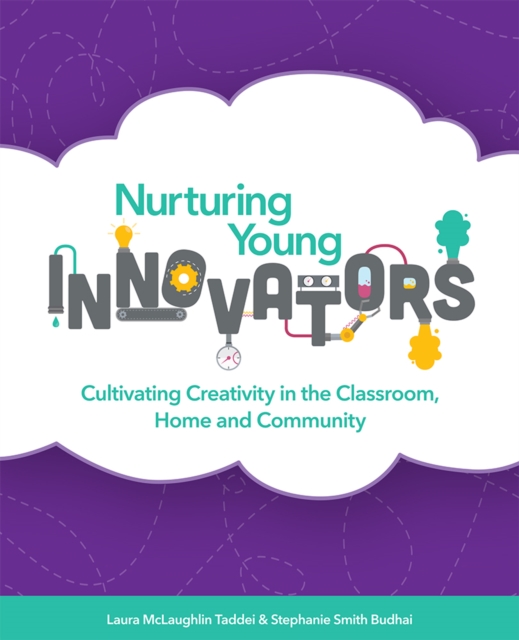
Nurturing Young Innovators
This book offers elementary teachers practical tools and ideas to foster risk-taking, curiosity and creative thinking in their students, helping them succeed as lifelong innovators.Today's students need broad skills to help them think creatively, work collaboratively and implement innovations in our complex and global society.
eBook