
Catalogue Search | MBRL


Are you sure you want to remove the book from the shelf?

{{itemTitle}}
110
result(s) for
"Technology and civilization Forecasting."
Sort by:

The long descent : a user's guide to the end of the industrial age
The Long Descentexamines how industrial society is following the same well-worn path into civilization decline, how our cultural narratives blind us to alternatives, and how it is too late for massive programs for top-down change. The only hope may come from individuals taking action.
eBook
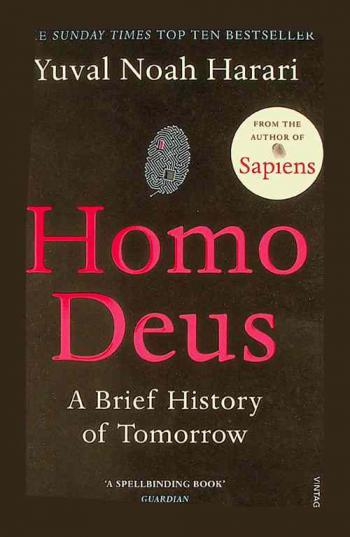
Homo Deus : a brief history of tomorrow
\"Over the past century, humankind has managed to do the impossible and rein in famine, plague, and war. For the first time ever, more people die from eating too much than from eating too little; more people die from old age than from infectious diseases; and more people commit suicide than are killed by soldiers, terrorists and criminals put together. The average American is a thousand times more likely to die from binging at McDonald's than from being blown up by Al Qaeda. What then will replace famine, plague, and war at the top of the human agenda? As the self-made gods of planet Earth, what destinies will we set for ourselves, and which quests will we undertake? Homo Deus explores the projects, dreams and nightmares that will shape the twenty-first century -- from overcoming death to creating artificial life. It asks the fundamental questions: Where do we go from here? And how will we protect this fragile world from our own destructive powers? This is the next stage of evolution. This is Homo Deus.\" --Publisher's Web site.
Book

The ecotechnic future : envisioning a post-peak world
This book examines peak oil in the larger context of human ecology. Greer sees peak oil as a result of historical trends that will continue to evolve for centuries. He advocates consciously maximizing creative approaches to address this global challenge.
eBook

The new digital age : transforming nations, businesses, and our lives
In collaboration, two leading global thinkers from in technology and foreign affairs from Google give readers their widely anticipated, transformational vision of the future: a world where everyone is connected, a world full of challenges and benefits that are ours to meet and to harness. With their combined knowledge and experiences, the authors are uniquely positioned to take on some of the toughest questions about our future: Who will be more powerful in the future, the citizen or the state? Will technology make terrorism easier or harder to carry out? What is the relationship between privacy and security, and how much will we have to give up to be part of the new digital age? In this they combine observation and insight to outline the promise and peril awaiting us in the coming decades. This is a forward-thinking account of where our world is headed and what this means for people, states and businesses. With the confidence and clarity of visionaries, the authors illustrate just how much we have to look forward to, and beware of, as the greatest information and technology revolution in human history continues to evolve. On individual, community and state levels, across every geographical and socioeconomic spectrum, they reveal the dramatic developments both good and bad, that will transform both our everyday lives and our understanding of self and society, as technology advances and our virtual identities become more and more fundamentally real. As their nuanced vision of the near future unfolds, an urban professional takes his driverless car to work, attends meetings via hologram and dispenses housekeeping robots by voice; a Congolese fisherwoman uses her smart phone to monitor market demand and coordinate sales (saving on costly refrigeration and preventing overfishing); the potential arises for \"virtual statehood\" and \"Internet asylum\" to liberate political dissidents and oppressed minorities, but also for tech-savvy autocracies (and perhaps democracies) to exploit their citizens' mobile devices for ever more ubiquitous surveillance. Along the way, we meet a cadre of international figures, including Julian Assange, who explain their own visions of our technology-saturated future. This book is an analysis of how our hyper-connected world will soon look.
Book

Engineers for Change
An account of conflicts within engineering in the 1960s that helped shape our dominant contemporary understanding of technological change as the driver of history.
In the late 1960s an eclectic group of engineers joined the antiwar and civil rights activists of the time in agitating for change. The engineers were fighting to remake their profession, challenging their fellow engineers to embrace a more humane vision of technology. In Engineers for Change, Matthew Wisnioski offers an account of this conflict within engineering, linking it to deep-seated assumptions about technology and American life.
The postwar period in America saw a near-utopian belief in technology's beneficence. Beginning in the mid-1960s, however, society—influenced by the antitechnology writings of such thinkers as Jacques Ellul and Lewis Mumford—began to view technology in a more negative light. Engineers themselves were seen as conformist organization men propping up the military-industrial complex. A dissident minority of engineers offered critiques of their profession that appropriated concepts from technology's critics. These dissidents were criticized in turn by conservatives who regarded them as countercultural Luddites. And yet, as Wisnioski shows, the radical minority spurred the professional elite to promote a new understanding of technology as a rapidly accelerating force that our institutions are ill-equipped to handle. The negative consequences of technology spring from its very nature—and not from engineering's failures. “Sociotechnologists” were recruited to help society adjust to its technology. Wisnioski argues that in responding to the challenges posed by critics within their profession, engineers in the 1960s helped shape our dominant contemporary understanding of technological change as the driver of history.
eBook

The age of em : work, love, and life when robots rule the Earth
Robots may one day rule the world, but what is a robot-ruled Earth like? Many think that the first truly smart robots will be brain emulations or \"ems.\" Robin Hanson draws on decades of expertise in economics, physics, and computer science to paint a detailed picture of this next great era in human (and machine) evolution - the age of em.
eBook


Predicting and explaining life satisfaction among older adults using tree-based ensemble models and SHAP: Evidence from the digital divide survey
As digital transformation continues to penetrate various sectors of society, the issue of the digital divide has become increasingly prominent. Against the backdrop of accelerating population aging, the barriers that older adults face in accessing and utilizing digital information have exerted a profound impact on their quality of life. This study employs tree-based ensemble learning algorithms to predict and identify the key factors of the digital divide that influence life satisfaction among older adults. It also evaluates the predictive performance of these models, thereby providing interpretive insights into the impact of the digital divide on subjective well-being. Using original data from the ‘2023 Report on Digital Information Divide Survey’ conducted by the National Information Society Agency of South Korea, this study constructs an analytical framework that integrates both predictive capability and interpretability. First, the XGBoost model is employed to conduct feature importance analysis, identifying 15 key variables that are highly influential in predicting life satisfaction. These variables are further examined using the SHAP method to provide interpretive insights into their contributions. Subsequently, multiple tree-based ensemble learning algorithms—including Random Forest, XGBoost, LightGBM, and CatBoost—are applied to compare their predictive performance. The results indicate that variables related to technological self-efficacy, digital information literacy, social capital, experience and perception of AI services, and household monthly income are significant predictors of life satisfaction among older adults. Among the models tested, CatBoost demonstrates superior overall predictive accuracy, suggesting its effectiveness in forecasting life satisfaction in this demographic. This study expands the application of machine learning in areas such as aging research and the digital divide and proves the effectiveness of ensemble learning algorithms in predicting digital divide factors that affect the life satisfaction of older adults. This approach provides a novel and powerful methodological for addressing complex social problems. Moreover, the study uncovers the structural configuration of key digital information factors associated with life satisfaction, offering data-driven insights into the mechanisms through which the digital divide influences well-being. These results have practical implications for enhancing digital inclusion, improving adaptability among older adults, and fostering a stronger sense of participation and happiness in digital society.
Journal Article