
Catalogue Search | MBRL


Are you sure you want to remove the book from the shelf?

{{itemTitle}}
8,966
result(s) for
"Technology and state China."
Sort by:

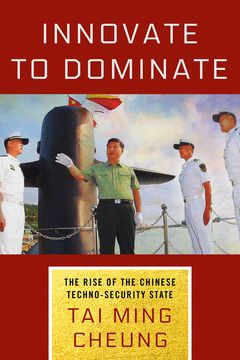
Innovate to Dominate
In Innovate to
Dominate , Tai Ming Cheung offers insight
into why, how, and whether China will overtake the United States to
become the world's preeminent technological and security
power . This examination of the means and ends of China's
quest for techno-security supremacy is required reading for anyone
looking for clues as to the long-term direction of the global
order. The techno-security domain, Cheung argues, is where national
security, innovation, and economic development converge, and it has
become the center of power and prosperity in the twenty-first
century. China's paramount leader Xi Jinping recognizes that
effectively harnessing the complex interactions among security,
innovation, and development is essential in enabling China to
compete for global dominance. Cheung offers a richly detailed
account of how China is building a potent techno-security state. In
Innovate to Dominate he takes readers from the strategic
vision guiding this transformation to the nuts-and-bolts of policy
implementation. The state-led top-down mobilizational model that
China is pursuing has been a winning formula so far, but the
sternest test is ahead as China begins to compete head-to-head with
the United States and aims to surpass its archrival by mid-century
if not sooner. Innovate to Dominate is a timely and
analytically rigorous examination of the key strategies guiding
China's transformation of its capabilities in the national,
technological, military, and security spheres and how this is
taking place. Cheung authoritatively addresses the burning
questions being asked in capitals around the world: Can China
become the dominant global techno-security power? And if so,
when?
eBook

Breakneck : China's quest to engineer the future
America used to pride itself on ambition. Today, it looks stuck. Meanwhile, China has been busy building the future. Over the past six years, technology analyst Dan Wang lived through China's astonishing, messy progress and the dissolution of its relationship to the West. In 'Breakneck', Wang offers a new framework for understanding China - which helps us to see global geopolitics more clearly too.
BOOK

China and the knowledge economy : seizing the 21st century
While China made impressive achievements in economic growth, and poverty reduction over the last quarter century, it now faces daunting, internal challenges, such as ensuring employment to millions over the coming decade, continuing to maintain high growth, increasing its international competitiveness, and reducing income, and regional inequalities. Compounding these challenges is the new knowledge, and information revolution. Thus, to prosper in this new era, China must welcome the knowledge revolution, and make effective use of knowledge in its agricultural, and industrial sectors, and especially, in developing its service industry. Additionally, it also needs to manage the transition to an environmentally, sustainable economy that better utilizes its relatively, limited natural resources. This book outlines those main challenges, and the importance of shifting from a factor-based to a knowledge-based strategy. It presents the long-term strategy for China, that integrates key knowledge-related policy components, improving relevant economic incentives, and institutions, including education, and training upgrading, to build an information structure that strengthens innovations, and research. Concrete steps are suggested for implementing this strategy, and, the book recommends a further withdrawal by Government, from hands-on management of the economy, to rather take the role of an architect for appropriate institutions, and provider of incentives to establish a new socialist, market economy.
eBook

Upgrading China's information and communication technology industry : state-firm strategic coordination and the geography of technological innovation
This book effectively challenges the conventional wisdom regarding the cluster-innovation relationship and provides convincing evidence to show that the prevailing theoretical models derived from Anglo-American experiences cannot be uncritically applied to Chinese reality. This book introduces a new theory of state-firm coordination to explain why and how some Chinese ICT firms have turned out to be more innovative than others. Perspectives from the viewpoint of economic geography, institutional economics, political science, and regulation theory have been provided to throw light on the enigma that is China's ICT industry. Empirically, the book provides state-of-the-art findings to clarify the confusion and misunderstanding about the exact nature of the ICT industry in China. This book has essentially set a new baseline and made definitive contribution to knowledge production about China's economic geography. Methodologically, it shows how original, critical, and independent research can be undertaken effectively and innovatively through cross-disciplinary theoretical interaction, deductive reasoning with hypotheses testing, combination of multiple means of data collection; integration of quantitative and qualitative methods; and structured presentation of research findings with extensive tabular, graphic, and cartographic illustrations.
eBook

China's science and technology sector and the forces of globalisation
China's booming economy has drawn both admiration and fear from the rest of the world. With its ability to churn out high-quality goods at low prices, China has become known as the “factory of the world”. To better understand China's development and modernisation since the 1978 reforms, it is necessary to analyse its policies on importing technologies and developing indigenous ones.
eBook
Theory of Science and Technology Transfer and Applications
Through many real-world examples, this book shows how to implement technology transfer in society, enabling it to become socially and economically valued. It presents the mechanisms, features, effects, and modes of technology transfer. The authors address the measurement, cost, benefit, optimal allocation, and game theory of technology transfer, along with the dynamics of the technical diffusion field. They also present case studies to illustrate the use of a linear programming model and government investment and planning model, offer strategic analyses that utilize game models, and discuss the impact of technology transfer on economic growth.
eBook

The military potential of China's commercial technology
This report examines and rates China's commercial technology in nine industries that have the most potential for supporting military technology development, and assessing the prospects for technological progress between 2000 and 2020.
eBook