
Catalogue Search | MBRL


Are you sure you want to remove the book from the shelf?

{{itemTitle}}
3,046
result(s) for
"Teenagers Political activity."
Sort by:

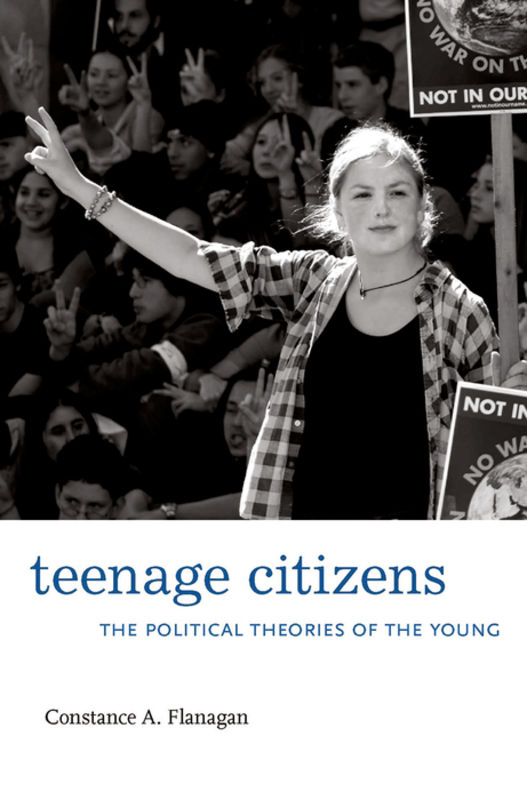
Teenage citizens : the political theories of the young
Most teenagers are too young to vote and are off the radar of political scientists. Yet civic identities form during adolescence and are rooted in experiences as members of families, schools, and community organizations. Flanagan helps us understand how young people come to envisage civic engagement, and how their political identities take form.
eBook

Generation Citizen : the power of youth in our politics
\"Enter Generation Citizen, an organization dedicated to empowering youth through revitalizing civics education across America. Since its beginnings in 2009 during CEO and co-founder Scott Warren's senior year at Brown, Generation Citizen has grown to become one of the most pre-eminent civics education organizations in the country. Generation Citizen: The Power of Youth in Our Politics details Warren's international upbringing and political awakening alongside stories of how young people have always been the vanguard of political change. Generation Citizen is also a practical guide, providing concrete steps to jumpstart an engagement with politics. Through interviews with students and historical portraits of young people who have enacted great political change--from the Civil Rights movement to the election of Ronald Reagan to #BlackLivesMatter and the Parkland students standing up to gun violence--Generation Citizen shows that time and again, it is the young people who lead the way to change\"-- Provided by publisher.
Book
Teenage Citizens
Most teenagers are too young to vote and are off the radar of political scientists. Teenage Citizens looks beyond the electoral game to consider the question of how this overlooked segment of our citizenry understands political topics. Bridging psychology and political science, Constance Flanagan argues that civic identities form during adolescence and are rooted in teens' everyday lives—in their experiences as members of schools and community-based organizations and in their exercise of voice, collective action, and responsibility in those settings. This is the phase of life when political ideas are born.
Through voices from a wide range of social classes and ethnic backgrounds in the United States and five other countries, we learn how teenagers form ideas about democracy, inequality, laws, ethnic identity, the social contract, and the ties that bind members of a polity together. Flanagan's twenty-five years of research show how teens' personal and family values accord with their political views. When their families emphasize social responsibility—for people in need and for the common good—and perform service to the community, teens' ideas about democracy and the social contract highlight principles of tolerance, social inclusion, and equality. When families discount social responsibility relative to other values, teens' ideas about democracy focus on their rights as individuals.
At a time when opportunities for youth are shrinking, Constance Flanagan helps us understand how young people come to envisage the world of politics and civic engagement, and how their own political identities take form.
eBook

Young citizens and political participation in a digital society : addressing the democratic disconnect
\"We are living in an era of democratic disconnect. A gap exists between institutional understandings and expectations of young citizens and the nature and substance of youthful forms of political action. In recent times youth participation policies have become a popular strategy to address a range of perceived 'issues' related to young people: either problems of youth disengagement from democracy or their exclusion from democratic processes.Drawing on the accounts of young people in Australia and the United Kingdom, this book examines questions of youth citizenship and participation by exploring their meanings in policy, practice and youth experience. With reference to recent theoretical work from the New Sociology of Youth, Political Sociology and Media and Communications it examines young people's perspectives on participation in non-government and youth-led organisations. In doing so, it focuses on what young people think and do - and what can be done to bridge the democratic disconnect\"-- Provided by publisher.
Book
Campaign Kicks off to Lower Australian Compulsory Voting Age to 16
\"Young people are increasingly concerned about the future of the planet and want to have a say, according to organisers of the Make It 16 campaign.\" (ABC Premium News) Learn more about the campaign to lower the voting age to 16 in Australia.
Web Resource

Parkland : birth of a movement
Offers an account of the extraordinary teenage survivors of Parkland who became activists and pushed back against the NRA and Congressional leaders, inspiring millions of Americans to join their grassroots #neveragain movement.
Book
Oregon Teen's Activism Could Lead to Lower Voting Age
\"Devon Lawson-McCourt, a sophomore at McKenzie River Community School in Blue River, has volunteered for political campaigns since fifth grade but is still several years away from being allowed to vote. Lawson-McCourt recently secured a promise from Rep. Rob Nosse, D-Portland, to propose an amendment to the state Constitution giving 16- and 17-year-olds the right to vote. Lawson-McCourt contends that lowering the voting age will result in young people engaging in politics earlier.\" (Investigate West) Read more about the Oregon teen's political activism and how it could lead to lowering the state voting age to 16.
Web Resource

Four Eids and a funeral
The death of a beloved mentor, and the need to save and rebuild their fire-damaged Islamic Center, bring former best friends Said and Tiwa back together, rekindling their romantic relationship.
Book
The Government Wants My Money but Not My Thoughts
\"At 16, I can legally work. I can earn money that helps pay for school expenses, transportation and family costs. The government has no hesitation about taxing that income. Yet when Election Day comes around, I am told I am too young to have a voice in deciding how those tax dollars are used.\" (Pittsburgh Post-Gazette) In this viewpoint article, the author -- a high school sophomore -- argues that if teenagers are old enough to work, they should also have the right to vote.
Newspaper Article