
Catalogue Search | MBRL


Are you sure you want to remove the book from the shelf?

{{itemTitle}}
4,514
result(s) for
"Telecommunication Technological innovations."
Sort by:

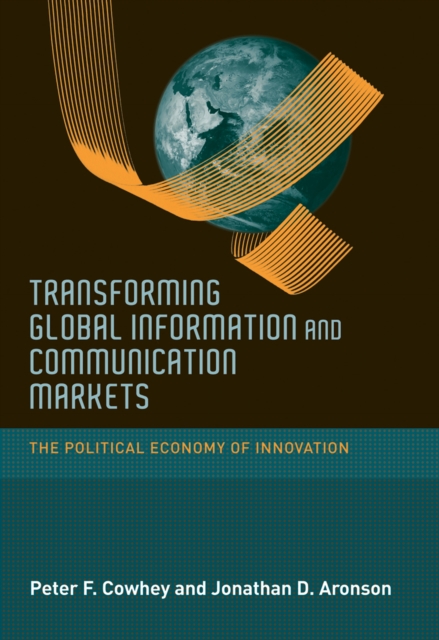
Transforming Global Information and Communication Markets
Innovation in information and communication technology (ICT) fuels the growth of the global economy. How ICT markets evolve depends on politics and policy, and since the 1950s periodic overhauls of ICT policy have transformed competition and innovation. For example, in the 1980s and the 1990s a revolution in communication policy (the introduction of sweeping competition) also transformed the information market. Today, the diffusion of Internet, wireless, and broadband technology, growing modularity in the design of technologies, distributed computing infrastructures, and rapidly changing business models signal another shift. This pathbreaking examination of ICT from a political economy perspective argues that continued rapid innovation and economic growth require new approaches in global governance that will reconcile diverse interests and enable competition to flourish. The authors (two of whom were architects of international ICT policy reforms in the 1990s) discuss this crucial turning point in both theoretical and practical terms.
eBook

Future Telco : successful positioning of network operators in the digital age
\"This book examines the extensive changes in markets, technologies and value chains that telecommunication companies are currently confronted with. It analyzes the crossroads they have reached and the choices that now need to be made - to be a bit pipe or a trendsetter of digitalization. Based on an analysis of the key challenges for telcos, the book derives future market scenarios and puts forward recommendations for how they can successfully position themselves. It proposes a framework based on seven \"levers,\" which addresses concrete measures in each step of the value chain, ranging from technology, IT and processes, to innovation, marketing and sales issues. The book discusses the current challenges and provides both general recommendations and concrete solutions. Respected experts illustrate innovative strategic and technical trends and provide insights gained in real-life transformation projects. Recent developments in the areas of regulation, product development, competition between over-the-top (OTT) providers and telcos, as well as technical innovations like 5G, SDN/NFV, LEO satellites and MEC are discussed. Accordingly, practitioners, managers and researchers alike will benefit from the book's wealth of examples and up-to-date insights\"--Publisher's website.
Book

Communications and mobility
Communications and Mobility is a unique, interdisciplinary look at mobility, territory, communication, and transport in the 21st century with extended case studies of three icons of this era: the mobile phone, the migrant, and the container box.
Urges scholars in media and communication to return to broader conceptions of the field that include mobility of all kinds—information, people, and commodities Embraces perspectives from media studies, science and technology studies, sociology, media anthropology, and cultural geography Discusses ideas of virtual and embodied mobility, network geographies, de-territorialization, sedentarism, nomadology, connectivity, containment, and exclusion Integrates the often-neglected transport studies into contemporary communication studies and theories of globalization
eBook


Disruptive Activity in a Regulated Industry
This book brings together the research on the effects of disruptive activity in a regulated industry, taking as its illustrative industry that of primarily mobile telecommunications. It provides case studies of both individual countries and international operators.
eBook

Opening Standards
Openness is not a given on the Internet. Technical standards--the underlying architecture that enables interoperability among hardware and software from different manufacturers--increasingly control individual freedom and the pace of innovation in technology markets. Heated battles rage over the very definition of \"openness\" and what constitutes an open standard in information and communication technologies. In Opening Standards, experts from industry, academia, and public policy explore just what is at stake in these controversies, considering both economic and political implications of open standards. The book examines the effect of open standards on innovation, on the relationship between interoperability and public policy (and if government has a responsibility to promote open standards), and on intellectual property rights in standardization--an issue at the heart of current global controversies. Finally, Opening Standards recommends a framework for defining openness in twenty-first-century information infrastructures. Contributors discuss such topics as how to reflect the public interest in the private standards-setting process; why open standards have a beneficial effect on competition and Internet freedom; the effects of intellectual property rights on standards openness; and how to define standard, open standard, and software interoperability.
eBook


Telexistence
Telexistence is a fundamental concept which refers to the general technology that enables a human being to have a real-time sensation of being at a place other than where he or she actually exists, while being able to interact with the remote environment, which may be real, virtual, or a combination of both. It also refers to an advanced type of teleoperation system that enables an operator at the control to perform remote tasks dexterously with the feeling of existing in a surrogate robot working in a remote environment. Telexistence in the real remote environment through a virtual environment is also possible.
eBook