
Catalogue Search | MBRL


Are you sure you want to remove the book from the shelf?

{{itemTitle}}
8
result(s) for
"Telekommunikationsdienste"
Sort by:

Conceptualising Digital Platforms in Developing Countries as Socio-Technical Transitions: A Multi-level Perspective Analysis of EasyTaxi in Colombia
Digital platforms play an increasing role across socio-economic sectors in developing countries yet development research to date on this topic has been limited and under-conceptualised. To help facilitate such research in future, this paper presents and applies the “multi-level perspective” as a framework to understand platforms in development as socio-technical transitions. Analysing a successful ride-hailing platform—EasyTaxi in Colombia—it finds what was originally a niche innovation then effected a socio-technical transition within Bogotá’s taxi regime. Although there are some issues in applying the framework, it is found to have a factoral, scalar and longitudinal holism that were lacking in existing conceptualisations within the literature on platforms and developing countries. The multi-level perspective offers insights into the process of innovation, rapidity of scaling, and development impacts relating to resource endowments, institutional formalisation, and shifts in power. The framework may therefore be a useful lens for development researchers seeking to better understand digital platforms.
Journal Article

The Huawei Model
In 2019, the United States' trade war with China expanded to
blacklist the Chinese tech titan Huawei Technologies Co. Ltd. The
resulting attention showed the information and communications
technology (ICT) firm entwined with China's political-economic
transformation. But the question remained: why does Huawei matter?
Yun Wen uses the Huawei story as a microcosm to understand
China's evolving digital economy and the global rise of the
nation's corporate power. Rejecting the idea of the transnational
corporation as a static institution, she explains Huawei's
formation and restructuring as a historical process replete with
contradictions and complex consequences. She places Huawei within
the international political economic framework to capture the
dynamics of power structure and social relations underlying
corporate China's globalization. As she explores the contradictions
of Huawei's development, she also shows the ICT firm's complicated
interactions with other political-economic forces.
Comprehensive and timely, The Huawei Model offers an
essential analysis of China's dynamic development of digital
economy and the global technology powerhouse at its core.
eBook

Area C and the future of the Palestinian economy
Restrictions on economic activity in area C of the West Bank have been particularly detrimental to the Palestinian economy. Area C constitutes about 61 percent of the West Bank territory. Area C is richly endowed with natural resources and it is contiguous, whereas areas A and B are smaller territorial islands. Mobilizing the area C potential will help a faltering Palestinian economy. Since area C is where the majority of the West Bank's natural resources laid, the impact of these restrictions on the Palestinian economy has been considerable. Thus, the key to Palestinian prosperity continues to lie in the removal of these restrictions with due regard for Israel's security. This report shows that rolling back the restrictions will bring substantial benefits to the Palestinian economy and can usher in a new period of increasing Palestinian gross domestic product (GDP) and substantially improve prospects for sustained growth. This report examines the economic benefits of lifting the restrictions on movement and access as well as other administrative obstacles to Palestinian investment and economic activity in area C. It focuses on the economic potential of area C and does not prejudge the status of any territory which may be subject to negotiations between Palestinians and Israelis. The authors examine potential direct, sector-specific benefits, but also indirect benefits related to improvements in physical and institutional infrastructure, as well as spillover effects to other sectors of the Palestinian economy. Realizing the full potential of such investments requires other changes as well - first, the rolling back of the movement and access restrictions in force outside area C, which prevent the easy export of Palestinian products and inhibit tourists and investors from accessing area C; and second, further reforms by the Palestinian authority to better enable potential investors to register businesses, enforce contracts, and acquire finance.
eBook
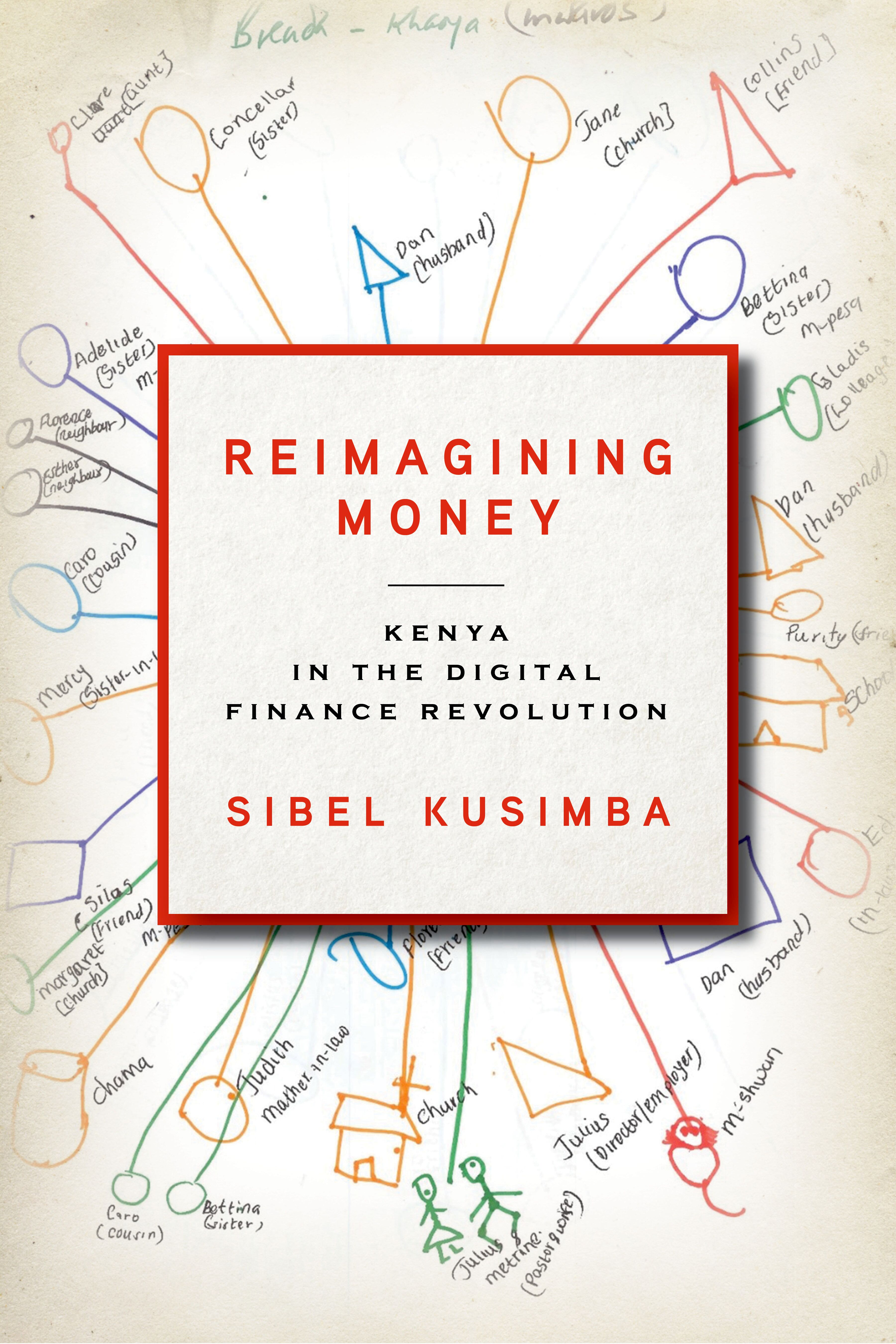
Reimagining money : Kenya in the digital finance revolution
Technology is rapidly changing the way we think about money. Digital payment has been slow to take off in the United States but is displacing cash in countries as diverse as China, Kenya, and Sweden. In Reimagining Money, Sibel Kusimba describes the rise of M-Pesa, and offers a rich portrait of how this technology changes the economic and social landscape, allowing users to create webs of relationships as they exchange, pool, borrow, lend, and share digital money in user-built networks. These networks, Kusimba argues, will shape the future of financial technologies and their impact on poverty, inclusion, and empowerment. She describes how urban and transnational migrants maintain a presence in rural areas through money gifts; how families use crowdfunding software to assemble donations for emergency medical care; and how new financial groups invest in real estate and fund weddings. The author presents fascinating accounts that challenge accepted wisdom by examining the notion of money as wealth-in-people—an idea long-cultivated in sub-Saharan Africa and now brought to bear on the digital age with homegrown financial technologies such as digital money transfer, digital microloans, and crowdfunding. The book concludes by proposing a new theory of money that can be applied to designing better financial technologies in the future.
eBook


Akzeptanz und Reaktanz von mobilen Diensten: Eine empirische Studie am Beispiel von Deutschland und den USA
Durch die zunehmende Mobilität und Flexibilität in der Gesellschaft wird das Mobiltelefon nicht länger nur in seiner originären Funktion der Kommunikation genutzt, sondern findet immer häufiger Anwendung in mobilen Diensten. Das Mobiltelefon wird von den Nutzern jedoch meistens als Teil der Privatsphäre empfunden, wodurch Fragen der Freiheitseinschränkung und Reaktanz durch mobile Dienste aufgegriffen werden müssen. Ziel dieser Studie ist daher die Akzeptanz und Reaktanz von mobilen Diensten zu erfassen. Aufbauend auf bisherigen Akzeptanzmodellen und dem Reaktanzverständnis von Brehm (1966) wird ein Akzeptanz-und Reaktanzmodell entwickelt. Die Modelle werden auf Basis von Daten aus Deutschland und den USA empirisch validiert, wobei eine Fokussierung auf Studenten als junge Konsumenten stattfand. Im Rahmen der Studie konnte gezeigt werden, dass die Akzeptanz und Reaktanz durch den Informations-und Unterhaltungswert der mobilen Dienste geprägt werden. Weiterhin stellt der Einfluss mobiler Dienste auf den Alltag der Nutzer einen wesentlichen anwendungsbezogenen Einflussfaktor auf die Akzeptanz dar. Konsumentenspezifische Einflussfaktoren auf die Akzeptanz und Reaktanz wurden sowohl in der Kenntnis über mobile Dienste als auch in der Intensität der Handynutzung und Technikbegeisterung festgestellt. Insgesamt zeigt sich, dass amerikanische Konsumenten eine höhere Akzeptanzausprägung und eine höhere Reaktanz aufweisen als die deutschen Nutzer. Through increasing mobility and flexibility in today's society the mobile phone is no longer only used in its primary function of communication, but expands its application with the increasing use of mobile services. However the mobile phone is mostly regarded as a part of privacy, so that questions of freedom restraints and reactance through mobile services have to be addressed. The purpose of this paper is the assessment of acceptance and reactance of mobile services. An acceptance and reactance model for mobile services will be derived upon existing acceptance models and the reactance theory of Brehm (1966). Focusing on students as youth consumers, we empirically test the models using data collected in Germany and the USA. The research findings show that the acceptance and reactance is influenced by information and entertainment value of the services. Moreover the influence of mobile services for the everyday live reveals a significant impact on acceptance. Knowledge of mobile services and intensity of mobile phone usage as consumer specific factors show also a significant effect on acceptance and reactance. The country comparison demonstrates that the US-consumers have a higher acceptance and a higher reactance of mobile services than German consumers.
Journal Article