
Catalogue Search | MBRL


Are you sure you want to remove the book from the shelf?

{{itemTitle}}
52
result(s) for
"Telemundo"
Sort by:

Spanish-Language Television
How Spanish-language television networks continue to thrive in a rapidly changing media landscape. The US television industry has suffered blow after blow amid media convergence and the rise of streaming. Those legacy broadcasters that survive are much diminished and highly dependent on live programming—the last redoubt of old media. There is an exception, though: Spanish-language television is thriving. Spanish-Language Television surveys the Latinx media landscape to better appreciate why Univision and Telemundo have flourished while others faltered. Manuel G. Avilés-Santiago and Jillian M. Báez show that the major Spanish-language networks are unusually flexible and open to innovation in hopes of reaching new demographics. Univision and Telemundo were early to streaming. To appeal to \"billennial\" audiences—bilingual millennials—who threatened to stray from TV, they rebuilt the telenovela, which now features social commentary, diverse characters, and genre crossovers. Today's reality programs defy old norms of linguistic correctness, and the airwaves are becoming less hospitable to racism and sexism, resulting in rising ratings and ad revenues. The first book-length treatment of reception patterns in Latinx TV, Spanish-Language Television deepens our understanding of new media in a moment of transformation and possibility.
eBook

Univision, Telemundo, and the Rise of Spanish-Language Television in the United States
In the most comprehensive history of Spanish-language television
in the United States to date, Craig Allen traces the development of
two prominent yet little-studied powerhouses, Univision and
Telemundo. Allen tells the inside story of how these networks
fought enormous odds to rise as giants of mass communication within
an English-dominated society.
The book begins in San Antonio, Texas, in 1961 with the launch
of the first Spanish-language station in the country. From it rose
the Spanish International Network (SIN), which would later become
Univision. Conceived by Mexican broadcasting mogul Emilio Azcárraga
Vidaurreta and created by unsung American television pioneers,
Unvision grew to provide a vast amount of international
programming, including popular telenovelas, and was the first U.S.
network delivered by satellite. After Telemundo was founded in the
1980s by Saul Steinberg and Harry Silverman, the two networks
battled over audiences and saw dramatic changes in leadership.
Today, Univision and Telemundo are multibillion-dollar television
providers that equal ABC, CBS, NBC, and Fox in scale and stature.
While Univision remains a beacon of U.S. television's
internationalization, Telemundo-owned by NBC-is a worldwide leader
in producing Spanish-language programs.
Using archival sources and original interviews to reconstruct
power struggles and behind-the-scenes intrigue, Allen uses this
exciting narrative to question monolingual and Anglo-centered
versions of U.S. television history. He demonstrates the endurance,
innovation, and popularity of Spanish-language television, arguing
that its story is essential to understanding the Latinx history of
contemporary America.
A volume in the series Reframing Media, Technology, and Culture
in Latin/o America, edited by Héctor Fernández L'Hoeste and Juan
Carlos Rodríguez
eBook
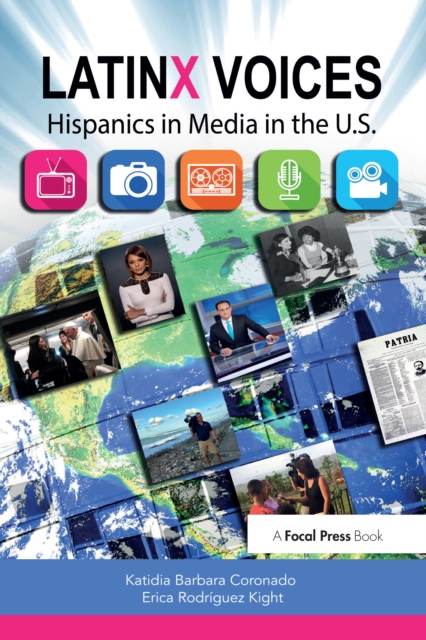
LatinX Voices
LatinX Voices: Hispanics in Media in the U.S. is the first undergraduate textbook to pro vide an overview of Hispanic/LatinX Media in the U.S., with chapters written by top scholars and professionals, giving readers an understanding of how the LatinX audience has transformed media in the United States. Editors Katidia Barbara Coronado and Erica Rodríguez Kight cover this evolving industry with years of professional and research experience, as well as years of teaching broadcast media courses in the classroom. Students will discover unique perspectives on topics related to Latin American areas of interest. With chapters from professionals who have left their mark in print, radio, television, film, and new media, this volume brings together expert voices in Hispanic/LatinX media from across the U.S., and explains the impact of this population on the media industry today.
eBook

Introduction
New media and modes of expression present issues that encourage understanding and reframing of modern Latino media. But in an older and little-studied medium that today is a cornerstone not merely of Latino but all mass communication—Spanish-language television such as Telemundo, Televisa, and Spanish International Network—a new need is found in a long unaddressed question: In an English-speaking country, how could a Spanish-language institution have emerged? The need for a first account of Spanish-language television is reflected in fervor among Latinos who believe its obscurity erases their history. Hidden historical source work can be and is found. A detective story that results in an inside story explains the meaning and prominence of Spanish-language television today. Significant yet unknown founding parents, historical roots tangled in two counties (Mexico and the U.S.), conflicts, and eventual landmark strides are introduced. Previewed are several themes and revelations. Because of foreign ownership restrictions, the now-giant Univision began as an outlaw firm. While U.S. mass communication is understood as a “Fortress America,” Spanish-language television internationalized U.S. media with implications scholars and experts have overlooked.
Book Chapter
Final Fight
Period: 2000–2012. The millennium brings predictions of vast new TV channels for a rapidly growing Latino population. Yet Perenchio’s deal for a second network crushes new entrants. Telemundo finally rises under chief James McNamara. At a $2.7 billion price, Sony sells Telemundo to NBC. The dispute between Perenchio and Azcárraga Jean over the PLA intensifies and erupts into lawsuits. Fighting expands when Azcárraga Jean claims Televisa’s right to succeed Perenchio as owner of Univision but Perenchio departs by selling to Haim Saban. A courtroom showdown ends with a surprise settlement but with Univision still uncertain of programs after the PLA expires in 2017. At Telemundo, NBC’s ownership is fortuitous. From NBC’s infusion of cash, McNamara and successor Don Browne introduce “coproduction” agreements with foreign studios. Telemundo becomes the first major U.S. producer of Spanish-language programs. Univision takes a more historic stride. Resolving their dispute, Univision and Televisa sign an unprecedented “joint operating agreement.” Univision is promised permanent Televisa programming. Televisa claims enlarged control of Univision. The JOA is the first definitive agreement between the parties since Telesistema Méxicano founded SIN in 1961. Yet after 50 years, little in Spanish-language television has changed. Univision still is dominant among Latinos. Its main programs, novelas, are the same. The influence and grip of the Azcárragas remain.
Book Chapter

Representations of class and gender on primetime Spanish-language television in the United States
This study examines the content of primetime Spanish-language programming available in the United States. Four alternate nights of primetime, serial programming, which included 6 telenovelas and 1 drama, were analyzed on three Spanish TV networks-Telemundo, Univision and Azteca America. Content analysis included gender roles, class, sexual talk, and physical and verbal aggression. Women were represented comparably to men in overall numbers, but with more childcare responsibilities, less job status and a greater emphasis on attractiveness. Lighter skin characters were more likely to play major roles, were more fit and younger, and more likely to be upper class than their darker skin counterparts. Sexual talk followed a pattern similar to U.S. soaps but was more pronounced on Spanish-language television. Verbal and physical aggression were less prevalent compared to U.S. programming. The potential impact of stereotypical class and gender roles on U.S. viewers is discussed.
Journal Article
