
Catalogue Search | MBRL


Are you sure you want to remove the book from the shelf?

{{itemTitle}}
919
result(s) for
"Telephone operators"
Sort by:

The Hello Girls : America's first women soldiers
\"In World War I, telephones linked commanding generals with soldiers in muddy trenches. A woman in uniform connected almost every one of their calls, speeding the orders that won the war. Like other soldiers, the 'Hello Girls' swore the Army oath and stayed for the duration ... When the switchboard operators sailed home a year later, the Army dismissed them without veterans' benefits or victory medals. The women commenced a sixty-year fight that a handful of survivors carried to triumph in 1979. This book shows how technological developments encouraged an unusual band to volunteer for military service at the precise moment that feminists back home championed a federal suffrage amendment\"--Provided by publisher.
Book

Serving a Wired World
In the public imagination, Silicon Valley embodies the newest of
the new-the cutting edge, the forefront of our social networks and
our globally interconnected lives. But the pressures exerted on
many of today's communications tech workers mirror those of a much
earlier generation of laborers in a very different space: the
London workforce that helped launch and shape the massive
telecommunications systems operating at the turn of the twentieth
century. As the Victorian age ended, affluent Britons came to rely
on information exchanged along telegraph and telephone wires for
seamless communication: an efficient and impersonal mode of sharing
thoughts, demands, and desires. This embrace of seemingly
unmediated communication obscured the labor involved in the smooth
operation of the network, much as our reliance on social media and
app interfaces does today. Serving a Wired World is a
history of information service work embedded in the daily
maintenance of liberal Britain and the status quo in the early
years of the twentieth century. As Katie Hindmarch-Watson shows,
the administrators and engineers who crafted these
telecommunications systems created networks according to
conventional gender perceptions and social hierarchies, modeling
the operation of the networks on the dynamic between master and
servant. Despite attempts to render telegraphists and telephone
operators invisible, these workers were quite aware of their
crucial role in modern life, and they posed creative challenges to
their marginalized status-from organizing labor strikes to
participating in deviant sexual exchanges. In unexpected ways,
these workers turned a flatly neutral telecommunications network
into a revolutionary one, challenging the status quo in ways
familiar today.
eBook

Berlin Electropolis
Berlin Electropolisties the German discourse on nervousness in the late nineteenth and early twentieth centuries to Berlin's transformation into a capital of the second industrial revolution. Focusing on three key groups-railway personnel, soldiers, and telephone operators-Andreas Killen traces the emergence in the 1880s and then later decline of the belief that modernity caused nervous illness. During this period, Killen explains, Berlin became arguably the most advanced metropolis in Europe. A host of changes, many associated with breakthroughs in technologies of transportation, communication, and leisure, combined to radically alter the shape and tempo of everyday life in Berlin. The resulting consciousness of accelerated social change and the shocks and afflictions that accompanied it found their consummate expression in the discourse about nervousness. Wonderfully researched and clearly written, this book offers a wealth of new insights into the nature of the modern metropolis, the psychological aftermath of World War I, and the operations of the German welfare state. Killen also explores cultural attitudes toward electricity, the evolution of psychiatric thought and practice, and the status of women workers in Germany's rapidly industrializing economy. Ultimately, he argues that the backlash against the welfare state that occurred during the late Weimar Republic brought about the final decoupling of modernity and nervous illness.
eBook


Evaluating a training intervention for improving alignment between emergency medical telephone operators and callers: a pilot study of communication behaviours
Background
Calls to emergency medical lines are an essential component in the chain of survival. Operators make critical decisions based on information they elicit from callers. Although smooth cooperation is necessary, the field lacks evidence-based guidelines for how to achieve it while adhering to strict parameters of index-driven questioning. We aimed to evaluate the effect of a training intervention for emergency medical operators at a call centre in Tønsberg, Norway. The course was designed to enhance operators’ communication skills for smoothing cooperation with callers.
Methods
Calls were analyzed using inductively developed coding based on the course rationale and content. To evaluate whether the course generated consolidated behavioral change in everyday practice, the independent analyst evaluated 32 calls, selected randomly from eight operators, two calls before and two after course completion. To measure whether skill attainment delayed decision making, we compared the time to the first decision logged by intervention operators to eight control operators. Analysis included 3034 calls: 1375 to intervention operators (T1 = 815; T2 = 560) and 1659 to control operators (T1 = 683; T2 = 976).
Results
Operators demonstrated improved behaviours on how they
greeted the caller
(
p
< .001),
acknowledged
the caller (
p
< .001), and
displayed empathy
(
p
= 0.015). No change was found in the use of
open-ended questions
and
agreeing
with the caller. Contrary to expectations, operators who took the course logged first decisions more quickly than the control group (
p
< .001).
Conclusions
This pilot study demonstrated that the training intervention generated behavioural change in these operators, providing justification for scaling up the intervention.
Journal Article
Impact of caller’s degree-of-worry on triage response in out-of-hours telephone consultations: a randomized controlled trial
Background
Telephone triage entails assessment of urgency and direction of flow in out-of-hours (OOH) services, while visual cues are inherently lacking. Triage tools are recommended but current tools fail to provide systematic assessment of the caller’s perspective. Research demonstrated that callers can scale their degree-of-worry (DOW) in a telephone contact with OOH services, but its impact on triage response is undetermined. The aim of this study was to investigate the association between call-handlers’ awareness of the caller’s DOW and the telephone triage response.
Methods
A randomized controlled trial at a Danish OOH service using telephone triage with quantitative analyses and qualitative process evaluation. Prior to contact with a call-handler, callers were asked to rate their DOW on a five-point scale. Calls were randomized to show or not show DOW on the call-handlers’ screens. Triage response (telephone consultation or face-to-face consultation) was analysed using Chi-square tests. Process evaluation incorporated a quantitative and qualitative assessment of intervention implementation and fidelity.
Results
Of 11,413 calls, 5705 were allocated to the intervention and 5708 to the control group. No difference in number of face-to-face consultations was detected between the two groups (OR 1.05, 95% CI 0.98 to 1.14,
p
= 0.17). The process evaluation showed that call-handlers did not use the DOW systematically and were reluctant to use DOW.
Conclusion
Awareness of DOW did not affect the triage response, but this finding could reflect a weak implementation strategy. Future studies should emphasise the implementation strategy to determine the effect of DOW on triage response.
Trial registration
Registration number, Clinicaltrials.gov
NCT02979457
.
Journal Article

\Weavers of Speech\: Telephone Operators as Defiant Domestics in American Literature and Culture
American telephone companies of the early twentieth century strictly trained their female operators to become domestic machines serving the economic interests of male business owners. Yet telephone dramas, films and magazine fiction celebrated the operator as a subversive maverick who flouts rules and transgresses social boundaries. These disaster tales, detective stories and romantic comedies suggest that, far from being pawns of social control, operators themselves regulate society and engineer their customers' fates, as well as their own. Motivated by curiosity and empathy, the heroines of these tales prefer human connections to purely mechanical ones, and they use the power of the switchboard to manifest their own vision of the social good. The stories attest to a deep cultural respect and desire for empowered women protagonists and for the triumph of human initiative and decision-making over the efficiency of mechanized work.
Journal Article
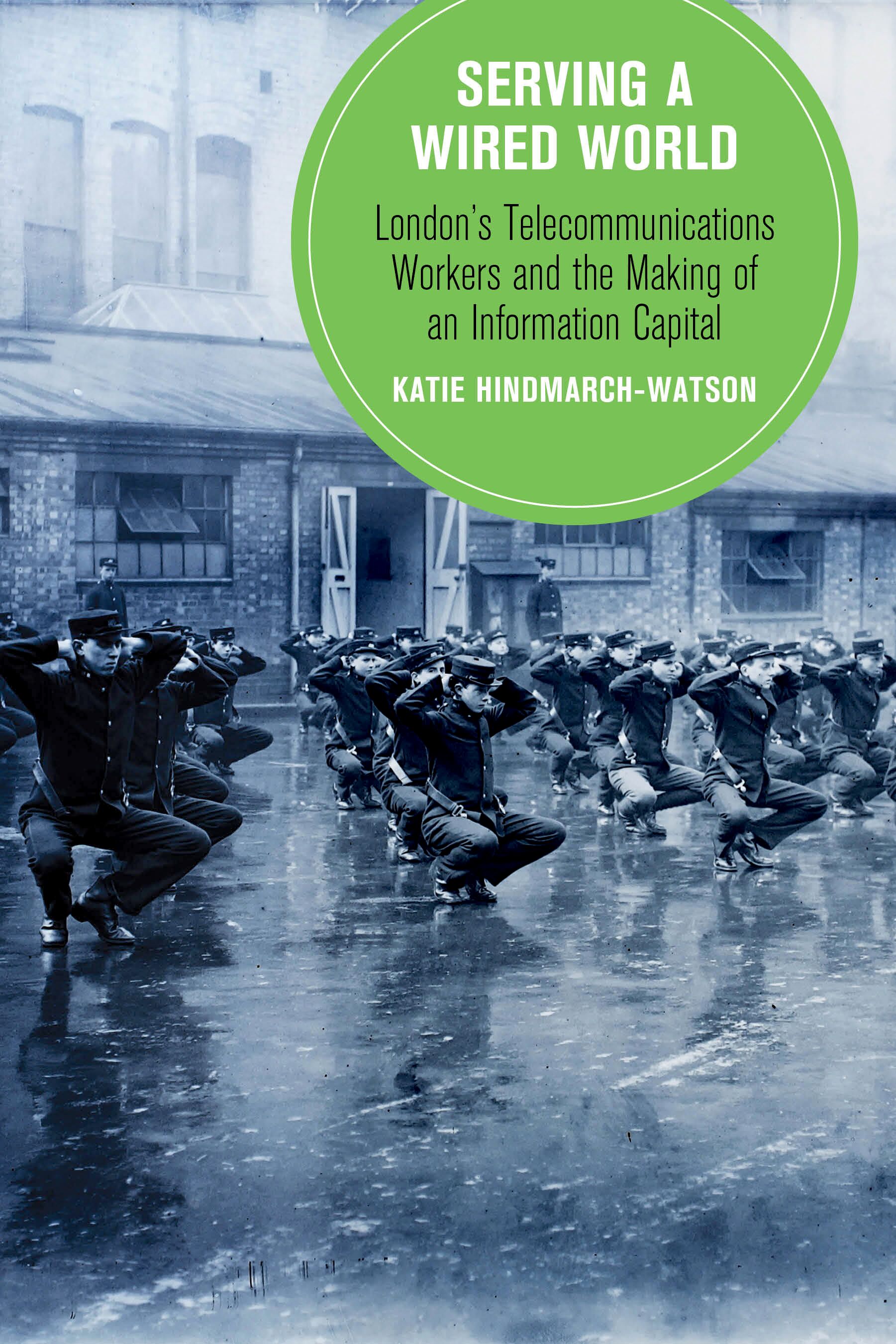
Serving a Wired World
In the public imagination, Silicon Valley embodies the newest of the new--the cutting edge, the forefront of our social networks and our globally interconnected lives. But the pressures exerted on many of today's communications tech workers mirror those of a much earlier generation of laborers in a very different space: the London workforce that helped launch and shape the massive telecommunications systems operating at the turn of the twentieth century. As the Victorian age ended, affluent Britons came to rely on information exchanged along telegraph and telephone wires for seamless communication: an efficient and impersonal mode of sharing thoughts, demands, and desires. This embrace of seemingly unmediated communication obscured the labor involved in the smooth operation of the network, much as our reliance on social media and app interfaces does today. Serving a Wired World is a history of information service work embedded in the daily maintenance of liberal Britain and the status quo in the early years of the twentieth century. As Katie Hindmarch-Watson shows, the administrators and engineers who crafted these telecommunications systems created networks according to conventional gender perceptions and social hierarchies, modeling the operation of the networks on the dynamic between master and servant. Despite attempts to render telegraphists and telephone operators invisible, these workers were quite aware of their crucial role in modern life, and they posed creative challenges to their marginalized status--from organizing labor strikes to participating in deviant sexual exchanges. In unexpected ways, these workers turned a flatly neutral telecommunications network into a revolutionary one, challenging the status quo in ways familiar today..
eBook


Non Emergency Calls-Depression Coupling in Call Handlers of Rescue 1122 Punjab, Pakistan
The study was conducted to know whether bulk inflow of Non Emergency Calls (NECs) acts as an independent predictor for depression in call handlers of Rescue 1122, Punjab, Pakistan. Forty five (45) call handlers were recruited from evening shift of 9 districts. Similarly, same-sized control group was made out of field rescuers. The groups were compared for rate and severity level of depression using Beck’s Depression Inventory-II (BDI-II; Beck, Steer, & Brown, 1996). Probable predictors (except workplace stress) for depression in call handlers were evaluated through risk estimates. For workplace stress, a purposefully developed close- ended Workplace Stress Questionnaire including two subscales i.e. Non Emergency call and Control Room Environment of 30 items each was administrated. Twenty nine (64.4%) subjects of study group reported depression on BDI. Consequently, the same group had significantly higher mean depression score than control (18.2 vs. 12.6; p = .00). The scores also showed insignificant association with any of the probable predictors (demographic variables) of the call attendees. The respondents perceived more occupational stress against NECs. The findings attract the attention of authorities towards the severity of the concern.
Journal Article