
Catalogue Search | MBRL


Are you sure you want to remove the book from the shelf?

{{itemTitle}}
254
result(s) for
"Television programs -- Canada -- History"
Sort by:

Recasting history : how CBC Television has shaped Canada's past
\"This book explores Canadian history documentary and docudrama programming on CBC television since its beginnings in 1952. During this fifty-year period, television was a uniquely powerful medium --at once intimate and widely shared, reaching millions of people. CBC was the only Canadian broadcaster to consistently show history programming and has played a unique role in shaping Canadians' perceptions of their history. Analyzing the major works of Canadian history on CBC television over fifty years -- Explorations (1956-63), Images of Canada (1972-76), The National Dream (1974), The Valour and the Horror (1992), and Canada: A People's History (2000-02) -- reveals patterns and developments in content and presentation. As the author argues, these developments were not arbitrary but were impelled by a wide range of external factors: developments in broadcasting policy and regulation in Canada; television industry developments, including competition from a growing American market and for new Canadian broadcasters (such as CTV and Global) for viewers and for advertising revenue; the evolution of television itself, including the standards and financing of production and attention to ratings, technological change, and job creation; and the evolution of journalism and the role of journalists as supposed authorities. This book is both a critique of public history and a political economy of television production. The author has three major findings.\"-- Provided by publisher.
Book


25 years of 22 minutes : an unauthorized oral history of this hour has 22 minutes, as told by cast members, staff, and guests
\"The final chaotic season of Codco had just wrapped when Mary Walsh sat down at a Toronto bistro with George Anthony, then creative head of CBC TV's arts programming. She'd been thinking about a news-based comedy show-did he think that would fly? He did. That was the early '90s. Twenty-five seasons later, hundreds of thousands of Canadians continue to tune in weekly to This Hour Has 22 Minutes for its unashamedly Canadian, bitingly satirical take on politics and power. 25 Years of 22 Minutes takes readers backstage to hear first-hand accounts of the show's key moments-in the words of the writers, producers, and cast members who were there. Readers will have a front-row seat to the birth of the show-including a crisis that had producers scrambling in the very first episode-and an insider's take on the highs, the lows and the daily grind behind the scenes at 22 Minutes.\"-- Provided by publisher.
Book
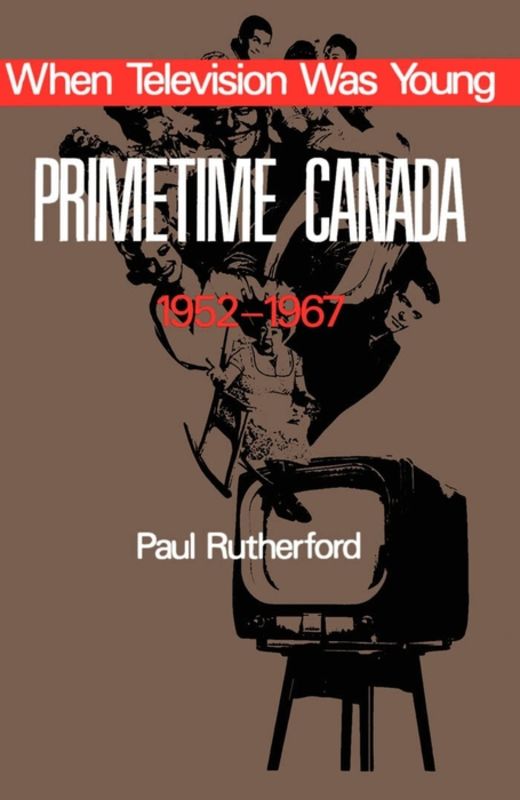
When Television was Young
A decade after the first Canadian telecasts in September 1952, TV had conquered the country. Why was the little screen so enthusiastically welcomed by Canadians? Was television in its early years more innovative, less commerical, and more Canadian than current than current offerings? In this study of what is often called the 'golden age' of television, Paul Rutherford has set out to dispel some cherished myths and to resurrect the memory of a noble experiment in the making of Canadian culture.
He focuses on three key aspects of the story. The first is the development of the national service, including the critical acclaim won by Radio-Canada, the struggles of the CBC's English service to provide mass entertainment that could compete with the Hollywood product, and the effective challenge of private television to the whole dream of public broadcasting.
The second deals with the wealth of made-in-Canada programming available to please and inform vviewers - even commercials receive close attention. Altogether, Rutherford argues, Canadian programming reflected as well as enhanced the prevailing values and assumptions of the mainstream.
The final focus is on McLuhan's Question: What happens to society when a new medium of communications enters the picture? Rutherford's findings cast doubt upon the common presumptions about the awesome power of television.
Television in Canada, Rutherford concludes, amounts to a failed revolution. It never realized the ambbitions of its masters or the fears of its critics. Its course was shaped not only by the will of the government, the power of commerce, and the empire of Hollywood, but also by the desires and habits of the viewers.
eBook
Documentary Television in Canada
Since the inception of Canadian television in the early 1950s, documentary television, consistently a favourite among viewers, has been misunderstood and often maligned by its critics. More popular, and arguably more innovative, than its cinematic counterpart or than dramatic Canadian television, Canadian documentary television has decisively shaped the form and function of public service television in this country. David Hogarth traces its history back to its roots in radio in the 1930s and 1940s and examines the variety of forms of documentary television that developed in the decades that followed, focusing on newsmagazines, science programs, historical essays, docudramas, and verité investigations.
eBook

Turn up the contrast : CBC television drama since 1952
Both a critical analysis and a survey history of how Canadians have used the medium of television, this is the first book to explore the content of Canadian television drama.
eBook

Little Mosque on the Prairie and the Paradoxes of Cultural Translation
Kyle Conway's textual analysis and in-depth research, including
interviews from the show's creator, executive producers, writers,
and CBC executives, reveals the many ways Muslims have and have not
been integrated into North American television.
eBook

Culture, Communication and National Identity
A European multilingual society, without a shared culture or common European audio-visual sphere and with viewers watching foreign television, can survive successfully as a political entity ? just as Canada has.
eBook
Canada. Season 1, episode 5, Expansion 1858 - 1899
In the lead up to Confederation, Canada faces the threat of American expansionism. Determined that Canada will remain independent and free, a generation of risk-takers, gold miners, cowboys and railway-men will rise to the challenge.
Streaming Video

The Historical Roots of CIA-Hollywood Propaganda
The ability to use movies that tell persuasive stories is a powerful tool, particularly if it is consciously used to legitimize war, assassination, and illegal activities and to undermine the core principles of democracy. The U.S. Central Intelligence Agency (CIA) and the U.S. military have made use of that tool for almost a century, starting with the War Department's quiet support for the movie Birth of a Nation in 1915 and continuing for a century, including such recent CIA-supported products as Homeland, The Agency, The Recruit, and many less likely movies and television shows. During World War II, this sort of propaganda was openly distributed, since there was a widespread consensus in support of that war. However, state-sponsored propaganda in the form of Hollywood movies continued throughout the Cold War up to the present. The production of movies that completely distorted the political meaning of George Orwell's and Graham Greene's novels were important examples of this practice. CIA involvement was covert, since the target audience was the American public and the ideological perspective being propagated often ran counter to democratic ideals. This article recounts the history of the process by which Americans came to accept the ideas continuously promoted by the government, often without knowing that their favorite movies and television shows had been vetted or even altered by agents of the CIA or the Pentagon. Since these practices violate federal laws, the public at least has a right to know that we are being subjected to this sort of propaganda and how much tax money is spent to produce entertaining forms of disinformation.
Journal Article