
Catalogue Search | MBRL


Are you sure you want to remove the book from the shelf?

{{itemTitle}}
1,260
result(s) for
"Television programs Great Britain."
Sort by:

British youth television : transnational teens, industry, genre
In this book, Faye Woods explores the raucous, cheeky, intimate voice of British youth television. This is the first study of a complete television system targeting teens and twenty somethings, chronicling a period of significant industrial change in the early 21st century. British Youth Television offers a snapshot of the complexities of contemporary television from a British standpoint youth-focused programming that blossomed in the commercial expansion of the digital era, yet indelibly shaped by public service broadcasting, and now finding its feet on proliferating platforms. Considering BBC Three, My Mad Fat Diary, The Inbetweeners, Our War and Made in Chelsea, amongst others; Woods identifies a television that is defiantly British, yet also has a complex transatlantic relationship with US teen TV. This book creates a space for British voices in an academic and cultural landscape dominated by the American teenager.
Book

The Great War on the Small Screen
In Britain since the 1960s television has been the most influential medium of popular culture. Television is also the site where the Western Front of popular culture clashes with the Western Front of history. This book examines the ways in which those involved in the production of historical documentaries for this most influential media have struggled to communicate the stories of the First World War to British audiences. Documents in the BBC Written Archives Centre at Caversham, Berkshire, the Imperial War Museum, and the Liddell Hart Centre for Military Archives all inform the analysis. Interviews and correspondence with television producers, scriptwriters and production crew, as well as two First World War veterans who appeared in several recent documentaries provide new insights for the reader. Emma Hanna takes the reader behind the scenes of the making of the most influential documentaries from the landmark epic series The Great War (BBC, 1964) up to more recent controversial productions such as The Trench (BBC, 2002) and Not Forgotten: The Men Who Wouldn't Fight (BBC, 2008). By examining the production, broadcast and reception of a number of British television documentaries this book examines the difficult relationship between the war's history and its popular memory.
eBook


Ordinary television : analyzing popular TV
Other books on Television tend to ignore ′ordinary′ television - lifestyle programmes and ′reality TV′, just the sort of programmes which increasing dominate the schedules. Bonner provides a distinctive angle on the content of television and the relations between television genres and audiences.
eBook

Grand designs : consumer markets and home-making
This is the first academic book to examine the long running hit series 'Grand Designs', which occupies a significant place in the popular imagination internationally. 0The authors apply an empirically grounded, critical perspective to the study of television to reveal how people use the program in their everyday lives. The emphasis on everyday uses and meanings combines creatively with understanding the program theoretically, textually and in terms of its production structures. This position challenges framings of the popular lifestyle and factual television genre that has been dominated by a neoliberal or governmentality perspective for many years. 0Presented by British designer and writer, Kevin McCloud, Grand Designs follows the progress of home owners as they embark on design, renovation and building projects at almost always dizzying scales of endeavour. Understanding the program as both a text to analyse and a site of material impact, the book draws on interviews with production members, home renovators, building practitioners and audiences, as well as references to associated media formats to provide contextual depth to the analysis. The authors argue that, as a cultural object, the program is both shaped by and enacts social discourses of home-making, design value and taste. Navigating public, commercial and promotional logics, Grand Designs sparks new forms of cultural production and consumer markets.
Book
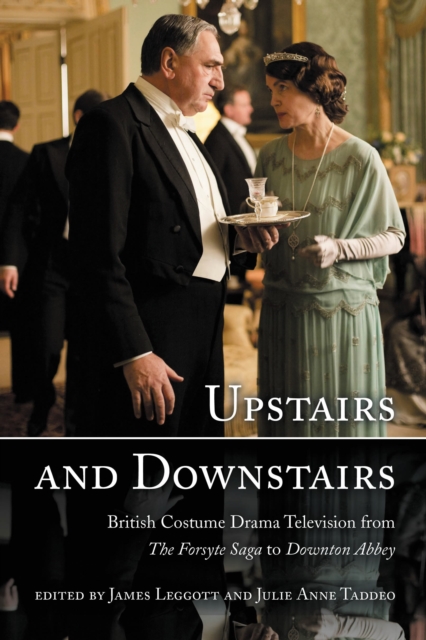
Upstairs and downstairs
The international success of Downton Abbey has led to a revived interest in period dramas, with older programs like The Forsyte Saga being rediscovered by a new generation of fans whose tastes also include grittier fare like Ripper Street. Though often criticized as a form of escapist, conservative nostalgia, these shows can also provide a lens to examine the class and gender politics of both the past and present. In Upstairs and Downstairs: British Costume Drama Television from The Forsyte Saga to Downton Abbey, James Leggott and Julie Anne Taddeo provide a collection of essays that analyze key developments in the history of period dramas from the late 1960s to the present day. Contributors explore such issues as how the genre fulfills and disrupts notions of “quality television,” the process of adaptation, the relationship between UK and U.S. television, and the connection between the period drama and wider developments in TV and popular culture. Additional essays examine how fans shape the content and reception of these dramas and how the genre has articulated or generated debates about gender, sexuality, and class. In addition to Downton Abbey and Upstairs, Downstairs, other programs discussed in this collection include Call the Midwife, Danger UXB, Mr. Selfridge, Parade’s End, Piece of Cake, and Poldark. Tracing the lineage of costume drama from landmark productions of the late 1960s and 1970s to some of the most talked-about productions of recent years, Upstairs and Downstairs will be of value to students, teachers, and researchers in the areas of film, television, Victorian studies, literature, gender studies, and British history and culture.
eBook


State of play
Robin Nelson's State of play up-dates and develops the arguments of his influential TV Drama In Transition (1997). It is equally distinctive in setting analusis of the aesethetics and compositional principles of texts within a broad conceptual framework (technologies, institutions, economics, cultural trends). Tracing \"the great value shift from conduit to content\" (Todreas, 1999), Nelson is relatively optimistic about the future quality of TV Drama in a global market-place. But, characteristically taking up questions of worth where others have avoided them, Nelson recognizes that certain types of \"quality\" are privileged for viewers able to pay, possibly at the expense of viewer preference worldwide for \"local\" resonances in television. The mix of arts and cultural studies methodologies makes for an unusual and insightful approach.
eBook

Remembering British television : audience, archive and industry
\"This original book asks how, in an age of convergence, when 'television' no longer means a box in the corner of the living room that we sit and watch together, do we remember television of the past? How do we gather and archive our memories? Kristyn Gordon and Joanne Garde-Hansen explore these questions through first person interviews with tv producers, curators and archivists, and case studies of popular television series and fan communities such as 'Cold Feet' and 'Doctor Who'. Their discussion takes in museum exhibitions, popular televison nostalgia programming and 'vintage' tv websites\"-- Provided by publisher.
Book
The Language of Television
The first part of this book assesses how television presents viewers with information - contrasting the 'official reality' of news and current affairs programmes with the anarchic view of the world put out by such as Morecambe and Wise and the two Ronnies. It challenges the politics of programme schedules and takes care to consider the language used in programs designed for different purposes.
The second, inspiring part contains accounts of three of the author's collaborative video projects which aimed to use the medium of video storytelling to access a different way of teaching. The third and most polemical part of the book explores more about education in relation to television and video. Originally published in 1981, it is a book about the way that television, through massive and constant reinforcement, made its own language the only language; and it presents the attempts - instructive, hilarious, occasionally quite touching - made by the author and students to discover other possible languages that television might use.
eBook