
Catalogue Search | MBRL


Are you sure you want to remove the book from the shelf?

{{itemTitle}}
683
result(s) for
"Television programs Psychological aspects."
Sort by:

Captive audience : on love and reality TV
\"In Lucas Mann's trademark vein--fiercely intelligent, self-deprecating, brilliantly observed, idiosyncratic, personal, funny, and infuriating--Captive Audience is an appreciation of reality television wrapped inside a love letter to his wife, with whom he shares the guilty pleasure of watching \"real\" people bare their souls in search of celebrity. Captive Audience resides at the intersection of popular culture with the personal; the exhibitionist impulse, with the schadenfreude of the vicarious, and in confronting some of our most suspect impulses achieves a heightened sense of what it means to live an authentic life and what it means to love a person.\"--Amazon.com.
Book

Reacting to Reality Television
The unremitting explosion of reality television across the schedules has become a sustainable global phenomenon generating considerable popular and political fervour.
The zeal with which television executives seize on the easily replicated formats is matched equally by the eagerness of audiences to offer themselves up as television participants for others to watch and criticise. But how do we react to so many people breaking down, fronting up, tearing apart, dominating, empathising, humiliating, and seemingly laying bare their raw emotion for our entertainment? Do we feel sad when others are sad? Or are we relieved by the knowledge that our circumstances might be better? As reality television extends into the experiences of the everyday, it makes dramatic and often shocking the mundane aspects of our intimate relations, inviting us as viewers into a volatile arena of mediated morality.
This book addresses the impact of this endless opening out of intimacy as an entertainment trend that erodes the traditional boundaries between spectator and performer demanding new tools for capturing television's relationships with audiences. Rather than asking how the reality television genre is interpreted as 'text' or representation the authors investigate the politics of viewer encounters as interventions, evocations, and more generally mediated social relations.
The authors show how different reactions can involve viewers in tournaments of value, as women viewers empathise and struggle to validate their own lives. The authors use these detailed responses to challenge theories of the self, governmentality and ideology.
A must read for both students and researchers in audience studies, television studies and media and communication studies.
eBook

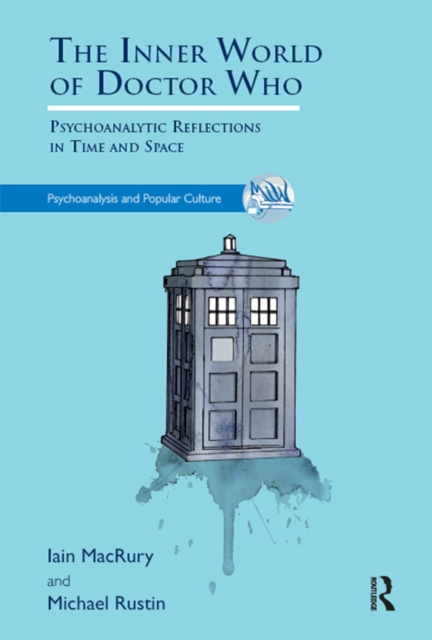
The Inner World of Doctor Who
As Doctor Who approaches its fiftieth anniversary recent series have taken the show to new heights in terms of popular appeal and critical acclaim.The Doctor and his TARDIS-driven adventures, along with companions and iconic monsters, are now recognised and enjoyed globally. The time is ripe for a detailed analytic assessment of this cultural phenomenon. Focussing on the most recent television output The Inner World of Doctor Who examines why the show continues to fascinate contemporary audiences. Presenting closely-observed psychoanalytic readings of selected episodes, this book examines why these stories of time travel, monsters, and complex human relationships have been successful in providing such an emotionally rich dramatization of human experience. The Inner World of Doctor Who seeks to explore the multiple cultural and emotional dimensions of the series, moving back and forth from behind the famous sofa, where children remember hiding from scary monsters, and onto the proverbial psychoanalytic couch.
eBook

Situation comedy, character, and psychoanalysis : on the couch with Lucy, Basil and Kimmie
Situation Comedy, Character and Psychoanalysis puts the sitcom character on the analyst's couch and closely examines the characters of Basil Fawlty, Lucy Ricardo and Kim from Australia's Kath & Kim, in order to reveal the essential elements that must exist in a sitcom before even the first joke is written. Original in its approach, D.T. Klika uncovers major findings about the sitcom as well as human behavior and relationships that we find 'arresting' and even \"familial\". By offering a new way of reading the sitcom using psychoanalytic theory, this book can be used as a basis for engaging in critical discourses as well as textual analysis of programs. Psychoanalytic theory enables a reading of character motivations and relationships, in turn elucidating the power struggle that exists between characters in this form of comedy. Situation Comedy, Character and Psychoanalysis shines a light on what is at play in the sitcom that makes us laugh, and why we love the characters we do, only to discover that this form of comedy is more complex than we first thought.
Book
Small screen, big feels : television and cultural anxiety in the twenty-first century
While television has always played a role in recording and curating history, shaping cultural memory, and influencing public sentiment, the changing nature of the medium in the post-network era finds viewers experiencing and participating in this process in new ways. They skim through commercials, live tweet press conferences and award shows, and tune into reality shows to escape reality. This new era, defined by the heightened anxiety and fear ushered in by 9/11, has been documented by our media consumption, production, and reaction.
In Small Screen, Big Feels, Melissa Ames asserts that TV has been instrumental in cultivating a shared memory of emotionally charged events unfolding in the United States since September 11, 2001. She analyzes specific shows and genres to illustrate the ways in which cultural fears are embedded into our entertainment in series such as The Walking Dead and Lost or critiqued through programs like The Daily Show. In the final section of the book, Ames provides three audience studies that showcase how viewers consume and circulate emotions in the post-network era: analyses of live tweets from Shonda Rhimes's drama, How to Get Away with Murder (2010–2020), ABC's reality franchises, The Bachelor (2002–present) and The Bachelorette (2003–present), and political coverage of the 2016 Presidential Debates.
Though film has been closely studied through the lens of affect theory, little research has been done to apply the same methods to television. Engaging an impressively wide range of texts, genres, media, and formats, Ames offers a trenchant analysis of how televisual programming in the United States responded to and reinforced a cultural climate grounded in fear and anxiety.
eBook


Girlfriends and Postfeminist Sisterhood
From Mean Girl to BFF, Girlfriends and Postfeminist Sisterhood explores female sociality in postfeminist popular culture. Focusing on a range of media forms, Alison Winch reveals how women are increasingly encouraged to strategically bond by controlling each other's body image through 'the girlfriend gaze'.
eBook

Feeding the monster : why horror has a hold on us
Zombies want brains. Vampires want blood. Cannibals want human flesh. All monsters need feeding. Horror has been embraced by mainstream pop culture more than ever before, with horror characters and aesthetics infecting TV, music videos and even TikTok trends. Yet even with the commercial and critical success of 'The Babadook', 'Hereditary', 'Get Out', 'The Haunting of Hill House', 'Yellowjackets' and countless other horror films and TV series over the last few years, loving the genre still prompts the question: what's wrong with you? Implying, of course, that there is something not quite right about the people who make and consume it. In 'Feeding the Monster', Anna Bogutskaya dispels this notion once and for all by examining how horror responds to and fuels our feelings of fear, anxiety, pain, hunger, and power.
BOOK

Individual EEG measures of attention, memory, and motivation predict population level TV viewership and Twitter engagement
Television (TV) programming attracts ever-growing audiences and dominates the cultural zeitgeist. Viewership and social media engagement have become standard indices of programming success. However, accurately predicting individual episode success or future show performance using traditional metrics remains a challenge. Here we examine whether TV viewership and Twitter activity can be predicted using electroencephalography (EEG) measures, which are less affected by reporting biases and which are commonly associated with different cognitive processes. 331 participants watched an hour-long episode from one of nine prime-time shows (~36 participants per episode). Three frequency-based measures were extracted: fronto-central alpha/beta asymmetry (indexing approach motivation), fronto-central alpha/theta power (indexing attention), and fronto-central theta/gamma power (indexing memory processing). All three EEG measures and the composite EEG score significantly correlated across episode segments with the two behavioral measures of TV viewership and Twitter volume. EEG measures explained more variance than either of the behavioral metrics and mediated the relationship between the two. Attentional focus was integral for both audience retention and Twitter activity, while emotional motivation was specifically linked with social engagement and program segments with high TV viewership. These findings highlight the viability of using EEG measures to predict success of TV programming and identify cognitive processes that contribute to audience engagement with television shows.
Journal Article