
Catalogue Search | MBRL


Are you sure you want to remove the book from the shelf?

{{itemTitle}}
66
result(s) for
"Temporal Clause"
Sort by:

Focus Construction with kî ʾim in Biblical Hebrew
This study uses modern linguistic theory to analyze a frequently recurring syntactic phenomenon in the Hebrew Bible that has thus far resisted explanation: כי אם.
The combination of the two particles כי and אם produces a construction that is notoriously difficult to describe, analyze syntactically, and translate. Dictionaries of Biblical Hebrew offer a dizzying variety of translations for this construction, including “that if,” “except,” “unless,” “but,” “but only,” and “surely,” among other possibilities. In this book, Grace J. Park provides a new approach that strives for greater precision and consistency in translation. Park argues that כי אם is used in three patterns: the “full focus” pattern, the “reduced focus” pattern, and the less common “non-focus” pattern. Her syntactic analysis of all 156 occurrences of the כי אם construction in the Bible lends greater clarity to the contested passages.
Drawing on recent linguistic research into the typology of clausal nominalization as well as previous work on contrastive focus, this innovative project provides important new insight into the syntax of Biblical Hebrew. It will be especially valuable for scholars seeking to translate כי אם more consistently and accurately.
eBook

\Before\ and \After\ without coercion: comment on the paper by Cleo Condoravdi
The following contribution was inspired by Cleo Condoravdi's article on NPI licensing in temporal clauses (Condoravdi 2010). Condoravdi gives a coherent and comprehensive account of before which crucially involves coercion of propositions to the earliest or maximal times at which the propositions are true, and a modal component for non-factual interpretations. I argue for a non-modal, non-coercive analysis of clauses like [A before B] as ¢ is the case when  has not been the case', triggering a conversational implicature that  will be the case later. I will also discuss temporal operators involving measure phrases, like three hours before.
Journal Article

Temporal clauses with the present indicative negated by μή in Ancient Greek
The article discusses the meaning of temporal clauses which contain a verb in the indicative with present reference, and specifically the negative forms of these clauses. The aim is to investigate whether and how the use of the negative μή in such clauses changes their meaning when compared to the formally identical clauses negated by οὐ. On the basis of a contextual analysis of several sentences found in classical Greek literature, regularly in non-narrative text, the article argues that, when using the negative word μή in a temporal clause with present indicative, the speaker indicates that he is not fully committed to the claim. However, when the verb in such a clause is negated by οὐ, the speaker treats the claim as an established fact. Thus, the choice of negative reflects different modal statuses of the respective utterances.
Journal Article

The Use of the Future Subjunctive in Colonial Spanish Texts: Evidence of Vitality or Demise?
This article examines the use of the future subjunctive in two corpora of colonial Mexican texts. The first corpus consists of 255 documents dated 1561–1646 pertaining primarily to the historical area of New Galicia and dealing with matters of the Real Audiencia of Guadalajara. The second consists of 191 documents dated 1681–1816 written in the altiplano central of Mexico, which covers a large geographical area from Mexico City to Zacatecas. After describing the syntactic distribution of the future subjunctive in Medieval Spanish, we examine the evidence of its patterns of usage in Peninsular Spanish in the sixteenth and seventeenth centuries. From there, we analyze the quantitative and qualitative data related to the 428 tokens of -re forms found in our corpora and the syntactic structures in which they appear. The data support findings that the future subjunctive first fell out of use in temporal adverbial clauses, while exhibiting the most apparent productivity in relative clauses. However, the corpora examined provide no evidence that the paradigm survived longer in Latin American Spanish than in Peninsular Spanish, as has been argued. Rather, this study suggests that by the eighteenth century, the future subjunctive was a highly stylized marker of formality or politeness in written Spanish.
Journal Article
Logical Spaces and Subjunctive Tenses
Apparently, Subjunctive tenses express temporal location, and, in some constructions, the past subjunctive can also express modal values. A long-standing debate exists over whether—even in the latter case—verbal tenses are temporal operators or whether in some constructions they convey temporal meaning, and in others they have a modal value, maybe derived from their basic temporal meaning. The assumption that the basic meaning of subjunctive tenses are of a temporal nature is challenged by the fact that the future subjunctive, which exists in Portuguese, has the same temporal interpretation as the present subjunctive, with which it is in complementary distribution. Moreover, no clear modal difference is observed between the future and present subjunctive tenses. In this paper, I present arguments against the separation of the temporal and modal values of the subjunctive tenses. I posit, instead, that a semantic analysis of subjunctive morphemes must consider ordered pairs of times and possible worlds; only in this way can we adequately capture the observed data and allow a comprehensive view of the system of subjunctive tenses in Portuguese (which will be extendable to Romance languages in general). If we accept this proposal, then the modal as temporal information associated with subjunctive tenses follows naturally, including the systematic futurate reading of subjunctive temporal clauses.
Journal Article

The Expression of Time in Amahuaca Switch-Reference Clauses
Many languages of lowland South America mark remoteness distinctions in their TAM systems. In Amahuaca (Panoan; Peru) multiple remoteness distinctions are made in the past and the future. I argue that the temporal remoteness morphemes (TRMs) of Amahuaca can be understood as indications of the remoteness of the event time relative to the utterance time in matrix environments. In dependent clauses, however, the picture is more complicated. By exploring adjunct switch-reference clauses, I show that TRMs in dependent clauses display a previously unreported ambiguity reminiscent of ambiguities found with adjunct tense. Specifically, they can relate the time of the adjunct clause event to the time of the matrix event or to the utterance time. I suggest that this ambiguity may arise from the availability of multiple interpretation sites for adjunct TRMs, with the possible interpretations being constrained by the temporal semantics of switch-reference markers themselves. This work thus contributes to the empirical understanding of how TRMs are interpreted in dependent clauses, suggesting interesting potential parallels to the interpretation of adjunct tense.
Journal Article
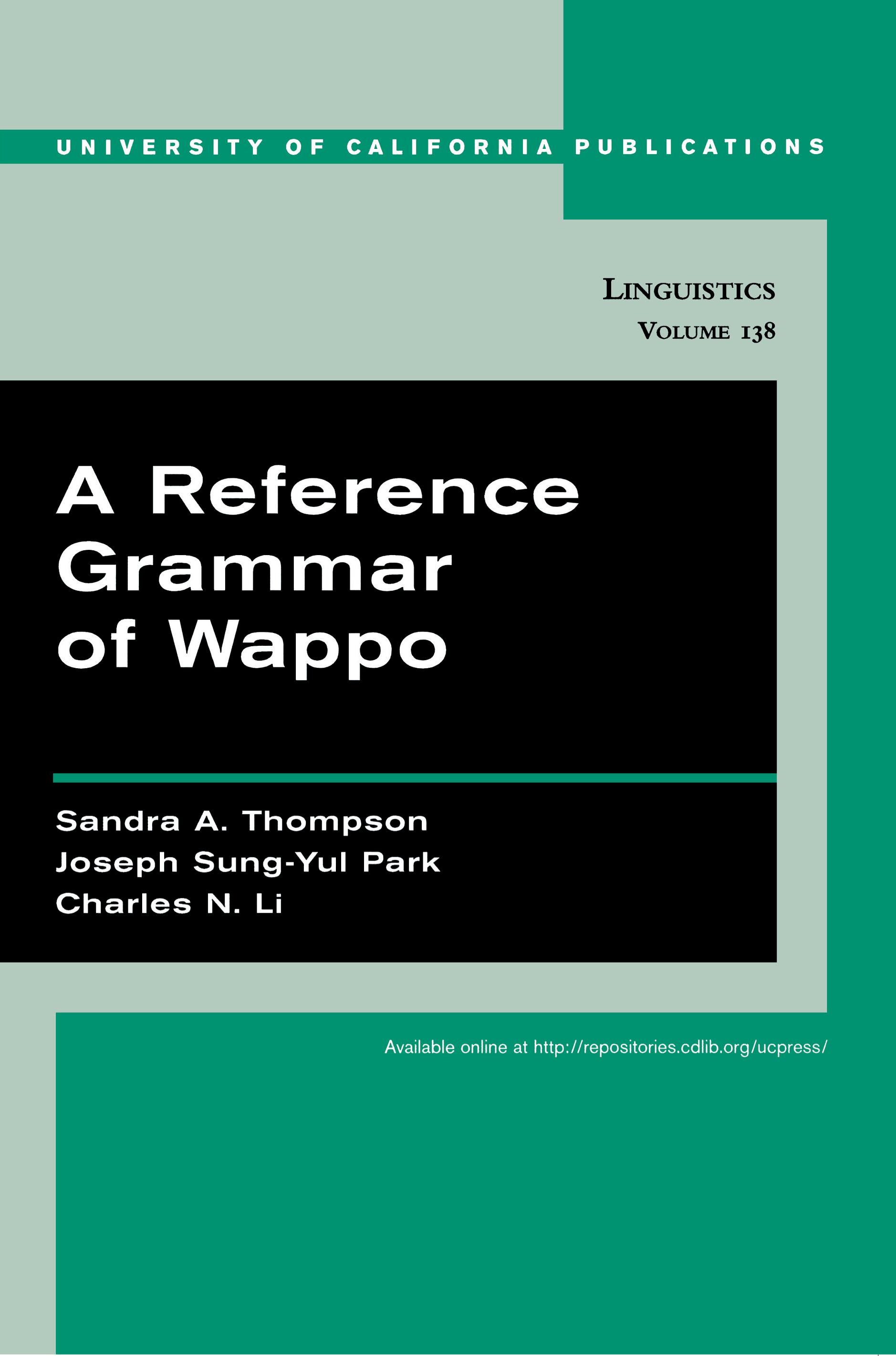
A Reference Grammar of Wappo
Wappo is an indigenous language, generally regarded as a language isolate, which was once spoken in the Russian River Valley, just north of San Francisco, California. This reference grammar is based on the speech of Laura Fish Somersal, its last fluent speaker, who died in 1990, and represents the most extensive data and grammatical research ever done on this language. The grammar focuses on morphosyntax, particularly nominal, verbal, and clausal structures and clause combining patterns, from a functional/typological perspective.
eBook

Estonian conditional clauses: The degree of hypotheticality and the link to temporal and concessive clauses
Estonian conditional clauses have previously been divided into two clear-cut groups: real and unreal, with indicative and conditional main verbs of conditional clauses, respectively. This article defends the view that it is a question of the degree of hypotheticality that a sentence conveys, and it treats hypotheticality as a continuum that includes groups of linguistic forms, which have a relatively clear core and are separated by fuzzy transition areas. Secondly, the article concentrates on the relationship between Estonian conditional clauses and temporal clauses. As these clause types have the same marker (kui), the article discusses whether it is always possible to distinguish between these two clauses and which factors are relevant for determining whether the clause is a temporal or conditional one. Thirdly, the relationship between Estonian conditional and concessive clauses is under consideration, focusing particularly on Estonian scalar concessive conditional clauses.
Journal Article

A Development Study on the Ordering Distribution of Temporal Adverbial Clauses by Chinese EFL Learners Based on Dependency Treebank
Temporal adverbial clause is an important language structure and exhibits different features in English and Chinese, which brings about difficulties for Chinese EFL learners. Based on the theory of Dependency Grammar, the study attempts to investigate the ordering distribution of temporal adverbial clauses by Chinese EFL learners at the beginning, intermediate and advanced levels. The results show that: 1) Chinese EFL learners at different proficiencies tend to precede temporal adverbial clause to main clause. With the increase of proficiency, the postposition of temporal adverbial clauses by learners increases and is approaching to the ordering preference of target language. 2) The ordering distribution of subordinators for temporal adverbial clauses by Chinese EFL learners is consistent with native English, showing a tendency of 100% preposition, which ascribes to the high frequency and salience of subordinators in English. 3) MDD is one of the significant motivations that cause the preference of prepositional temporal adverbial clauses by Chinese EFL learners. As a kind of natural language, interlanguage has a unique cognitive mechanism which distinguishes from both native and target language. This study provides a more comprehensive theoretical reference for learners at different proficiencies to understand and learn temporal adverbial clauses, as well as data support from empirical research for language teaching.
Journal Article