
Catalogue Search | MBRL


Are you sure you want to remove the book from the shelf?

{{itemTitle}}
34,419
result(s) for
"Tennessee"
Sort by:

Long man : a novel
Refusing to evacuate their East Tennessee hometown that is being flooded by a newly constructed dam, Annie Clyde Dodson battles with her husband, who wishes to start over elsewhere, only to begin a frantic search when their toddler goes missing.
Book

Tried Men and True, or Union Life in Dixie
Tried Men and True, or Union Life in Dixie is the
memoir of a Union supporter in south-central Tennessee. In it,
he chronicles in vivid and emotional detail the local tensions
between Unionists and Confederates during the Civil War South
and offers a rare first-person account of the guerrilla war
that devastated Western Tennessee.
Thomas Jefferson Cypert (1827-1918) was a staunch Union man
of Wayne County, Tennessee. In 1863, he helped organize the
Second Tennessee Mounted Infantry, a regiment of loyalist
Southerners enlisted to combat Confederate cavalry in West
Tennessee and Northern Alabama.
Tried Men and True is Cypert’s memoir of his
time as Captain of Company A, including his capture by
Confederate cavalry and subsequent daring escape, in which he
was aided by local Union sympathizers and slaves.
After the Civil War, Cypert served two terms in the
Tennessee State Senate, one of them during the heated first
years of Reconstruction, when Tennessee disenfranchised former
rebels and attempted to establish Unionist Republican rule in
the state. Cypert clearly wrote his memoir to defend Unionism,
condemn secession and rebellion, and support loyalists’
claims for post-war power through an account of their wartime
sacrifices. Never before published, the manuscript has been
preserved in nearly perfect condition by Cypert’s
descendants over the generations. This book is a remarkable and
engagingly written account of resistance to the Confederacy by
a group of southwestern Tennessee loyalists.
eBook


Archaeology of the Southern Appalachians and Adjacent Watersheds
This book presents archaeology addressing all periods in the Native Southeast as a tribute to the career of Jefferson Chapman, longtime director of the Frank H. McClung Museum of Natural History and Culture at the University of Tennessee, Knoxville. Written by Chapman's colleagues and former students, the chapters add to our current understanding of early native southeastern peoples as well as Chapman's original work and legacy to the field of archaeology. Some chapters review, reevaluate, and reinterpret archaeological evidence using new data, contemporary methods, or alternative theoretical perspectives—something that Chapman, too, fostered throughout his career. Others address the history and significance of archaeological collections curated at the Frank H. McClung Museum of Natural History and Culture, where Chapman was the director for nearly thirty years. The essays cover a broad range of archaeological material studies and methods and in doing so carry forth Chapman's legacy.
eBook

Generational Poverty
Are the impoverished victims of circumstance or are they contributing to their situations through their own actions and principles? This perplexing question does not have a simple answer. \"Generational Poverty: An Economic Look at the Culture of the Poor\" examines both sides of the coin. Written by an economist, the book provides a unique perspective into the study of this emotionally-charged issue. It shows that economic analysis can shed light on some of the roots of persistent poverty and may point to its potential solution. Generational Poverty covers the author's eye-opening experiences with a young man named Jermaine and his family, initiated through the Big Brothers Big Sisters (BBBS) program. As someone who cares for Jermaine and his family, it was nothing short of a surprise to see first-hand some of the obstacles Jermaine's family are creating for themselves, while at the same time battling many of today's social constructs. In the course of the program, the author learned a great deal about Jermaine's life, culture, and the obstacles he faces. This work identifies impediments that Jermaine has experienced as well as common challenges faced in his community. In the words of the author: \"Most of my research for this book is devoted to pinpointing these cultural issues and gathering varying opinions for each one. While I do detail each unique perspective, my goal is to align each argument to an economic fundamental. This creates a more consistent diagnosis that does not depend on a personal set of values. My hope is that future economists will continue to study this suffering portion of our population to determine the most effective way to remedy the continuingly increasing problem of poverty.\".
eBook

Race, economics, and the politics of educational change : the dynamics of school consolidation in Shelby County, Tennessee
\"This edited volume will examine the implications of the largest school consolidation in the history of the United States, the Memphis school system. In the wake of the 2010 mid-term elections, the Republican Party gained control of both houses of the Tennessee State Legislature and the governorship. In Memphis, the immediate aftermath was that leaders of the Shelby County Schools (SCS) school district began to work on legislation that would give the district special status that would make it permanently separated from the other school district in the city, Memphis City Schools (MCS). Long a goal of the predominately white, suburban SCS, this objective was thwarted when the MCS revoked its own charter, which, under Tennessee law, forced SCS to take over the running of MCS--in effect, consolidating all Memphis area schools. This work will examine the history of the Memphis school system, the economic factors that arise in consolidations, the socioeconomic inequalities borne of long-term racism that lie in the background of the system's recent history, and the political situation that promises to complicate the consolidation process\"-- Provided by publisher.
Book
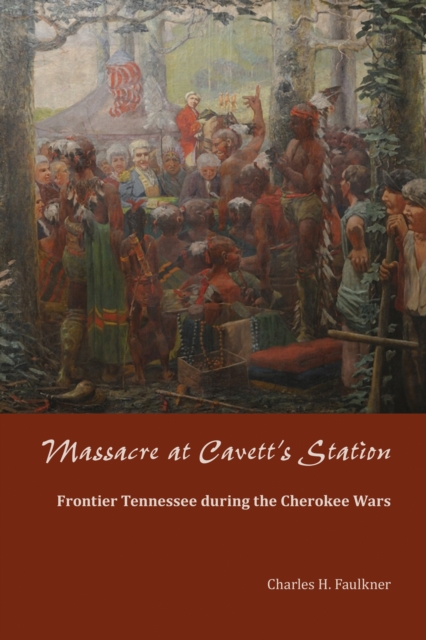
Massacre at Cavett's Station
In the late 1700s, as white settlers spilled across the
Appalachian Mountains, claiming Cherokee and Creek lands for
their own, tensions between Native Americans and pioneers reached
a boiling point. Land disputes stemming from the 1791 Treaty of
Holston went unresolved, and Knoxville settlers attacked a
Cherokee negotiating party led by Chief Hanging Maw resulting in
the wounding of the chief and his wife and the death of several
Indians. In retaliation, on September 25, 1793, nearly one
thousand Cherokee and Creek warriors descended undetected on
Knoxville to destroy this frontier town. However, feeling they
had been discovered, the Indians focused their rage on
Cavett’s Station, a fortified farmstead of Alexander Cavett
and his family located in what is now west Knox County. Violating
a truce, the war party murdered thirteen men, women, and
children, ensuring the story’s status in Tennessee lore. In
Massacre at Cavett’s Station , noted archaeologist
and Tennessee historian Charles Faulkner reveals the true story
of the massacre and its aftermath, separating historical fact
from pervasive legend. In doing so, Faulkner focuses on the
interplay of such early Tennessee stalwarts as John Sevier, James
White, and William Blount, and the role each played in the white
settlement of east Tennessee while drawing the ire of the
Cherokee who continued to lose their homeland in questionable
treaties. That enmity produced some of history’s notable
Cherokee war chiefs including Doublehead, Dragging Canoe, and the
notorious Bob Benge, born to a European trader and Cherokee
mother, whose red hair and command of English gave him a distinct
double identity. But this conflict between the Cherokee and the
settlers also produced peace-seeking chiefs such as Hanging Maw
and Corn Tassel who helped broker peace on the Tennessee frontier
by the end of the 18th century. After only three decades of
peaceful co-existence with their white neighbors, the now
democratic Cherokee Nation was betrayed and lost the remainder of
their homeland in the Trail of Tears. Faulkner combines careful
historical research with meticulous archaeological excavations
conducted in developed areas of the west Knoxville suburbs to
illuminate what happened on that fateful day in 1793. As a
result, he answers significant questions about the massacre and
seeks to discover the genealogy of the Cavetts and if any family
members survived the attack. This book is an important
contribution to the study of frontier history and a long-overdue
analysis of one of East Tennessee’s well-known
legends.
eBook

The Tennessee walking horse
The Tennessee Walking Horse is most popular in trail riding. With its smooth gait and relaxed temperament, it is an easy and enjoyable horse for people to ride. Hit the trails and read all about this breeds history, physical characteristics, and what it is used for today.
Book

You Must Be from the North
\"You must be from the North,\" was a common, derogatory reaction to the activities of white women throughout the South, well-meaning wives and mothers who joined together to improve schools or local sanitation but found their efforts decried as more troublesome civil rights agitation.You Must Be from the North: Southern White Women in the Memphis Civil Rights Movementfocuses on a generation of white women in Memphis, Tennessee, born between the two World Wars and typically omitted from the history of the civil rights movement. The women for the most part did not jeopardize their lives by participating alongside black activists in sit-ins and freedom rides. Instead, they began their journey into civil rights activism as a result of their commitment to traditional female roles through such organizations as the Junior League. What originated as a way to do charitable work, however, evolved into more substantive political action.
While involvement with groups devoted to feeding schoolchildren and expanding Bible study sessions seemed benign, these white women's growing awareness of racial disparities in Memphis and elsewhere caused them to question the South's hierarchies in ways many of their peers did not. Ultimately, they found themselves challenging segregation more directly, found themselves ostracized as a result, and discovered they were often distrusted by a justifiably suspicious black community. Their newly discovered commitment to civil rights contributed to the success of the city's sanitation workers' strike of 1968. Dr. Martin Luther King, Jr.'s death during the strike resonated so deeply that for many of these women it became a defining moment. In the long term, these women proved to be a persistent and progressive influence upon the attitudes of the white population of Memphis, and particularly on the city's elite.
eBook