
Catalogue Search | MBRL


Are you sure you want to remove the book from the shelf?

{{itemTitle}}
393
result(s) for
"Tennessee (Nashville)"
Sort by:


Nashville in the New Millennium
Beginning in the 1990s, the geography of Latino migration to and within the United States started to shift. Immigrants from Central and South America increasingly bypassed the traditional gateway cities to settle in small cities, towns, and rural areas throughout the nation, particularly in the South. One popular new destination-Nashville, Tennessee-saw its Hispanic population increase by over 400 percent between 1990 and 2000. Nashville, like many other such new immigrant destinations, had little to no history of incorporating immigrants into local life. How did Nashville, as a city and society, respond to immigrant settlement? How did Latino immigrants come to understand their place in Nashville in the midst of this remarkable demographic change? InNashville in the New Millennium, geographer Jamie Winders offers one of the first extended studies of the cultural, racial, and institutional politics of immigrant incorporation in a new urban destination.
Moving from schools to neighborhoods to Nashville's wider civic institutions,Nashville in the New Millenniumdetails how Nashville's long-term residents and its new immigrants experienced daily life as it transformed into a multicultural city with a new cosmopolitanism. Using an impressive array of methods, including archival work, interviews, and participant observation, Winders offers a fine-grained analysis of the importance of historical context, collective memories and shared social spaces in the process of immigrant incorporation. Lacking a shared memory of immigrant settlement, Nashville's long-term residents turned to local history to explain and interpret a new Latino presence. A site where Latino day laborers gathered, for example, became a flashpoint in Nashville's politics of immigration in part because the area had once been a popular gathering place for area teenagers in the 1960s and 1970s. Teachers also drew from local historical memories, particularly the busing era, to make sense of their newly multicultural student body. They struggled, however, to help immigrant students relate to the region's complicated racial past, especially during history lessons on the Jim Crow era and the Civil Rights movement. When Winders turns to life in Nashville's neighborhoods, she finds that many Latino immigrants opted to be quiet in public, partly in response to negative stereotypes of Hispanics across Nashville. Long-term residents, however, viewed this silence as evidence of a failure to adapt to local norms of being neighborly.
Filled with voices from both long-term residents and Latino immigrants,Nashville in the New Millenniumoffers an intimate portrait of the changing geography of immigrant settlement in America. It provides a comprehensive picture of Latino migration's impact on race relations in the country and is an especially valuable contribution to the study of race and ethnicity in the South.
eBook

Generational Poverty
Are the impoverished victims of circumstance or are they contributing to their situations through their own actions and principles? This perplexing question does not have a simple answer. \"Generational Poverty: An Economic Look at the Culture of the Poor\" examines both sides of the coin. Written by an economist, the book provides a unique perspective into the study of this emotionally-charged issue. It shows that economic analysis can shed light on some of the roots of persistent poverty and may point to its potential solution. Generational Poverty covers the author's eye-opening experiences with a young man named Jermaine and his family, initiated through the Big Brothers Big Sisters (BBBS) program. As someone who cares for Jermaine and his family, it was nothing short of a surprise to see first-hand some of the obstacles Jermaine's family are creating for themselves, while at the same time battling many of today's social constructs. In the course of the program, the author learned a great deal about Jermaine's life, culture, and the obstacles he faces. This work identifies impediments that Jermaine has experienced as well as common challenges faced in his community. In the words of the author: \"Most of my research for this book is devoted to pinpointing these cultural issues and gathering varying opinions for each one. While I do detail each unique perspective, my goal is to align each argument to an economic fundamental. This creates a more consistent diagnosis that does not depend on a personal set of values. My hope is that future economists will continue to study this suffering portion of our population to determine the most effective way to remedy the continuingly increasing problem of poverty.\".
eBook


The Nashville Way
Among Nashville's many slogans, the one that best reflects its emphasis on manners and decorum is the Nashville Way, a phrase coined by boosters to tout what they viewed as the city's amicable race relations. Benjamin Houston offers the first scholarly book on the history of civil rights in Nashville, providing new insights and critiques of this moderate progressivism for which the city has long been credited. Civil rights leaders such as John Lewis, James Bevel, Diane Nash, and James Lawson who came into their own in Nashville were devoted to nonviolent direct action, or what Houston calls the \"black Nashville Way.\" Through the dramatic story of Nashville's 1960 lunch counter sit-ins, Houston shows how these activists used nonviolence to disrupt the coercive script of day-to-day race relations. Nonviolence brought the threat of its opposite-white violence- into stark contrast, revealing that the Nashville Way was actually built on a complex relationship between etiquette and brute force. Houston goes on to detail how racial etiquette forged in the era of Jim Crow was updated in the civil rights era. Combined with this updated racial etiquette, deeper structural forces of politics and urban renewal dictate racial realities to this day. In The Nashville Way, Houston shows that white power was surprisingly adaptable. But the black Nashville Way also proved resilient as it was embraced by thousands of activists who continued to fight battles over schools, highway construction, and economic justice even after most Americans shifted their focus to southern hotspots like Birmingham and Memphis.
eBook


Air Castle of the South
Started by the National Life and Accident Insurance Company in 1925, WSM became one of the most influential and exceptional radio stations in the history of broadcasting and country music. WSM gave Nashville the moniker \"Music City USA\" as well as a rich tradition of music, news, and broad-based entertainment. With the rise of country music broadcasting and recording between the 1920s and '50s, WSM, Nashville, and country music became inseparable, stemming from WSM's launch of the Grand Ole Opry, popular daily shows like Noontime Neighbors, and early morning artist-driven shows such as Hank Williams on Mother's Best Flour. _x000B__x000B_Sparked by public outcry following a proposal to pull country music and the Opry from WSM-AM in 2002, Craig Havighurst scoured new and existing sources to document the station's profound effect on the character and self-image of Nashville. Introducing the reader to colorful artists and businessmen from the station's history, including Owen Bradley, Minnie Pearl, Jim Denny, Edwin Craig, and Dinah Shore, the volume invites the reader to reflect on the status of Nashville, radio, and country music in American culture._x000B_
eBook

A dream of the future : race, empire, and modernity at the Atlanta and Nashville world's fairs
\"'A Dream of the Future: Race, Empire, and Modernity at the Atlanta and Nashville World's Fairs' examines how southerners at the end of the nineteenth century worked through the major questions facing a nation undergoing profound change. In an age of empire and industry, southerners grappled with what it meant to be modern. At the 1895 Cotton States and International Exposition held in Atlanta and the 1897 Tennessee Centennial Exposition held in Nashville, they attempted to understand how their region could be industrial and imperial on its own terms. On a local, national, and global stage, African Americans, New South boosters, New Women, and Civil War veterans presented their dreams of the future. They aimed to prove to the world how rapidly the South had embraced and built, in the words of Henry Grady in 1890, 'from pitiful resources a great and expanding empire.' The Atlanta and Nashville world's fairs were spaces in which southerners presented themselves as modern and imperial citizens ready to spread the South's culture and racial politics across the globe. This work connects the South to a global conversation in the late nineteenth century over how to include peoples deemed fit for labor but unfit for citizenship\"-- Provided by publisher.
Book
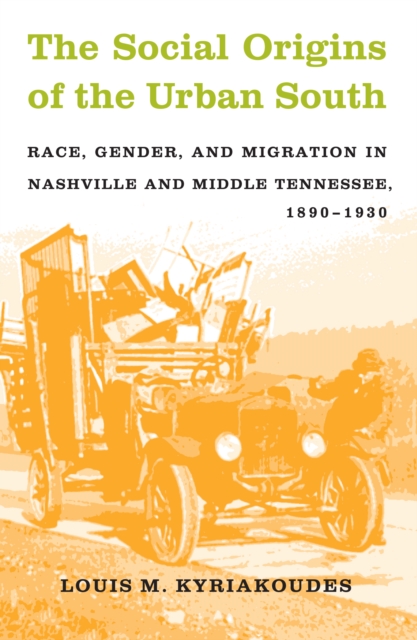
The social origins of the urban South : race, gender, and migration in Nashville and middle Tennessee, 1890-1930
In the late nineteenth and early twentieth centuries, millions of black and white southerners left farms and rural towns to try their fate in the region's cities. This transition brought about significant economic, social, and cultural changes in both urban centers and the countryside. Focusing on Nashville and its Middle Tennessee hinterland, Louis Kyriakoudes explores the impetus for this migration and illuminates its effects on regional development.
Kyriakoudes argues that increased rural-to-urban migration in the late nineteenth century grew out of older seasonal and circular migration patterns long employed by southern farm families. These mobility patterns grew more urban-oriented and more permanent as rural blacks and whites turned increasingly to urban migration in order to cope with rapid economic and social change.
The urban economy was particularly welcoming to women, offering freedom from the male authority that dominated rural life. African Americans did not find the same freedoms, however, as whites found ways to harness the forces of modernization to deny them access to economic and social opportunity. By linking urbanization, economic and social change, and popular cultural institutions, Kyriakoudes lends insight into the development of an urban, white, working-class identity that reinforced racial divisions and laid the demographic and social foundations for today's modern, urban South.
eBook