
Catalogue Search | MBRL


Are you sure you want to remove the book from the shelf?

{{itemTitle}}
3,084
result(s) for
"Terminal Care - ethics"
Sort by:

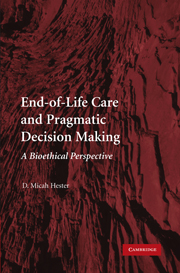
End-of-Life Care and Pragmatic Decision Making
Every one of us will die, and the processes we go through will be our own - unique to our own experiences and life stories. End-of-Life Care and Pragmatic Decision Making provides a pragmatic philosophical framework based on a radically empirical attitude toward life and death. D. Micah Hester takes seriously the complexities of experiences and argues that when making end-of-life decisions, healthcare providers ought to pay close attention to the narratives of patients and the communities they inhabit so that their dying processes embody their life stories. He discusses three types of end-of-life patient populations - adults with decision-making capacity, adults without capacity, and children (with a strong focus on infants) - to show the implications of pragmatic empiricism and the scope of decision making at the end of life for different types of patients.
eBook

Finishing our story : preparing for the end of life
\"Death is the destiny we all share, and this will not change. Yet the way we die, which had remained the same for many generations, has changed drastically in a relatively short time for those in developed countries with access to healthcare. For generations, if people were lucky enough to reach old age, not having died in infancy or childhood, in childbirth, in war, or by accident, they would take to bed, surrounded by loved ones who cared for them, and fade into death. Most likely, they would have seen their parents and grandparents die the same way, and so this manner of dying would be familiar: it was part of the natural cycle of life. Now less than 25 per cent of Americans die at home, having reached much older ages than people would have dreamed of in past generations, often after surviving many illnesses and even diseases that would have been terminal for their grandparents. We are fortunate to live (and die) today, supported by myriad scientific, medical, and technological advancements, however we also face new problems as a result of the new way in which we die. We can no longer anticipate a peaceful waning at home with family. We know our lives will likely end in hospitals likely after we have endured grueling treatments to prolong life. We have to decide what decisions we want our loved ones, or care-givers, to make when we cannot choose for ourselves. We have to think about whether in any circumstances we would seek physician-assisted death. We know we face other questions as well, but we may not even know where to start. In the face of these decisions, we can feel daunted and afraid. The best remedy is information and planning. In this book, Gregory Eastwood - a physician who has cared for dying patients, served as an ethics consultant, and taught end of life issues to medical and other health profession students - draws from his substantial experience with patients and families to provide the information that will help us think clearly about the choices and issues we will face at the end of our own lives, and when faced with the deaths of our loved ones. With sensitivity and profound insight, Eastwood guides us through all the important questions about death and dying in straightforward, clear language, enhanced by real-life stories. Throughout, he shows us how we can take ownership of the way we want to die, when we must die, and feel more in control as death approaches. \"-- Provided by publisher.
Book

The luck of the draw: physician-related variability in end-of-life decision-making in intensive care
Purpose
To critically analyze physician-related variability in end-of-life decision-making in intensive care.
Methods
An ethical analysis of factors contributing to physician-related variability in end-of-life decision-making.
Results
There is variability in decision-making about life support, both within and between intensive care units. Physician age, race, religion, attitude to risk, and personality factors have been associated with decisions to provide or limit life-sustaining treatment, though it is unclear how much these factors affect patient outcome. Inconsistency in decision-making appears worryingly arbitrary, and may mean that patients’ values are sometimes being ignored or overridden. However, physician influence on decisions may also sometimes be appropriate and unavoidable, particularly where patient values are unclear.
Conclusions
We argue that, although physician-related variability in end-of-life care can never be eliminated entirely, it is potentially ethically problematic. We outline four potential strategies for reducing the “roster lottery.”
Journal Article

The anticipatory corpse : medicine, power, and the care of the dying
\"In this original and compelling book, Jeffrey P. Bishop, a philosopher, ethicist, and physician, argues that something has gone sadly amiss in the care of the dying by contemporary medicine and in our social and political views of death, as shaped by our scientific successes and ongoing debates about euthanasia and the \"right to die\"--or to live. The Anticipatory Corpse: Medicine, Power, and the Care of the Dying, informed by Foucault's genealogy of medicine and power as well as by a thorough grasp of current medical practices and medical ethics, argues that a view of people as machines in motion--people as, in effect, temporarily animated corpses with interchangeable parts--has become epistemologically normative for medicine. The dead body is subtly anticipated in our practices of exercising control over the suffering person, whether through technological mastery in the intensive care unit or through the impersonal, quasi-scientific assessments of psychological and spiritual \"medicine.\" The result is a kind of nihilistic attitude toward the dying, and troubling contradictions and absurdities in our practices. Wide-ranging in its examples, from organ donation rules in the United States, to ICU medicine, to \"spiritual surveys,\" to presidential bioethics commissions attempting to define death, and to high-profile cases such as Terri Schiavo's, The Anticipatory Corpse explores the historical, political, and philosophical underpinnings of our care of the dying and, finally, the possibilities of change. A ground-breaking work in bioethics, this book will provoke thought and argument for all those engaged in medicine, philosophy, theology, and health policy.\"With extraordinary philosophical sophistication as well as knowledge of modern medicine, Bishop argues that the body that shapes the work of modern medicine is a dead body. He defends this claim decisively with with urgency. I know of no book that is at once more challenging and informative as The Anticipatory Corpse. To say this book is the most important one written in the philosophy of medicine in the last twenty-five years would not do it justice. This book is destined to change the way we think and, hopefully, practice medicine.\" -Stanley Hauerwas, Duke Divinity School \"Jeffrey Bishop carefully builds a detailed, scholarly case that medicine is shaped by its attitudes toward death. Clinicians, ethicists, medical educators, policy makers, and administrators need to understand the fraught relationship between clinical practices and death, and The Anticipatory Corpse is an essential text. Bishop's use of the writings of Michel Foucault is especially provocative and significant. This book is the closest we have to a genealogy of death.\" Arthur W. Frank, University of Calgary \"Jeffrey Bishop has produced a masterful study of how the living body has been placed within medicine's metaphysics of efficient causality and within its commitment to a totalizing control of life and death, which control has only been strengthened by medicine's taking on the mantle of a bio-psycho-socio-spiritual model. This volume's treatment of medicine's care of the dying will surely be recognized as a cardinal text in the philosophy of medicine.\" H. Tristram Engelhardt, Jr., Rice University, Baylor College of Medicine\"--Provided by publisher.
Book

The anticipatory corpse : medicine, power, and the care of the dying
In this original and compelling book, Jeffrey P. Bishop, a philosopher, ethicist, and physician, argues that something has gone sadly amiss in the care of the dying by contemporary medicine and in our social and political views of death, as shaped by our scientific successes and ongoing debates about euthanasia and the \"right to die\"—or to live. The Anticipatory Corpse: Medicine, Power, and the Care of the Dying, informed by Foucault's genealogy of medicine and power as well as by a thorough grasp of current medical practices and medical ethics, argues that a view of people as machines in motion—people as, in effect, temporarily animated corpses with interchangeable parts—has become epistemologically normative for medicine. The dead body is subtly anticipated in our practices of exercising control over the suffering person, whether through technological mastery in the intensive care unit or through the impersonal, quasi-scientific assessments of psychological and spiritual \"medicine.\" The result is a kind of nihilistic attitude toward the dying, and troubling contradictions and absurdities in our practices. Wide-ranging in its examples, from organ donation rules in the United States, to ICU medicine, to \"spiritual surveys,\" to presidential bioethics commissions attempting to define death, and to high-profile cases such as Terri Schiavo's, The Anticipatory Corpse explores the historical, political, and philosophical underpinnings of our care of the dying and, finally, the possibilities of change. This book is a ground-breaking work in bioethics. It will provoke thought and argument for all those engaged in medicine, philosophy, theology, and health policy.
eBook
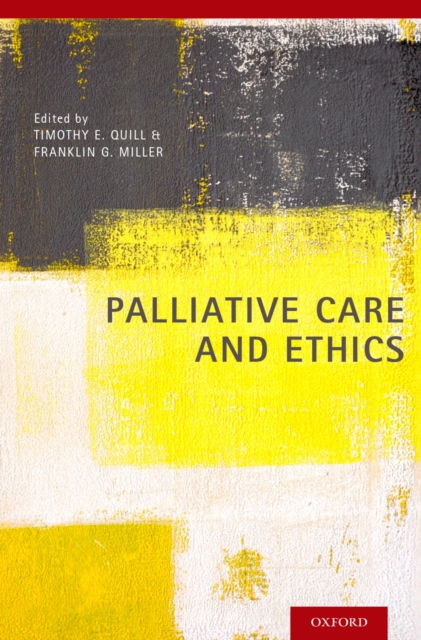
Palliative Care and Ethics
The practice of palliative care and hospice is filled with overt and sometimes covert ethical challenges. These challenges are addressed by leading international palliative care and hospice scholars under three main domains: care delivery systems; addressing the many dimensions of suffering; and difficult decisions near the end of life.
eBook
Reasons, considerations, difficulties and documentation of end-of-life decisions in European intensive care units: the ETHICUS Study
Objective
To evaluate physicians' reasoning, considerations and possible difficulties in end-of-life decision-making for patients in European intensive care units (ICUs).
Design
A prospective observational study.
Setting
Thirty-seven ICUs in 17 European countries.
Patients and participants
A total of 3,086 patients for whom an end-of-life decision was taken between January 1999 and June 2000. The dataset excludes patients who died after attempts at cardiopulmonary resuscitation and brain-dead patients.
Measurements and results
Physicians indicated which of a pre-determined set of reasons for, considerations in, and difficulties with end-of-life decision-making was germane in each case as it arose. Overall, 2,134 (69%) of the decisions were documented in the medical record, with inter-regional differences in documentation practice. Primary reasons given by physicians for the decision mostly concerned the patient's medical condition (79%), especially unresponsive to therapy (46%), while chronic disease (12%), quality of life (4%), age (2%) and patient or family request (2%) were infrequent. Good medical practice (66%) and best interests (29%) were the commonest primary considerations reported, while resource allocation issues such as cost effectiveness (1%) and need for an ICU bed (0%) were uncommon. Living wills were considered in only 1% of cases. Physicians in central Europe reported no significant difficulty in 81% of cases, while in northern and southern regions there was no difficulty in 92–93% of cases.
Conclusions
European ICU physicians do not experience difficulties with end-of-life decisions in most cases. Allocation of limited resources is a minor consideration and autonomous choices by patient or family remain unusual. Inter-regional differences were found.
Journal Article

Seeking Worldwide Professional Consensus on the Principles of End-of-Life Care for the Critically Ill. The Consensus for Worldwide End-of-Life Practice for Patients in Intensive Care Units (WELPICUS) Study
Abstract
Great differences in end-of-life practices in treating the critically ill around the world warrant agreement regarding the major ethical principles. This analysis determines the extent of worldwide consensus for end-of-life practices, delineates where there is and is not consensus, and analyzes reasons for lack of consensus. Critical care societies worldwide were invited to participate. Country coordinators were identified and draft statements were developed for major end-of-life issues and translated into six languages. Multidisciplinary responses using a web-based survey assessed agreement or disagreement with definitions and statements linked to anonymous demographic information. Consensus was prospectively defined as >80% agreement. Definitions and statements not obtaining consensus were revised based on comments of respondents, and then translated and redistributed. Of the initial 1,283 responses from 32 countries, consensus was found for 66 (81%) of the 81 definitions and statements; 26 (32%) had >90% agreement. With 83 additional responses to the original questionnaire (1,366 total) and 604 responses to the revised statements, consensus could be obtained for another 11 of the 15 statements. Consensus was obtained for informed consent, withholding and withdrawing life-sustaining treatment, legal requirements, intensive care unit therapies, cardiopulmonary resuscitation, shared decision making, medical and nursing consensus, brain death, and palliative care. Consensus was obtained for 77 of 81 (95%) statements. Worldwide consensus could be developed for the majority of definitions and statements about end-of-life practices. Statements achieving consensus provide standards of practice for end-of-life care; statements without consensus identify important areas for future research.
Journal Article

Resuscitation policy should focus on the patient, not the decision
Zoë Fritz and colleagues discuss new approaches to resuscitation decisions that incorporate broader goals of care
Journal Article