
Catalogue Search | MBRL


Are you sure you want to remove the book from the shelf?

{{itemTitle}}
3,753
result(s) for
"Terrorism -- Government policy -- United States"
Sort by:


Spying Blind
In this pathbreaking book, Amy Zegart provides the first scholarly examination of the intelligence failures that preceded September 11. Until now, those failures have been attributed largely to individual mistakes. But Zegart shows how and why the intelligence system itself left us vulnerable.
Zegart argues that after the Cold War ended, the CIA and FBI failed to adapt to the rise of terrorism. She makes the case by conducting painstaking analysis of more than three hundred intelligence reform recommendations and tracing the history of CIA and FBI counterterrorism efforts from 1991 to 2001, drawing extensively from declassified government documents and interviews with more than seventy high-ranking government officials. She finds that political leaders were well aware of the emerging terrorist danger and the urgent need for intelligence reform, but failed to achieve the changes they sought. The same forces that have stymied intelligence reform for decades are to blame: resistance inside U.S. intelligence agencies, the rational interests of politicians and career bureaucrats, and core aspects of our democracy such as the fragmented structure of the federal government. Ultimately failures of adaptation led to failures of performance. Zegart reveals how longstanding organizational weaknesses left unaddressed during the 1990s prevented the CIA and FBI from capitalizing on twenty-three opportunities to disrupt the September 11 plot.
Spying Blind is a sobering account of why two of America's most important intelligence agencies failed to adjust to new threats after the Cold War, and why they are unlikely to adapt in the future.
eBook

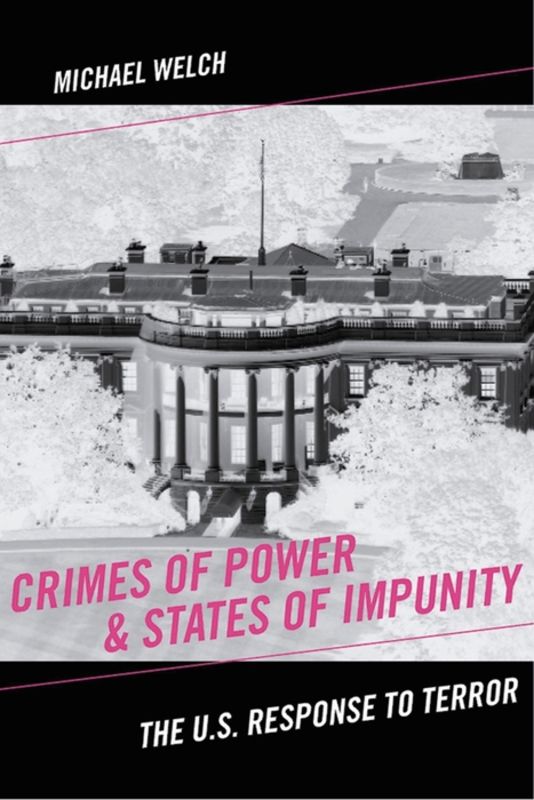
Crimes of Power & States of Impunity
Since 9/11, a new configuration of power situated at the core of the executive branch of the U.S. government has taken hold. In Crimes of Power & States of Impunity, Michael Welch takes a close look at the key historical, political, and economic forces shaping the country's response to terror.
Welch continues the work he began in Scapegoats of September 11th and argues that current U.S. policies, many enacted after the attacks, undermine basic human rights and violate domestic and international law. He recounts these offenses and analyzes the system that sanctions them, offering fresh insight into the complex relationship between power and state crime. Welch critically examines the unlawful enemy combatant designation, Guantanamo Bay, recent torture cases, and collateral damage relating to the war in Iraq. This book transcends important legal arguments as Welch strives for a broader sociological interpretation of what transpired early this century, analyzing the abuses of power that jeopardize our safety and security.
eBook

Intelligence for an Age of Terror
During the Cold War, U.S. intelligence was concerned primarily with states; non-state actors like terrorists were secondary. Now the priorities are reversed and the challenge is enormous. States had an address, and they were hierarchical and bureaucratic. They thus came with some 'story'. Terrorists do not. States were 'over there', but terrorists are there and here. They thus put pressure on intelligence at home, not just abroad. The strength of this book is that it underscores the extent of the change and ranges broadly across data collection and analysis, foreign and domestic, as well as presenting the issues of value that arise as new targets require collecting more information at home.
eBook


Clinton's War on Terror: Redefining US Security Strategy, 1993-2001
In the aftermath of the catastrophic attacks of September 11, 2001, President Bill Clinton's time in office was portrayed as one in which vital opportunities to confront growing threats to US security were missed. Firmly challenging this characterization, James Boys explores the long-misunderstood approach adopted by the Clinton administration as it sought to define an effective response to acts of political violence.Boys argues that only by understanding the efforts of Clinton and his team to address international terrorism can we make sense of the reasoning behind the actions of George W. Bush, Barack Obama, and Donald Trump, all of whom inherited, continued, and expanded on Clinton-era policies and practices. Drawing on official documents and on interviews with key players, he reveals the evolution of counterterrorism strategy throughout the Clinton administration, as well as the ramifications that it has today.
eBook


Find, Fix, Finish
On 9/11 the U.S. had effectively no counterterrorism doctrine. Fast forward ten years: Osama bin Laden is dead; al Qaeda is organizationally ruined and pinned in the tribal areas of Pakistan and Afghanistan; there has been no major attack on American soil; and while there has been at least one instance of a massive planned attack, it was crushed by the greatest international collaboration of intelligence services seen since the end of the Cold War. Its been a remarkable transformation.Aki Peritz and Eric Rosenbach have experienced first-hand the monumental strategy changes in our countrys counterterrorism strategy within the intelligence, defense, and political communities. In this book, they show how America learned to be very good at taking on the terrorists, often one at a time, in ever more lethally incisive operations. They offer new details behind some headlines from the last decade. They are frank about the mistakes that have been made. And they explain how a concept coined by General Grant during the Civil War has been reinvented in the age of satellite technology to manage a globally distributed foe, allowing the U.S. to find, fix, and finish its enemies.
eBook