
Catalogue Search | MBRL


Are you sure you want to remove the book from the shelf?

{{itemTitle}}
189
result(s) for
"Terrorism -- Prevention -- Law and legislation -- United States"
Sort by:


Civil Rights in Wartime
In the days, months, and now years following the events of September 11th, 2001, discrimination against the Sikh community in America has escalated sharply, due in part to a populace that often confuses Sikhs, compelled by their faith to wear turbans, with the Muslim extremists responsible for the devastating terrorist attacks. Although Sikhs have since mobilized to spread awareness and condemn violence against themselves and Muslims, there has been a conspicuous absence of academic literature to aid scholars and commentators in understanding the effect of the backlash on the Sikh community. This volume provides a unique window onto this particular minority group's experience in an increasingly hostile climate, and offers a sharp analysis of the legal battles fought by Sikhs in post-9/11 America. In doing so, it adds a new chapter to the ongoing national story of the difficulties minority groups have faced in protecting their civil liberties in times of war.
eBook

Combating terrorism in the 21st century : American laws, strategies, and agencies
\"This combination A-Z encyclopedia and primary document collection provides an authoritative and enlightening overview of U.S. anti- and counter terrorism politics, policies, attitudes, and actions related to both foreign and domestic threats, with a special emphasis on post-9/11 events\"-- Provided by publisher.
BOOK

Terrorism on trial : political violence and abolitionist futures
A landmark sociological examination of terrorism prosecution in United States courts Rather than functioning as a final arbiter of justice, U.S. domestic courts are increasingly seen as counterterrorism tools that can incapacitate terrorists, maintain national security operations domestically, and produce certain narratives of conflict. Terrorism on Trial examines the contemporary role that these courts play in the global war on terror and their use as a weapon of war: hunting, criminalizing, and punishing entire communities in the name of national security. Nicole Nguyen advocates for a rethinking of popular understandings of political violence and its root causes, encouraging readers to consider anti-imperial abolitionist alternatives to the criminalization, prosecution, and incarceration of individuals marked as real or perceived terrorists. She exposes how dominant academic discourses, geographical imaginations, and social processes have shaped terrorism prosecutions, as well as how our fundamental misunderstanding of terrorism has led to punitive responses that do little to address the true sources of violence, such as military interventions, colonial occupations, and tyrannical regimes. Nguyen also explores how these criminal proceedings bear on the lives of defendants and families, seeking to understand how legal processes unevenly criminalize and disempower communities of color. A retheorization of terrorism as political violence, Terrorism on Trial invites readers to carefully consider the role of power and politics in the making of armed resistance, addressing the root causes of political violence, with a goal of building toward a less violent and more liberatory world.
eBook

Law's wars : the fate of the rule of law in the US 'War on Terror'
\"In the more than two centuries since the US was founded, the rule of law has been tested and compromised in numerous ways: the oppression of Native Americans, slavery, Jim Crow, labor struggles, the treatment of German-Americans in WW I, Japanese-Americans in WW II and radicals after both wars, the civil rights movement, protests against the Vietnam War, and more recently the distortion of the electoral process by money, gerrymandering, and disenfranchisement, and police responses to the Occupy movement and killings of young black man documented by Black Lives Matter. The \"war on terror\" has posed at least as great a danger\"-- Provided by publisher.
Book

Taking liberties : the war on terror and the erosion of American democracy
Since 9/11, the U.S. government has acted in a variety of ways--some obvious, some nearly invisible--to increase its surveillance and detention power over American citizens and residents. While most of us have made our peace with the various new restrictions on our civil liberties after 9/11, we have done it without really understanding what those restrictions are or the extent of their reach. Moreover, we tend to think that if the national security state overreaches, we shouldn't worry--the courts will come to the rescue and rein it in. In Taking Liberties, Susan Herman explains how this came to be. Beginning in late 2001, the Bush Administration undertook a series of measures, some of which were understandable and valid given the context, to expand federal surveillance authority. Yet as she shows through a series of gripping episodes involving ordinary Americans, they overreached to the point eroding basic constitutional liberties. Herman spells out in vivid detail why all Americans should be worried about the governmental dragnet that has slowly and at times imperceptibly expanded its coverage over the American public. The erosion of civil liberties doesn't just impact immigrants, Americans of Middle Eastern descent, or Guantanamo detainees, but any American who appears to be engaging in provocative political activity. Taking Liberties is a wake-up call for all Americans, who remain largely unaware of the post-9/11 surveillance regime's insidious and continuing growth.
eBook


Courts at War
On June 28, 2004, the US Supreme Court broke with a long-standing tradition of deference to the executive in wartime national security cases and became an important actor in an armed conflict. By declining to rubber-stamp the executive branch's actions, the judiciary would henceforth play a major role in shaping national security policies in the war on terror. After the September 11, 2001, terrorist attacks, lawyers, lawsuits, and court decisions have repeatedly altered the landscape in the policy areas of detention and military commissions. In Courts at War Gregory Burnep explores how, after 9/11, lawyers and judges became deeply involved in an armed conflict, with important consequences for presidential authority, the separation of powers, and the treatment of individuals suspected of posing a threat to the United States.
Courts at War goes beyond the postâ€\"9/11 armed conflict. It analyzes the changes in the position of courts vis-à-vis the other branches of government (courts in conflict with the executive, the legislature, or both)-even courts in conflict with other courts. The consequences included increased checks on presidential authority and greater levels of due process for suspected belligerents held in US custody. But Burnep also shows that there are unintended consequences that accompany these developments.
Burnep innovatively applies an interbranch perspective to persuasively argue that litigation and judicial involvement have important implications for changing patterns of policy development in a wide range of national security policy areas, including surveillance, interrogation, targeted killings, and President Trump's travel ban.
eBook

The future of foreign intelligence : privacy and surveillance in a digital age
\"Since the Revolutionary War, America's military and political leaders have recognized that U.S. national security depends upon the collection of intelligence. Absent information about foreign threats, the thinking went, the country and its citizens stood in great peril. To address this, the Courts and Congress have historically given the President broad leeway to obtain foreign intelligence. But in order to find information about an individual in the United States, the executive branch had to demonstrate that the person was an agent of a foreign power. Today, that barrier no longer exists. The intelligence community now collects massive amounts of data and then looks for potential threats to the United States. As renowned national security law scholar Laura K. Donohue explains in The Future of Foreign Intelligence, the internet and new technologies such as biometric identification systems have not changed our lives in countless ways. But they have also led to a very worrying transformation. The amount and types of information that the government can obtain has radically expanded, and information that is being collected for foreign intelligence purposes is now being used for domestic criminal prosecution. Traditionally, the Courts have allowed exceptions to the Fourth Amendment rule barring illegal search and seizure on national security grounds. But the new ways in which we collect intelligence are swallowing the rule altogether. Just as alarming, the ever-weaker standards that mark foreign intelligence collection are now being used domestically-and the convergence between these realms threatens individual liberty. Donohue traces the evolution of foreign intelligence law and pairs that account with the progress of Fourth Amendment jurisprudence. She argues that the programmatic surveillance that the National Security Agency conducts amounts to a general warrant-the prevention of which was the point of introducing the Fourth Amendment. The expansion of foreign intelligence surveillance-leant momentum by significant advances in technology, the Global War on Terror, and the emphasis on securing the homeland-now threatens to consume protections essential to privacy, which is a necessary component of a healthy democracy. Donohue offers an agenda for reining in the national security state's expansive reach, primarily through Congressional statutory reform that will force the executive and judicial branches to take privacy seriously, even as it provides for the continued collection of intelligence central to U.S. national security. Both alarming and penetrating, this is essential reading for anyone interested in the future of foreign intelligence and privacy in the United States\"-- Provided by publisher.
Book
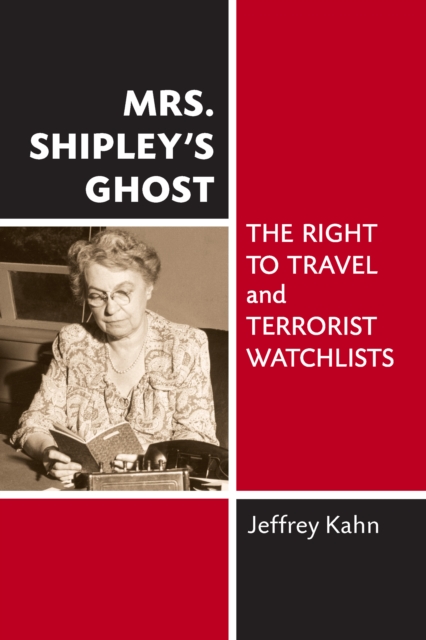
Mrs. Shipley's ghost
Today, when a single person can turn an airplane into a guided missile, no one objects to rigorous security before flying. But can the state simply declare some people too dangerous to travel, ever and anywhere? Does the Constitution protect a fundamental right to travel? Should the mode of travel (car, plane, or boat) or itinerary (domestic or international) make a constitutional difference? This book explores the legal and policy questions raised by government travel restrictions, from passports and rubber stamps to computerized terrorist watchlists. In tracing the history and scope of U.S. travel regulations, Jeffrey Kahn begins with the fascinating story of Mrs. Ruth Shipley, a federal employee who almost single-handedly controlled access to passports during the Cold War. Kahn questions how far national security policies should go and whether the government should be able to declare some individuals simply too dangerous to travel. An expert on constitutional law, Kahn argues that U.S. citizens' freedom to leave the country and return is a fundamental right, protected by the Constitution.
eBook