
Catalogue Search | MBRL


Are you sure you want to remove the book from the shelf?

{{itemTitle}}
16,402
result(s) for
"Terrorism History."
Sort by:


Disciplining Terror
Since 9/11 we have been told that terrorists are pathological evildoers, beyond our comprehension. Before the 1970s, however, hijackings, assassinations, and other acts we now call 'terrorism' were considered the work of rational strategic actors. Disciplining Terror examines how political violence became 'terrorism', and how this transformation ultimately led to the current 'war on terror'. Drawing upon archival research and interviews with terrorism experts, Lisa Stampnitzky traces the political and academic struggles through which experts made terrorism, and terrorism made experts. She argues that the expert discourse on terrorism operates at the boundary - itself increasingly contested - between science and politics, and between academic expertise and the state. Despite terrorism now being central to contemporary political discourse, there have been few empirical studies of terrorism experts. This book investigates how the concept of terrorism has been developed and used over recent decades.
eBook
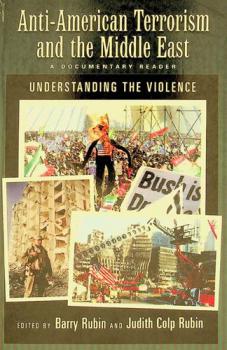
Anti-American terrorism and the Middle East : a documentary reader
After the September 11, 2001 terrorist attacks on the World Trade Center and the Pentagon, a stunned public asked: How could this happen? Why did the attackers do what they did? What did they hope to accomplish? This wasn't the first battle in a conflict that has included bombings of U.S. embassies and planes, the Iran hostage crisis, and kidnappings or shootings of American citizens. This unique volume sets out to answer these questions using the unfiltered words of the terrorists themselves. Over many decades, radical forces in the Middle East have changed and evolved, yet their basic outlook and anti-Western views have remained remarkably consistent. The editors have assembled nearly one hundred key documents, charting the evolution of radical Middle East movements, their anti-Americanism, and Western policy response. The buildup to the battle between a world superpower and Middle East revolutionaries is brought dramatically to life. Among the documents included are the charters of such organizations as Hizballah, Hamas, and World Islamic Front; speeches by Syrian president Hafiz al-Asad and Iraqi president Saddam Hussein; al-Qa'ida recruitment materials; and terrorist training manuals. The book also shows and analyzes the often conflicting and deeply conflicted responses to September 11 by journalists, clerics, and activists in the Arab world. Supplemented by an annotated chronology, a glossary of terms, and sections that put each selection in context, this comprehensive reference serves not only as essential historical background to the ongoing aftermath of the September 11 attacks, but more generally as an invaluable framework for understanding a long-term, continuing conflict that has caused many crises for the United States.
Book

America Unbound: The Bush Revolution in Foreign Policy
George W. Bush has launched a revolution in American foreign policy. He has redefined how America engages the world, shedding the constraints that friends, allies, and international institutions impose on its freedom of action. He has insisted that an America unbound is a more secure America. How did a man once mocked for knowing little about the world come to be a foreign policy revolutionary? In America Unbound, Ivo H. Daalder and James M. Lindsay dismiss claims that neoconservatives have captured the heart and mind of the president. They show that George W. Bush has been no one's puppet. He has been a strong and decisive leader with a coherent worldview that was evident even during the 2000 presidential campaign. Daalder and Lindsay caution that the Bush revolution comes with significant risks. Raw power alone is not enough to preserve and extend America's security and prosperity in the modern world. The United States often needs the help of others to meet the challenges it faces overseas. But Bush's revolutionary impulse has stirred great resentment abroad. At some point, Daalder and Lindsay warn, Bush could find that America's friends and allies refuse to follow his lead. America will then stand alone-a great power unable to achieve its most important goals.
eBook


The Islamic State
This book offers insights into the nature of the Islamic State and what the international community can do to combat it. The origins, intentions, leadership, capabilities, and operations of the IS, as well as specific steps that governmental, intergovernmental, and non-governmental bodies can take to counter the IS menace, are examined.
eBook


The Battle against Anarchist Terrorism
This is the first global history of the secret diplomatic and police campaign that was waged against anarchist terrorism from 1878 to the 1920s. Anarchist terrorism was at that time the dominant form of terrorism and for many continued to be synonymous with terrorism as late as the 1930s. Ranging from Europe and the Americas to the Middle East and Asia, Richard Bach Jensen explores how anarchist terrorism emerged as a global phenomenon during the first great era of economic and social globalization at the end of the nineteenth and beginning of the twentieth centuries and reveals why some nations were so much more successful in combating this new threat than others. He shows how the challenge of dealing with this new form of terrorism led to the fundamental modernization of policing in many countries and also discusses its impact on criminology and international law.
eBook


Chronologies of Modern Terrorism
Concise yet comprehensive, this one-volume reference examines the history of terrorism in the modern world, including its origins and development, and terrorist acts by groups and individuals from the French Revolution to today. Organized thematically and regionally, it outlines major developments in conflicts that involved terrorism, the history of terrorist groups, key aspects of counterterrorist policy, and specific terrorist incidents.Initial chapters explore terrorism as a social force, and analyze the use of terrorism as a political tool, both historically and in the contemporary world. Subsequent chapters focus on different parts of the world and consider terrorism as a part of larger disputes. Each chapter begins with a historical introduction and analysis of the topic or region, followed by one or more chronologies that trace events within political and social contexts. A glossary, selected bibliography, and detailed index are also included.
eBook