
Catalogue Search | MBRL


Are you sure you want to remove the book from the shelf?

{{itemTitle}}
813
result(s) for
"Terrorism Prevention Law and legislation."
Sort by:


Courts at War
On June 28, 2004, the US Supreme Court broke with a long-standing tradition of deference to the executive in wartime national security cases and became an important actor in an armed conflict. By declining to rubber-stamp the executive branch's actions, the judiciary would henceforth play a major role in shaping national security policies in the war on terror. After the September 11, 2001, terrorist attacks, lawyers, lawsuits, and court decisions have repeatedly altered the landscape in the policy areas of detention and military commissions. In Courts at War Gregory Burnep explores how, after 9/11, lawyers and judges became deeply involved in an armed conflict, with important consequences for presidential authority, the separation of powers, and the treatment of individuals suspected of posing a threat to the United States.
Courts at War goes beyond the postâ€\"9/11 armed conflict. It analyzes the changes in the position of courts vis-à-vis the other branches of government (courts in conflict with the executive, the legislature, or both)-even courts in conflict with other courts. The consequences included increased checks on presidential authority and greater levels of due process for suspected belligerents held in US custody. But Burnep also shows that there are unintended consequences that accompany these developments.
Burnep innovatively applies an interbranch perspective to persuasively argue that litigation and judicial involvement have important implications for changing patterns of policy development in a wide range of national security policy areas, including surveillance, interrogation, targeted killings, and President Trump's travel ban.
eBook


Counterterrorism and the State
Dorle Hellmuth argues that the nature of state responses to terrorism is shaped by the particular governmental framework and process within which counterterrorism measures are decided. Using four Western democracies as case studies, Hellmuth measures effects of government structures on counterterrorism decision-making processes and outcomes. In doing so, she examines how similar or different the responses have been in four parliamentary and presidential systems, and clears up common misperceptions about domestic counterterrorism efforts on both sides of the Atlantic.
Each of Hellmuth's four case studies reviews the official constitutional powers and informal relationships between executive and legislative branches, outlines decision-making processes leading to counterterrorism policies and reforms since 9/11, and summarizes how structural factors influenced those processes. By measuring and comparing structural effects, and by going beyond the common U.S. and British focus to include counterterrorism decision-making in Germany and France, Hellmuth shows that there are important similarities between those governments designed to constrain executive power (Germany and the United States) and those that facilitate executive power (France and Great Britain). Her analysis further demonstrates that in presidential systems executive and legislative branches have incentives to produce a steady stream of reforms, that presidents have more opportunities than leaders of parliamentary systems to expand their unilateral powers during times of crisis, and that choices designed to strengthen presidential positions influence the direction, nature, and scope of institutional reform.
Understanding the nature, scope, and trends of national decision-making processes in Western democracies, Hellmuth contends, is imperative to identifying new mechanisms for containing transnational terrorist networks beyond national borders.
eBook


Investigating terrorism
INVESTIGATING TERRORISM
'How can we be more effective in bringing terrorists to justice in ways that uphold our legal traditions? This book provides crucial clues drawn from highly experienced prosecution and defence lawyers, detectives, security experts and forensic psychologists. I highly recommend it for all who want to understand and respond to the serious threat from jihadist terrorism over the years to come.'
Professor Sir David Omand, former UK Security and Intelligence Coordinator, Permanent Secretary of the Home Office and Director GCHQ
'Edited and written by experts in their fields and with a plethora of experience, the authors know what they are talking about. This book is a must for those who need to know, those who are interested to know, and those who think they know it all already.'
Susan Young, Professor of Forensic Clinical Psychology, Broadmoor Hospital, West London Mental Health Trust
Investigating Terrorism takes a look behind the closed doors of terrorist cases, and at the entire judicial process of these cases from heated debates in both Houses of Parliament, through arrest, prosecution and imprisonment. In doing so, it confronts many of the crucial political, enforcement, legal and psychological issues currently influencing major decision-makers in this arena.
Specialist contributors discuss recently released research into the effectiveness of front-line counter-terrorism officers in their dealings with terrorist suspects, including the findings from a study commissioned by New Scotland Yard into the effectiveness of police interviews with terrorist suspects. Also included are strategic reviews of many of the major legislative changes and subsequent high-profile legal challenges that have repeatedly undermined government policy. Contributors provide a clear psychological understanding of aspects of terrorist behaviour, including insights into what drives individuals to become suicide bombers.
Contributions come from leading barristers, senior police officers and psychologists. Contributors Lord Carlile, the former HMG's Independent Reviewer of Terrorist Legislation, and Peter Clarke, the recently retired head of the Anti-Terrorist Branch for the UK, combine academic credentials and understanding with substantial policy or practitioner experience. This combination of perspectives ensures a holistic and richly informed view of the subject and issues.
eBook

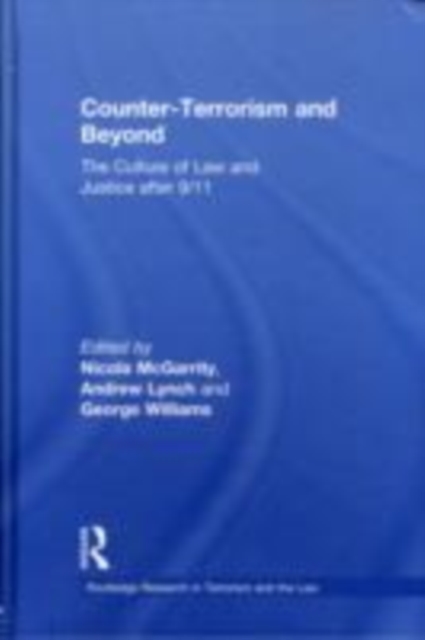
Counter-Terrorism and Beyond
This book considers the increasing trend towards a ‘culture of control’ in democratic countries. The post-9/11 counter-terrorism laws in nations such as the USA, the UK, Canada and Australia provide a stark demonstration of this trend. These laws share a focus on the pre-emption of crime, restrictions on the right to liberty of non-suspects, limited public access to information, and increased community surveillance. The laws derogate, in many respects, from the ordinary principles of the criminal justice system and fundamental human rights while also harnessing public institutions in the broader project of prevention and control.
Distinctively, the contributors to this volume focus on the impact of these laws outside of the counter-terrorism context. The book draws together a range of experts in both public and criminal law, from Australia and overseas, to examine the effect of counter-terrorism laws on public institutions within democracies more broadly. Issues considered include changes to the role and functions of the courts, the expansion of executive discretion, the seepage of extraordinary powers and pre-emptive measures into other areas of the criminal law, and the interaction and overlap between intelligence and law enforcement agencies.
Counter-Terrorism and Beyond: The Culture of Law and Justice After 9/11 will be of interest to students and scholars of criminal law, criminology, comparative criminal justice, terrorism and national security, public law, human rights, governance and public policy.
Part 1: Introduction 1. The Emergence of a ‘Culture of Control’, Andrew Lynch, Nicola McGarrity and George Williams Part 2: Prevention and Pre-Emption, Evidence and Intelligence 2. Counter-Terrorism: The Law and Policing of Pre-Emption, Jude McCulloch and Sharon Pickering 3. The Counter-Terrorism Purposes of an Australian Preventative Detention Order, Claire Macken 4. The Eroding Distinction Between Intelligence and Evidence in Terrorism Investigations, Kent Roach Part 3: Community Surveillance and the Creation of a Culture of Suspicion 5. Constitutional Criminal Procedure and Civil Rights in the Shadow of the ‘War on Terror’: A Look at Recent United States Decisions and the Rhetoric of Terrorism, Charles Weisselberg 6. Suspicionless Searches and the Prevention of Terrorism, John Ip 7. A Passport to Punishment: Administrative Measures of Control for National Security Purposes, Susan Harris Rimmer Part 4: The Normalisation of Extraordinary Measures 8. When Extraordinary Measures Become Normal: Pre-Emption in Counter-Terrorism and Other Laws, Nicola McGarrity and George Williams 9. The Anti-Terror Creep: Law and Order, the States and the High Court of Australia, Gabrielle Appleby and John Williams Part 5: The Flow of Information in Liberal Democracies 10. Proxies for the Authorities? Using Media Information in the Investigation and Prosecution of Terrorism Offences, Lawrence McNamara 11. The Show Must Go On: The Drama of Dr Mohamed Haneef and the Theatre of Counter-Terrorism, Mark Rix Part 6: Judicial Review and the Parliamentary Process: How Best to Protect Human Rights? 12. Extra-Constitutionalism, Dr Mohamed Haneef and Controlling Executive Power in Times of Emergency, Fergal Davis
Nicola McGarrity is the Director of the Terrorism and Law Project at the Gilbert + Tobin Centre of Public Law and a Research Fellow in the Faculty of Law, University of New South Wales, Australia.
Andrew Lynch is the Director of the Gilbert + Tobin Centre of Public Law and an Associate Professor in the Faculty of Law, University of New South Wales, Australia.
George Williams is the Anthony Mason Professor of Law and Foundation Director of the Gilbert + Tobin Centre of Public Law in the Faculty of Law, University of New South Wales, Australia, and an Australian Research Council Laureate Fellow.
eBook