
Catalogue Search | MBRL


Are you sure you want to remove the book from the shelf?

{{itemTitle}}
25,666
result(s) for
"Terrorism United States."
Sort by:


Killing McVeigh
On April 19, 1995, Timothy McVeigh detonated a two-ton truck bomb that felled the Alfred P. Murrah Federal Building in Oklahoma City, killing 168 people. On June 11, 2001, an unprecedented 242 witnesses watched him die by lethal injection. In the aftermath of the bombings, American public commentary almost immediately turned to closure rhetoric. Reporters and audiences alike speculated about whether victim's family members and survivors could get closure from memorial services, funerals, legislation, monuments, trials, and executions. But what does closure really mean for those who survive - or lose loved ones in - traumatic acts? In the wake of such terrifying events, is closure a realistic or appropriate expectation? In Killing McVeigh, Jody Lynee Madeira uses the Oklahoma City bombing as a case study to explore how family members and other survivors come to terms with mass murder. As the fullest case study to date of the Oklahoma City Bombing survivors' struggle for justice and the first-ever case study of closure, this book describes the profound human and institutional impacts of these labors to demonstrate the importance of understanding what closure really is before naively asserting it can or has been reached.
eBook
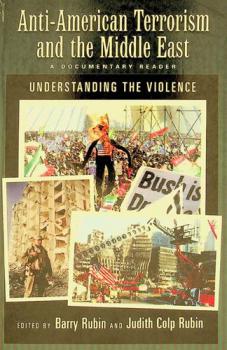
Anti-American terrorism and the Middle East : a documentary reader
After the September 11, 2001 terrorist attacks on the World Trade Center and the Pentagon, a stunned public asked: How could this happen? Why did the attackers do what they did? What did they hope to accomplish? This wasn't the first battle in a conflict that has included bombings of U.S. embassies and planes, the Iran hostage crisis, and kidnappings or shootings of American citizens. This unique volume sets out to answer these questions using the unfiltered words of the terrorists themselves. Over many decades, radical forces in the Middle East have changed and evolved, yet their basic outlook and anti-Western views have remained remarkably consistent. The editors have assembled nearly one hundred key documents, charting the evolution of radical Middle East movements, their anti-Americanism, and Western policy response. The buildup to the battle between a world superpower and Middle East revolutionaries is brought dramatically to life. Among the documents included are the charters of such organizations as Hizballah, Hamas, and World Islamic Front; speeches by Syrian president Hafiz al-Asad and Iraqi president Saddam Hussein; al-Qa'ida recruitment materials; and terrorist training manuals. The book also shows and analyzes the often conflicting and deeply conflicted responses to September 11 by journalists, clerics, and activists in the Arab world. Supplemented by an annotated chronology, a glossary of terms, and sections that put each selection in context, this comprehensive reference serves not only as essential historical background to the ongoing aftermath of the September 11 attacks, but more generally as an invaluable framework for understanding a long-term, continuing conflict that has caused many crises for the United States.
Book

Jihadi Terrorism and the Radicalisation Challenge
Osama bin Laden's demise in May 2011 marked only the symbolic end of an era. By the time of his killing, he no longer represented the Robin Hood icon that once stirred global fascination. Ten years after the 11 September 2001 attacks, jihadi terrorism has largely lost its juggernaut luster. It now mostly resembles a patchwork of self-radicalising local groups with international contacts but without any central organisational design - akin to the radical left terrorism of the 1970s and the anarchist fin-de-siècle terrorism.
This volume addresses two issues that remain largely unexplored in contemporary terrorism studies. It rehabilitates the historical and comparative analysis as a way to grasp the essence of terrorism, including its jihadi strand. Crucial similarities with earlier forms of radicalisation and terrorism abound and differences appear generally not fundamental. Likewise, the very concept of radicalisation is seldom questioned anymore. Nevertheless it often lacks conceptual clarity and empirical validation.
Once considered a quintessential European phenomenon, the United States too experiences how some of its own citizens radicalise into terrorist violence.
This collective work compares radicalisation in both continents and the strategies aimed at de-radicalisation. But it also assesses if the concept merits its reputation as the holy grail of terrorism studies. The volume is aimed at an audience of decision makers, law enforcement officials, academia and think tanks, by its combination of novel thinking, practical experience and a theoretical approach.
eBook


Terrorism as crime : from Oklahoma City to Al-Qaeda and beyond
Car bombing, suicide bombing, abduction, smuggling, homicide, and hijacking are all profoundly criminal acts. In Terrorism as Crime Mark S. Hamm presents an understanding of terrorism from a criminological point of view, arguing that the most successful way to understand, detect, prosecute and deter these acts is to use conventional criminal investigation methods. Whether in Oklahoma City or London, Terrorism as Crime demonstrates that criminal activity is the lifeblood of terrorist groups and that there are simple common denominators at work that can remove the mystery surrounding many of these terrorist groups. Once understood the vulnerabilities of these organizations can be exposed.
This important volume focuses in on six case studies of crimes committed by jihad and domestic right wing groups, including biographies of more than two dozen terrorists along with descriptions of their organizations, strategies, and terrorist plots. Terrorism as Crime offers an original and significant framework for explaining international and domestic terrorism, as well as how future acts might be detected or exposed.
eBook

Civil Rights in Wartime
In the days, months, and now years following the events of September 11th, 2001, discrimination against the Sikh community in America has escalated sharply, due in part to a populace that often confuses Sikhs, compelled by their faith to wear turbans, with the Muslim extremists responsible for the devastating terrorist attacks. Although Sikhs have since mobilized to spread awareness and condemn violence against themselves and Muslims, there has been a conspicuous absence of academic literature to aid scholars and commentators in understanding the effect of the backlash on the Sikh community. This volume provides a unique window onto this particular minority group's experience in an increasingly hostile climate, and offers a sharp analysis of the legal battles fought by Sikhs in post-9/11 America. In doing so, it adds a new chapter to the ongoing national story of the difficulties minority groups have faced in protecting their civil liberties in times of war.
eBook


Homegrown
An insightful study of how identity is mobilized in and for war in the face of homegrown terrorism.
\"You are either with us, or against us\" is the refrain that captures the spirit of the global war on terror. Images of the \"them\" implied in this war cry-distinct foreign \"others\"-inundate Americans on hit television shows, Hollywood blockbusters, and nightly news. However, in this book, Piotr Szpunar tells the story of a fuzzier image: the homegrown terrorist, a foe that blends into the crowd, who Americans are told looks, talks, and acts \"like us.\"
Homegrown delves into the dynamics of domestic counterterrorism, revealing the complications that arise when the terrorist threat involves Americans, both residents and citizens, who have taken up arms against their own country. Szpunar examines the ways in which identities are blurred in the war on terror, amid debates concerning who is \"the real terrorist.\" He considers cases ranging from the white supremacist Sikh Temple shooter,,to the Newburgh Four, ex-convicts caught up in an FBI informant-led plot to bomb synagogues, to ecoterrorists, to the Tsarnaev brothers responsible for the Boston Marathon bombing.
Drawing on popular media coverage, court documents, as well as \"terrorist\"-produced media, Szpunar poses new questions about the strategic deployment of identity in times of conflict. The book argues that homegrown terrorism challenges our long held understandings of how identity and difference play out in war-beyond \"us versus them\"-and, more importantly, that the way in which it is conceptualized and combatted has real consequences for social, cultural, and political notions of citizenship and belonging. The first critical examination of homegrown terrorism, this book will make you question how we make sense of the actions of ourselves and others in global war, and the figures that fall in between.
eBook