
Catalogue Search | MBRL


Are you sure you want to remove the book from the shelf?

{{itemTitle}}
5,377
result(s) for
"Terrorists -- United States"
Sort by:


Terrorism on trial : political violence and abolitionist futures
A landmark sociological examination of terrorism prosecution in United States courts Rather than functioning as a final arbiter of justice, U.S. domestic courts are increasingly seen as counterterrorism tools that can incapacitate terrorists, maintain national security operations domestically, and produce certain narratives of conflict. Terrorism on Trial examines the contemporary role that these courts play in the global war on terror and their use as a weapon of war: hunting, criminalizing, and punishing entire communities in the name of national security. Nicole Nguyen advocates for a rethinking of popular understandings of political violence and its root causes, encouraging readers to consider anti-imperial abolitionist alternatives to the criminalization, prosecution, and incarceration of individuals marked as real or perceived terrorists. She exposes how dominant academic discourses, geographical imaginations, and social processes have shaped terrorism prosecutions, as well as how our fundamental misunderstanding of terrorism has led to punitive responses that do little to address the true sources of violence, such as military interventions, colonial occupations, and tyrannical regimes. Nguyen also explores how these criminal proceedings bear on the lives of defendants and families, seeking to understand how legal processes unevenly criminalize and disempower communities of color. A retheorization of terrorism as political violence, Terrorism on Trial invites readers to carefully consider the role of power and politics in the making of armed resistance, addressing the root causes of political violence, with a goal of building toward a less violent and more liberatory world.
eBook


Terrorism: The Basics
Terrorism: The Basics is an ideal starting point for anyone interested in one of the most discussed, written about and analysed aspects of modern life. Common misconceptions are dispelled as the authors provide clear and jargon-free answers to the big questions:
What does terrorism involve?
Who can be classified as a terrorist?
What are terrorists trying to achieve?
Who are the supporters of terrorism?
Can there ever be an end to terrorist activity?
These questions and more are answered with reference to contemporary groups and situations allowing readers to relate theory to what they have seen on the news. Written with clarity and insight, this book is the perfect first book on terrorism for students of all levels.
eBook


Would-Be Warriors
Between 9/11 and the end of 2009, 46 publicly reported cases of domestic radicalization and recruitment to jihadist terrorism occurred in the United States, 13 of them in 2009. Most of the would be jihadists recruited themselves into the terrorist role, assisting foreign terrorist organizations, joining jihad fronts abroad, and plotting attacks. The terrorist threat has pushed law enforcement toward prevention rather than post-event apprehension.
eBook

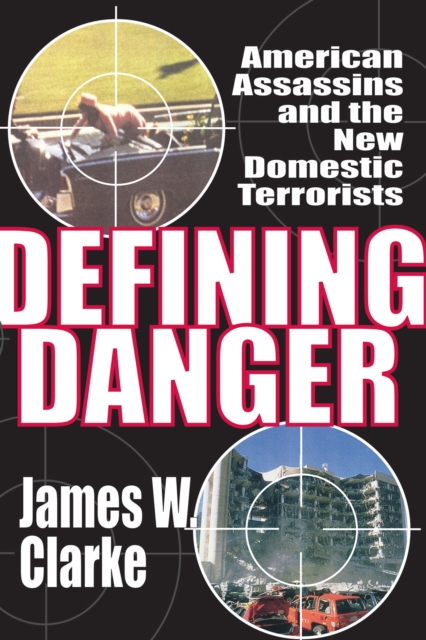
Defining Danger
Since 1789, when George Washington became the first president of the United States, forty-three men have held the nation's highest office. Four were killed by assassins, and serious attempts were made on the lives of eight others. Add to that list the names of Martin Luther King, Jr. and Malcolm X, and it is reasonable to conclude that political prominence in the United States entails grave risks. In \"Defining Danger\", James W. Clarke explores the cultural and psychological linkages that define assassinations and a new era of domestic terrorism in America. Clarke notes an upsurge in political violence beginning with the assassination of John F. Kennedy in 1963. Since then, there have been ten assassination attempts on nationally prominent political leaders. That is two more than the eight recorded in the previous 174 years of the nation's presidential history. New elements of domestic terror in American life were introduced in the 1990s by Timothy McVeigh, the \"Oklahoma City Bomber,\" Ted Kaczynski, the \"Unabomber,\" and Eric Rudolph, the abortion clinic bomber. These men were politically motivated; their crimes unprecedented. These events and the perpetrators behind them are the subjects of this book. The volume conveys two central themes. The first is that individual acts of violence directed toward America's democratically elected leaders represent a defining element of American politics. The second addresses how danger is defined, through an analysis of the motives and characteristics of twenty-one perpetrators responsible for these acts of political violence where shots were fired, or bombs detonated, and, in most instances, victims died. The importance and originality of this material have been acknowledged in presentations to and consultations with the U.S. Secret Service and some of the nation's top independent private investigators. It is written in an accessible and engaging style that will appeal to the informed general reader, as well as to professionals in a variety of fields - especially in the wake of recent events and the specter of future violence that, sadly, haunts us all.
eBook

FBI files. The Unabomber
\"[The author] presents the story of the FBI's investigation of the Unabomber and the agent who helped bring him to justice.\"-- Publisher's description.
BOOK

Justice and the enemy : Nuremberg, 9/11, and the trial of Khalid Sheikh Mohammed
Since the Nuremberg Trials of 1945, lawful nations have struggled to impose justice around the world, especially when confronted by tyrannical and genocidal regimes. But in Cambodia, the USSR, China, Bosnia, Rwanda, and beyond, justice has been served haltingly if at all in the face of colossal inhumanity. International Courts are not recognized worldwide. There is not a global consensus on how to punish transgressors. The war against Al Qaeda is a war like no other. Osama bin Laden, Al Qaeda's founder, was killed in Pakistan by Navy Seals. Few people in America felt anything other than that justice had been served. But what about the man who conceived and executed the 9/11 attacks on the US, Khalid Sheikh Mohammed? What kind of justice does he deserve? The U.S. has tried to find the high ground by offering KSM a trial albeit in the form of military tribunal. But is this hypocritical? Indecisive? Half-hearted? Or merely the best application of justice possible for a man who is implacably opposed to the civilization that the justice system supports and is derived from? In this book, William Shawcross explores the visceral debate that these questions have provoked over the proper application of democratic values in a time of war, and the enduring dilemma posed to all victors in war: how to treat the worst of your enemies.
eBook