
Catalogue Search | MBRL


Are you sure you want to remove the book from the shelf?

{{itemTitle}}
2,851
result(s) for
"Testing, Measurement and Assessment"
Sort by:

Essentials of assessing, preventing, and overcoming reading difficulties
\"Practical, effective, evidence-based reading interventions that change students' lives Essentials of Understanding and Assessing Reading Difficulties is a practical, accessible, in-depth guide to reading assessment and intervention. It provides a detailed discussion of the nature and causes of reading difficulties, which will help develop the knowledge and confidence needed to accurately assess why a student is struggling. Readers will learn a framework for organizing testing results from current assessment batteries such as the WJ-IV, KTEA-3, and CTOPP-2. Case studies illustrate each of the concepts covered. A thorough discussion is provided on the assessment of phonics skills, phonological awareness, word recognition, reading fluency, and reading comprehension. Formatted for easy reading as well as quick reference, the text includes bullet points, icons, callout boxes, and other design elements to call attention to important information. Although a substantial amount of research has shown that most reading difficulties can be prevented or corrected, standard reading remediation efforts have proven largely ineffective. School psychologists are routinely called upon to evaluate students with reading difficulties and to make recommendations to address such difficulties. This book provides an overview of the best assessment and intervention techniques, backed by the most current research findings. Bridge the gap between research and practice Accurately assess the reason(s) why a student struggles in reading Improve reading skills using the most highly effective evidence-based techniques Reading may well be the most important thing students are taught during their school careers. It is a skill they will use every day of their lives; one that will dictate, in part, later life success. Struggling students need help now, and Essentials of Understanding and Assessing Reading Difficulties shows how to get these students on track\"-- Provided by publisher.
Book

Applying the Rasch Model
Recognised as the most influential publication in the field, ARM facilitates deep understanding of the Rasch model and its practical applications. The authors review the crucial properties of the model and demonstrate its use with examples across the human sciences. Readers will be able to understand and critically evaluate Rasch measurement research, perform their own Rasch analyses and interpret their results. The glossary and illustrations support that understanding, and the accessible approach means that it is ideal for readers without a mathematical background.
Intended as a text for graduate courses in measurement, item response theory, (advanced) research methods or quantitative analysis taught in psychology, education, human development, business and other social and health sciences. Professionals in these areas will also appreciate the book's accessible introduction.
Highlights of the new edition include:
More learning tools to strengthen readers' understanding including chapter introductions, boldfaced key terms, chapter summaries, activities and suggested readings.
Greater emphasis on the use of R packages; readers can download the R code from the Routledge website.
Explores the distinction between numerical values, quantity and units, to understand the measurement and the role of the Rasch logit scale (Chapter 4).
A new four-option data set from the IASQ (Instrumental Attitude toward Self-assessment Questionnaire) for the Rating Scale Model (RSM) analysis exemplar (Chapter 6).
Clarifies the relationship between Rasch measurement, path analysis and SEM, with a host of new examples of Rasch measurement applied across health sciences, education and psychology (Chapter 10).
eBook
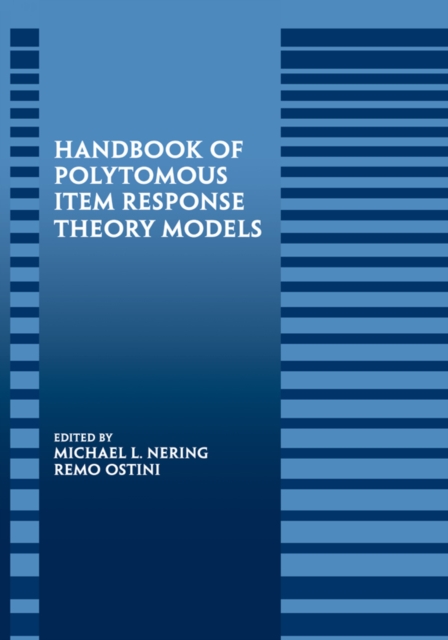
Handbook of Polytomous Item Response Theory Models
This comprehensive Handbook focuses on the most used polytomous item response theory (IRT) models. These models help us understand the interaction between examinees and test questions where the questions have various response categories. The book reviews all of the major models and includes discussions about how and where the models originated, conceptually and in practical terms. Diverse perspectives on how these models can best be evaluated are also provided. Practical applications provide a realistic account of the issues practitioners face using these models. Disparate elements of the book are linked through editorial sidebars that connect common ideas across chapters, compare and reconcile differences in terminology, and explain variations in mathematical notation. These sidebars help to demonstrate the commonalities that exist across the field. By assembling this critical information, the editors hope to inspire others to use polytomous IRT models in their own research so they too can achieve the type of improved measurement that such models can provide.
Part 1 examines the most commonly used polytomous IRT models, major issues that cut across these models, and a common notation for calculating functions for each model. An introduction to IRT software is also provided. Part 2 features distinct approaches to evaluating the effectiveness of polytomous IRT models in various measurement contexts. These chapters appraise evaluation procedures and fit tests and demonstrate how to implement these procedures using IRT software. The final section features groundbreaking applications. Here the goal is to provide solutions to technical problems to allow for the most effective use of these models in measuring educational, psychological, and social science abilities and traits. This section also addresses the major issues encountered when using polytomous IRT models in computerized adaptive testing. Equating test scores across different testing co
eBook

Exploring teacher growth mindset measurement: an analytical synthesis
The interest in fostering growth mindset among teachers has led to a surge in research; however, no consensus exists on how to best measure this construct. Concerns regarding variability in instruments, limited validity evidence, and inconsistent classification practices underscore the need for a systematic synthesis. We reviewed 42 peer-reviewed studies published between 2000 and 2024 that measured teacher growth mindset. We analyzed the instruments employed, response formats, growth mindset score distributions, standard-setting procedures, and reported psychometric evidence. Most studies relied on self-report instruments derived from Dweck's original scale, with a 4-item, 6-point Likert format. Nonetheless, instruments varied in length, domain specificity, and item wording. Standardized growth mindset scores were positively skewed across studies, independent of instrument length or teacher type. Classification practices were heterogeneous as studies applied either absolute or relative cut-off scores, with limited theoretical or empirical justification. Reliability evidence was abundant, with most studies reporting high internal consistency using Cronbach's alpha. Validity evidence, though more prevalent in recent publications, was restricted to convergent validity, with minimal evidence based on response processes, and test content. We recommend refining item design, adopting criterion-referenced standard setting grounded in construct maps, and incorporating behavioral or scenario-based methods.
Journal Article

Statistical approaches to measurement invariance
This book reviews the statistical procedures used to detect measurement bias. Measurement bias is examined from a general latent variable perspective so as to accommodate different forms of testing in a variety of contexts including cognitive or clinical variables, attitudes, personality dimensions, or emotional states. Measurement models that underlie psychometric practice are described, including their strengths and limitations. Practical strategies and examples for dealing with bias detection are provided throughout. The book begins with an introduction to the general topic, followed by a review of the measurement models used in psychometric theory. Emphasis is placed on latent variable models, with introductions to classical test theory, factor analysis, and item response theory, and the controversies associated with each, being provided. Measurement invariance and bias in the context of multiple populations is defined in chapter 3 followed by chapter 4 that describes the common factor model for continuous measures in multiple populations and its use in the investigation of factorial invariance. Identification problems in confirmatory factor analysis are examined along with estimation and fit evaluation and an example using WAIS-R data. The factor analysis model for discrete measures in multiple populations with an emphasis on the specification, identification, estimation, and fit evaluation issues is addressed in the next chapter. An MMPI item data example is provided. Chapter 6 reviews both dichotomous and polytomous item response scales emphasizing estimation methods and model fit evaluation. The use of models in item response theory in evaluating invariance across multiple populations is then described, including an example that uses data from a large-scale achievement test. Chapter 8 examines item bias evaluation methods that use observed scores to match individuals and provides an example that applies item response theory to data introduced earlier in the book. The book concludes with the implications of measurement bias for the use of tests in prediction in educational or employment settings. (DIPF/Orig.).
eBook
Adaption and Validation of the Behaviors, Related Attitudes, and Intentions Toward Science-survey (BRAINS) for Albanian-speaking students
A primary focus of scientific education studies has been investigating students' attitudes toward pursuing scientific knowledge, which drives a strong interest in fostering positive attitudes toward science and promoting scientific education. This study provides a comprehensive description of the process of adapting and validating the Behaviors, Related Attitudes, and Intentions toward Science (BRAINS) survey to assess the attitudes toward science of pre-college Albanian-speaking students of natural sciences in Kosovo's lower-education system. The original version of BRAINS, developed by Summers and Abd-El-Khalick (2018) has been proven reliable by the criteria of current psychometric evaluation and theoretical background. This study employed CFA to assess construct validity of the original survey. The overall results validated the acceptability and reliability of the scale (α = 0.91), and demonstrated the consistency of its factorial structure with five sub-scales and respective loadings: attitudes toward science (0.49-0.87), behavioral beliefs about science (0.37-0.72), intentions to engage in science (0.37-0.81), normative beliefs (0.39-0.79), and control beliefs (0.37-0.70). The BRAINS survey may be customized for the Kosovar context to emphasize the pertinent beliefs, actions, and intentions of students regarding science and how these impact their performance and decision-making.
Journal Article

Psychometric validation of the Jordanian version of the Bergen Social Media Addiction Scale (BSMAS)
Over the last two decades, there has been a steady increase in research on problematic social media use (PSMU) in several countries worldwide. However, Jordan lacks validated tools to assess PSMU. The Bergen Social Media Addiction Scale (BSMAS) is the most extensively utilized assessment tool for Social Media Addiction (SMA). Therefore, this study aims to investigate the psychometric validation of a Jordanian version of BSMAS. In a cross-sectional study with 605 users (mean age = 21.7 years, SD = 8.5 years, 55.2% female), confirmatory factor analysis (CFA) and network analysis were employed. CFA validated the unidimensionality of the Jordanian version of the BSMAS. The reliability was good (Cronbach's alpha α = 0.79, Omega Macdonald ω = 0.79, and test-retest reliability r = 0.78). The associations between PSMU, depression, anxiety, and stress suggest concurrent validity. The partial scalar invariance of the BSMAS across genders has been established. The t-test results indicated no significant differences in PSMU between men and women, nor between adolescents and adults. Network analysis findings indicated that mood modification and salience are the primary symptoms of PSMU among Jordanians. This study provides evidence that the Jordanian version of BSMAS is a psychometrically reliable tool that can be used in future research on the PSMU in Jordan.
Journal Article

Factors influencing the behavior in recycling of e-waste using integrated TPB and NAM model
The rapid advancement of technology across multiple sectors including education, the workplace, manufacturing, and household appliances, has resulted in a notable increase in the prevalence of electronic gadgets. Therefore, these devices, also known as e-waste, are discarded once they have reached the end of their useful life. The focus of the study is to identify and examine the factors that influence students’ intentions toward the disposal of e-waste. The study adopts a quantitative approach with a cross-section study design to collect data from 415 participants selected through a purposive sampling method. The data was collected through an online survey. The study found that factors such as Environmental Knowledge, Public Awareness, Publicity, Convenience, Infrastructure, Willingness to Pay (WTP), Data security, and Personal norms positively influence students’ intentions toward e-waste disposal behavior. This paper delineates the fundamental characteristics of e-waste management strategies that prioritize customer needs and presents a comprehensive framework for India. Policymakers must prioritize increasing customers’ willingness to pay (WTP), offering support in advertising efforts, and ensuring robust data protection. Additionally, supporting education on environmental awareness is of utmost importance.
Journal Article
Development and validation of the student feedback literacy test for secondary schoolers
Nowadays, there is a paradigm shift in the discourse around feedback, i.e. instead of viewing feedback as information transmitted from teachers to students, feedback is now viewed as a process in which students are proactively involved in feedback giving. This gave rise to the concept of Student Feedback Literacy (SFL) Yet, there is a lack of reliable and valid tools to measure SFL. To address this issue, we developed and examined the psychometric properties of the Student Feedback Literacy Test for Secondary Schoolers (SFLT), a situational test. This tool was designed to measure SFL by assessing students' responses to specific situations presented in the items, making it a more valid tool. Participants are 600 secondary schoolers in grades 7 - 12 in public schools in Bangkok, the capital of Thailand. Results demonstrate good psychometric properties, supported by the following evidence, i.e. item parameters, internal consistency reliability, content validity, construct validity, and measurement invariance across sexes and grade levels. This solidifies that the SFLT can be used to measure SFL in an accurate manner with insignificant errors.
Journal Article
Predictive value of prior academic and psychosocial factors on first-year students' academic achievement at Wallaga University
This study aims to determine to what extent prior academic performance (secondary school Grade Point Average (GPA) and Ethiopian University Entrance Exam (EUEE) scores) and the psychosocial factors (academic motivation, self-esteem, academic self-efficacy, perceived stress, academic adjustment, and perceived social support) predict first-year students' Cumulative Grade Point Average (CGPA). To this end, correlational research design was employed. Data were gathered using Academic Motivation Scale, Rosenberg Self-esteem Scale, Academic Self-Efficacy Scale, Perceived Stress Scale, Multidimensional Scale of Perceived Social Support Scale, Academic Adjustment Scale, Ethiopian University Entrance Examination, Secondary School GPA, and First-year CGPA. The research involved 343 first-year regular students of Wallaga University. Results revealed that academic motivation (r =.686; p < .001), self-esteem (r =.849; p < .001), academic adjustment (r =.771; p < .001), secondary school CGPA (r =.643; p < .001), and EUEE (r = .266; p < .001) were correlated positively and significantly with first-year students' CGPA, while perceived stress (r= −.164; p = .002) is negatively correlated with academic achievement. Moreover, self-esteem (β = .539; p < .01), secondary school CGPA (β =.232; p < .01), academic adjustment (β =.219; p < .01), and academic self-efficacy (β = −.075; p < .01) were found to be the significant predictors of first-year students' CGPA. Demographic variables, such as students' sex, the place where they grew up, and parents' level of education were also shown to be important determinant factors influencing students' academic success i.e. being male, being grew up in urban settings, and being from parents with higher educational status were important contributors for students' academic achievement. It is recommended that university leaders and instructors should provide the necessary support for their students' psychosocial adjustment by reducing their stress levels and thereby improve their CGPA. Studying psychosocial factors alongside prior academic performance factors is crucial because it provides a more holistic understanding of student success and failure. Thus, in the context of the Ethiopian higher education, where dropout rates remain a significant concern, this research offers valuable empirical evidence to inform institutional practices and policy interventions aimed at enhancing student retention and academic outcomes.
Building on and extending previous researches, the present study aimed to examine the predictive value of prior academic and psychosocial factors on first-year students' academic achievement at Wallaga University. In line with most previous research findings, the present study revealed that higher levels of academic motivation, self-esteem, academic adjustment, secondary school CGPA, and EUEE were associated with higher level of academic success, while higher level of perceived stress was related to lower academic performance. However, contrary to most previous findings, academic self-efficacy was related negatively with academic achievement. Moreover, among the psychosocial and prior academic performance factors only self-esteem, secondary school CGPA, academic adjustment, and academic self-efficacy were found to be significant contributors to first-year students' academic achievement. Thus, university instructors and administrators should provide guidance and counseling services that could help students adjust to university environment and thereby improve their CGPA.
Journal Article