
Catalogue Search | MBRL


Are you sure you want to remove the book from the shelf?

{{itemTitle}}
1,424
result(s) for
"Thailand History."
Sort by:

The crown and the capitalists : the ethnic Chinese and the founding of the Thai nation
\"Despite competing with much larger imperialist neighbors in Southeast Asia, the Kingdom of Thailand--or Siam, as it was formerly known--has succeeded in transforming itself into a rival modern nation-state over the last two centuries. Recent historiography has placed progress--or lack thereof--toward Western-style liberal democracy at the center of Thailand's narrative, but that view underestimates the importance of the colonial context. In particular, a long-standing relationship with China and the existence of a large and important Chinese diaspora within Thailand have shaped development at every stage. As the emerging nation struggled against colonial forces in Southeast Asia, ethnic Chinese entrepreneurs were neither a colonial force against whom Thainess was identified, nor had they been able to fully assimilate into Thai society. Wasana Wongsurawat demonstrates that the Kingdom of Thailand's transformation into a modern nation-state required the creation of a national identity that justified not only the hegemonic rule of monarchy but also the involvement of the ethnic Chinese entrepreneurial class upon whom it depended. Her revisionist view traces the evolution of this codependent relationship through the twentieth century, as Thailand struggled against colonial forces in Southeast Asia, found itself an ally of Japan in World War II, and reconsidered its relationship with China in the postwar era\"-- Provided by publisher.
Book

The Ambiguous Allure of the West
The Ambiguous Allure of the West examines the impact of Western imperialism on Thai cultural development from the 1850s to the present and highlights the value of postcolonial analysis for studying the ambiguities, inventions, and accommodations with the West that continue to enrich Thai culture. Since the mid-nineteenth century, Thais have adopted and adapted aspects of Western culture and practice in an ongoing relationship that may be characterized as semicolonial. As they have done so, the notions of what constitutes \"Thainess\" have been inflected by Western influence in complex and ambiguous ways, producing nuanced, hybridized Thai identities.The Ambiguous Allure of the West brings together Thai and Western scholars of history, anthropology, film, and literary and cultural studies to analyze how the protean Thai self has been shaped by the traces of the colonial Western Other. Thus, the book draws the study of Siam/Thailand into the critical field of postcolonial theory, expanding the potential of Thai Studies to contribute to wider debates in the region and in the disciplines of cultural studies and critical theory. The chapters in this book present the first sustained dialogue between Thai cultural studies and postcolonial analysis.By clarifying the distinctive position of semicolonial societies such as Thailand in the Western-dominated world order, this book bridges and integrates studies of former colonies with studies of the Asian societies that retained their political independence while being economically and culturally subordinated to Euro-American power.
eBook


Creolization and diaspora in the Portuguese Indies : the social world of Ayutthaya, 1640-1720
This book examines the sizeable Portuguese community in Ayutthaya, the chief river-state in Siam, during a period in which Portuguese power in the region declined. The analysis turns on the creolization and diaspora that affected this community, as well as problems with international trade, the Christian conversion process, and European rivalries.
eBook

A history of Thailand
This edition sheds light on Thailand's recent political, social and economic developments, covering the coup of 2006, the violet street politics of May 2010, and the landmark election of 2011 and its aftermath.
Book

Thai Stick
Located on the left bank of the Chao Phya River, Thailand's capital, Krungthep, known as Bangkok to Westerners and \"the City of Angels\" to Thais, has been home to smugglers and adventurers since the late eighteenth century. During the 1970s, it became a modern Casablanca to a new generation of treasure seekers, from surfers looking to finance their endless summers to wide-eyed hippie true believers and lethal marauders left over from the Vietnam War.
Moving a shipment of Thai sticks from northeast Thailand farms to American consumers meant navigating one of the most complex smuggling channels in the history of the drug trade. Many forget that until the mid-1970s, the vast majority of marijuana consumed in the United States was imported, and there was little to no domestic production.
Peter Maguire and Mike Ritter are the first historians to document this underground industry, the only record of its existence rooted in the fading memories of its elusive participants. Drawing on hundreds of interviews with smugglers and law enforcement agents, the authors recount the buy, delivery, voyage home, and product offload. They capture the eccentric personalities of the men and women who transformed the Thai marijuana trade from a GI cottage industry into a professionalized business moving the world's most lucrative commodities, unraveling a rare history from the smugglers' perspective.
eBook


Thailand : a struggle for the nation
\"As a historian, Charnvit Kasetsiri is not satisfied simply to have found an instructive angle from which to explore the mysteries in a modern experimental monarchy. His keen sense of time has filled his narrative with insights that only a few people could have identified. To me, that is a mark of one with a fine sense of what the past can mean. I thank him for the chance to see this mature and thoughtful Charnvit at work and commend this book to everyone who wants to understand Thailand better.\" -- Wang Gungwu, National University of Singapore.
eBook

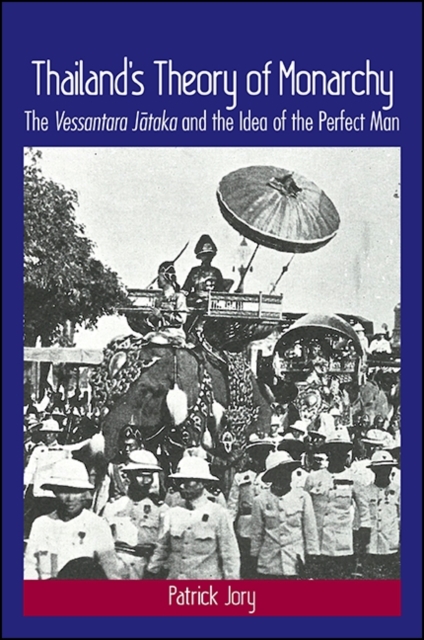
Thailand's theory of monarchy : the Vessantara Jataka and the idea of the perfect man
2016 CHOICE Outstanding Academic TitleSince the 2006 coup d'état, Thailand has been riven by two opposing political visions: one which aspires to a modern democracy and the rule of law, and another which holds to the traditional conception of a kingdom ruled by an exemplary Buddhist monarch. Thailand has one of the world's largest populations of observant Buddhists and one of its last politically active monarchies. This book examines the Theravada Buddhist foundations of Thailand's longstanding institution of monarchy. Patrick Jory states that the storehouse of monarchical ideology is to be found in the popular literary genre known as the Jatakas, tales of the Buddha's past lives. The best-known of these, the Vessantara Jataka, disseminated an ideal of an infinitely generous prince as a bodhisatta or future Buddha-an ideal which remains influential in Thailand today. Using primary and secondary source materials largely unknown in Western scholarship, Jory traces the history of the Vessantara Jataka and its political-cultural importance from the ancient to the modern period. Although pressures from European colonial powers and Buddhist reformers led eventually to a revised political conception of the monarchy, the older Buddhist ideal of kingship has yet endured.
eBook