
Catalogue Search | MBRL


Are you sure you want to remove the book from the shelf?

{{itemTitle}}
10
result(s) for
"The History of the Decline and Fall of the Roman Empire"
Sort by:

The Roman Predicament
Modern America owes the Roman Empire for more than gladiator movies and the architecture of the nation's Capitol. It can also thank the ancient republic for some helpful lessons in globalization. So argues economic historian Harold James in this masterful work of intellectual history.
The book addresses what James terms \"the Roman dilemma\"--the paradoxical notion that while global society depends on a system of rules for building peace and prosperity, this system inevitably leads to domestic clashes, international rivalry, and even wars. As it did in ancient Rome, James argues, a rule-based world order eventually subverts and destroys itself, creating the need for imperial action. The result is a continuous fluctuation between pacification and the breakdown of domestic order.
James summons this argument, first put forth more than two centuries ago in Adam Smith'sWealth of Nationsand Edward Gibbon'sDecline and Fall of the Roman Empire, to put current events into perspective. The world now finds itself staggering between a set of internationally negotiated trading rules and exchange--rate regimes, and the enforcement practiced by a sometimes-imperial America. These two forces--liberal international order and empire--will one day feed on each other to create a shakeup in global relations, James predicts. To reinforce his point, he invokes the familiarbon motonce applied to the British Empire:\"When Britain could not rule the waves, it waived the rules.\"
Despite the pessimistic prognostications of Smith and Gibbon, who saw no way out of this dilemma, James ends his book on a less depressing note. He includes a chapter on one possible way in which the world could resolve the Roman Predicament--by opting for a global system based on values as opposed to rules.
eBook

Before and After Muhammad
Islam emerged amid flourishing Christian and Jewish cultures, yet students of Antiquity and the Middle Ages mostly ignore it. Despite intensive study of late Antiquity over the last fifty years, even generous definitions of this period have reached only the eighth century, whereas Islam did not mature sufficiently to compare with Christianity or rabbinic Judaism until the tenth century.Before and After Muhammadsuggests a new way of thinking about the historical relationship between the scriptural monotheisms, integrating Islam into European and West Asian history.
Garth Fowden identifies the whole of the First Millennium--from Augustus and Christ to the formation of a recognizably Islamic worldview by the time of the philosopher Avicenna--as the proper chronological unit of analysis for understanding the emergence and maturation of the three monotheistic faiths across Eurasia. Fowden proposes not just a chronological expansion of late Antiquity but also an eastward shift in the geographical frame to embrace Iran.
InBefore and After Muhammad, Fowden looks at Judaism, Christianity, and Islam alongside other important developments in Greek philosophy and Roman law, to reveal how the First Millennium was bound together by diverse exegetical traditions that nurtured communities and often stimulated each other.
eBook
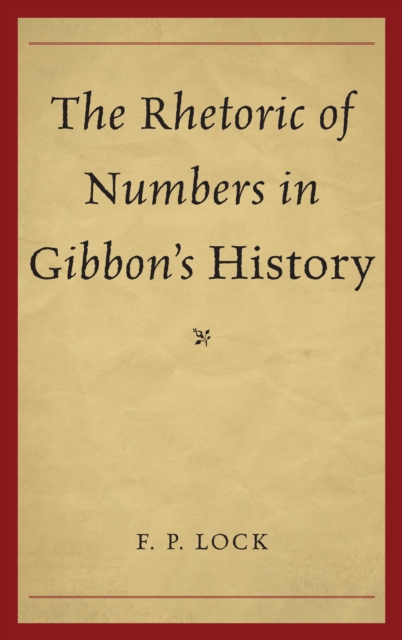
The Rhetoric of Numbers in Gibbon's History
Gibbon aspired to combine the critical analysis of the eighteenth-century philosophe with the older traditions of the humanist and scholarly historian.His different uses of numbers, to inform and to persuade, illustrate his remarkable fusion of these approaches.
eBook

Gibbon’s Christianity
There has never been much doubt about the faith of the \"infidel
historian\" Edward Gibbon. But for all of Gibbon's skepticism
regarding Christianity's central doctrines, the author of The
History of the Decline and Fall of the Roman Empire did not
merely seek to oppose Christianity; he confronted it as a
philosophical and historical puzzle. Gibbon's Christianity
tallies the results and conditions of that confrontation.
Using rich correspondence, private journals, early works, and
memoirs that were never completed, Hugh Liebert provides intimate
access to Gibbon's life in order to better understand his complex
relationship with religion. Approaching the Decline and
Fall from the context surrounding its conception, Liebert
shows how Gibbon adapted explanations of the Roman republic's rise
to account for a new spiritual republic and, subsequently, the rise
of modern Europe. Taken together, Liebert's analysis of this
context, including the nuance of Gibbon's relationship to
Christianity, and his readings of Gibbon's better- and lesser-known
texts suggest a historian more eager to comprehend Christianity's
worldly power than to sneer at or dismiss it.
Eminently readable and wholly accessible to anyone interested in
or familiar with the Decline and Fall , this groundbreaking
reassessment of Gibbon's most famous work will appeal especially to
scholars of eighteenth-century studies.
eBook


War in Social Thought
This book, the first of its kind, provides a sweeping critical history of social theories about war and peace from Hobbes to the present. Distinguished social theorists Hans Joas and Wolfgang Knöbl present both a broad intellectual history and an original argument as they trace the development of thinking about war over more than 350 years--from the premodern era to the period of German idealism and the Scottish and French enlightenments, and then from the birth of sociology in the nineteenth century through the twentieth century. While focusing on social thought, the book draws on many disciplines, including philosophy, anthropology, and political science.
Joas and Knöbl demonstrate the profound difficulties most social thinkers--including liberals, socialists, and those intellectuals who could be regarded as the first sociologists--had in coming to terms with the phenomenon of war, the most obvious form of large-scale social violence. With only a few exceptions, these thinkers, who believed deeply in social progress, were unable to account for war because they regarded it as marginal or archaic, and on the verge of disappearing. This overly optimistic picture of the modern world persisted in social theory even in the twentieth century, as most sociologists and social theorists either ignored war and violence in their theoretical work or tried to explain it away. The failure of the social sciences and especially sociology to understand war, Joas and Knöbl argue, must be seen as one of the greatest weaknesses of disciplines that claim to give a convincing diagnosis of our times.
eBook

REVIEW --- Masterpiece: Erudition and Entertainment
In a footnote to this item, in the fifth volume of \"The History of the Decline and Fall of the Roman Empire,\" Edward Gibbon writes: \"If I may speak of myself (the only person of whom I can speak with certainty), my happy hours have far exceeded, and far exceed, the scanty number of the caliph of Spain; and I shall not scruple to add, that many of them are due to the pleasing labour of the present composition.\"
Newspaper Article

Development and Crisis in Ancient Rome: the Role of Mediterranean Trade
Between the second and the third century A.D., after centuries characterized by nearly continuous growth, the Roman Empire experienced a profound crisis. Evidence of this crisis comes from important economic signals, such as the fineness of coins and the number of shipwrecks in the Mediterranean Sea. After showing that the empire's economic decline had already begun in the second century A.D., we will outline a hypothesis about the causes of the fall, based on the de-specialization of the Roman economic system, which prevented it from continuing its evolution towards modernity, leading it instead along a path of progressive implosion.
Journal Article

Sympathy for the Sovereign: Sovereignty, Sympathy, and the Colonial Relation in Edward Gibbon's \The Decline and Fall of the Roman Empire\
This article argues that Edward Gibbon's The Decline and Fall of the Roman Empire makes a timely and decisive intervention in eighteenth-century political philosophy. Rejecting attempts to reduce the social bond to its horizontal through the force of sympathy or through the emergent ideology of cosmopolitanism, Gibbon insists on the continuing importance of the vertical, and radically unequal, bond between sovereign and subject to the constitution of the social field. Moving from an analysis of Gibbon's portrayal of an absolute disjunction between the interests and happiness of sovereign and subject within the Roman Empire, the essay then argues that Gibbon illustrates the persistence of this disjunction in the eighteenth-century in the relation between Europe and its colonial territories. Finally, the essay claims that Gibbon's intervention is relevant to current debates about sovereignty and globalization within the fields of eighteenth-century studies and contemporary political philosophy.
Journal Article