
Catalogue Search | MBRL


Are you sure you want to remove the book from the shelf?

{{itemTitle}}
17,695
result(s) for
"The State and Revolution"
Sort by:

Revolutionary Backlash
The Seneca Falls Convention is typically seen as the beginning of the first women's rights movement in the United States. Revolutionary Backlash argues otherwise. According to Rosemarie Zagarri, the debate over women's rights began not in the decades prior to 1848 but during the American Revolution itself. Integrating the approaches of women's historians and political historians, this book explores changes in women's status that occurred from the time of the American Revolution until the election of Andrew Jackson.Although the period after the Revolution produced no collective movement for women's rights, women built on precedents established during the Revolution and gained an informal foothold in party politics and male electoral activities. Federalists and Jeffersonians vied for women's allegiance and sought their support in times of national crisis. Women, in turn, attended rallies, organized political activities, and voiced their opinions on the issues of the day. After the publication of Mary Wollstonecraft's A Vindication of the Rights of Woman, a widespread debate about the nature of women's rights ensued. The state of New Jersey attempted a bold experiment: for a brief time, women there voted on the same terms as men.Yet as Rosemarie Zagarri argues in Revolutionary Backlash, this opening for women soon closed. By 1828, women's politicization was seen more as a liability than as a strength, contributing to a divisive political climate that repeatedly brought the country to the brink of civil war. The increasing sophistication of party organizations and triumph of universal suffrage for white males marginalized those who could not vote, especially women. Yet all was not lost. Women had already begun to participate in charitable movements, benevolent societies, and social reform organizations. Through these organizations, women found another way to practice politics.
eBook

Unfriendly to Liberty
In Unfriendly to
Liberty , Christopher F. Minty explores the
origins of loyalism in New York City between 1768 and 1776, and
revises our understanding of the coming of the American
Revolution.
Through detailed analyses of those who became loyalists, Minty
argues that would-be loyalists came together long before Lexington
and Concord to form an organized, politically motivated, and
inclusive political group that was centered around the DeLancey
faction. Following the DeLanceys' election to the New York Assembly
in 1768, these men, elite and nonelite, championed an inclusive
political economy that advanced the public good, and they strongly
protested Parliament's reorientation of the British Empire.
For New York loyalists, it was local politics, factions,
institutions, and behaviors that governed their political
activities in the build up to the American Revolution. By focusing
on political culture, organization, and patterns of allegiance,
Unfriendly to Liberty shows how the contending allegiances
of loyalists and patriots were all but locked in place by 1775 when
British troops marched out of Boston to seize caches of weapons in
neighboring villages.
Indeed, local political alignments that were formed in the
imperial crises of the 1760s and 1770s provided a critical platform
for the divide between loyalists and patriots in New York City.
Political and social disputes coming out of the Seven Years' War,
more than republican radicalization in the 1770s, forged the united
force that would make New York City a center of loyalism throughout
the American Revolution.
eBook

Sealed with Blood
The first martyr to the cause of American liberty was Major General Joseph Warren, a well-known political orator, physician, and president of the Provincial Congress of Massachusetts. Shot in the face at close range at Bunker Hill, Warren was at once transformed into a national hero, with his story appearing throughout the colonies in newspapers, songs, pamphlets, sermons, and even theater productions. His death, though shockingly violent, was not unlike tens of thousands of others, but his sacrifice came to mean something much more significant to the American public.Sealed with Bloodreveals how public memories and commemorations of Revolutionary War heroes, such as those for Warren, helped Americans form a common bond and create a new national identity. Drawing from extensive research on civic celebrations and commemorative literature in the half-century that followed the War for Independence, Sarah Purcell shows how people invoked memories of their participation in and sacrifices during the war when they wanted to shore up their political interests, make money, argue for racial equality, solidify their class status, or protect their personal reputations. Images were also used, especially those of martyred officers, as examples of glory and sacrifice for the sake of American political principles. By the midnineteenth century, African Americans, women, and especially poor white veterans used memories of the Revolutionary War to articulate their own, more inclusive visions of the American nation and to try to enhance their social and political status. Black slaves made explicit the connection between military service and claims to freedom from bondage. Between 1775 and 1825, the very idea of the American nation itself was also democratized, as the role of \"the people\" in keeping the sacred memory of the Revolutionary War broadened.
eBook

Imperial Republics
Imperial Republicsis a sophisticated, wide-ranging examination of the intellectual origins of republican movements, and explains why revolutionaries felt the need to 'don the toga' in laying the foundation for their own uprisings.
eBook

Sentiments of a British-American Woman
At the time of her death in 1780, British-born Esther DeBerdt Reed—a name few know today—was one of the most politically important women in Revolutionary America. Her treatise \"The Sentiments of an American Woman\" articulated the aspirations of female patriots, and the Ladies Association of Philadelphia, which she founded, taught generations of women how to translate their political responsibilities into action. DeBerdt Reed's social connections and political sophistication helped transform her husband, Joseph Reed, from a military leader into the president of the Supreme Executive Council of Pennsylvania, a position analogous to the modern office of governor.
DeBerdt Reed's life yields remarkable insight into the scope of women's political influence in an age ruled by the strict social norms structured by religion and motherhood. The story of her courtship, marriage, and political career sheds light both on the private and political lives of women during the Revolution and on how society, religion, and gender interacted as a new nation struggled to build its own identity.
Engaging, comprehensive, and built on primary source material that allows DeBerdt Reed's own voice to shine, Owen Ireland's expertly researched biography rightly places her in a prominent position in the pantheon of our founders, both female and male.
eBook
Whose American Revolution Was It?
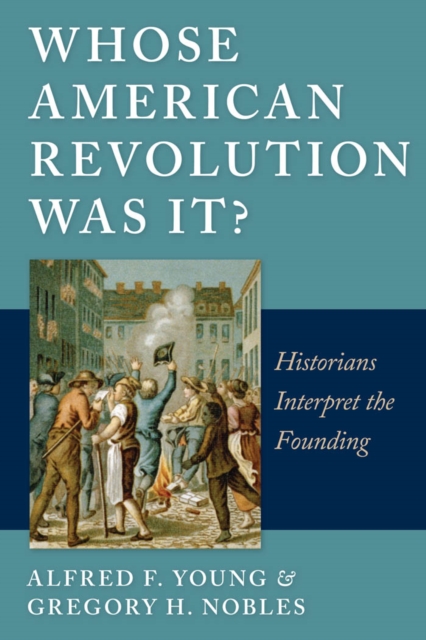
The meaning of the American Revolution has always been a much-contested question, and asking it is particularly important today: the standard, easily digested narrative puts the Founding Fathers at the head of a unified movement, failing to acknowledge the deep divisions in Revolutionary-era society and the many different historical interpretations that have followed. Whose American Revolution Was It? speaks both to the ways diverse groups of Americans who lived through the Revolution might have answered that question and to the different ways historians through the decades have interpreted the Revolution for our own time. As the only volume to offer an accessible and sweeping discussion of the period's historiography and its historians, Whose American Revolution Was It? is an essential reference for anyone studying early American history. The first section, by Alfred F. Young, begins in 1925 with historian J. Franklin Jameson and takes the reader through the successive schools of interpretation up to the 1990s. The second section, by Gregory H. Nobles, focuses primarily on the ways present-day historians have expanded our understanding of the broader social history of the Revolution, bringing onto the stage farmers and artisans, who made up the majority of white men, as well as African Americans, Native Americans, and women of all social classes.
eBook


The men who lost America : British leadership, the American Revolution, and the fate of the empire
A unique account of the American Revolution, told from the perspective of the leaders who conducted the British war effort.
eBook

Gender and the Mexican Revolution
The state of Yucatan is commonly considered to have been a hotbed of radical feminism during the Mexican Revolution. Challenging this romanticized view, Stephanie Smith examines the revolutionary reforms designed to break women's ties to tradition and religion, as well as the ways in which women shaped these developments.Smith analyzes the various regulations introduced by Yucatan's two revolution-era governors, Salvador Alvarado and Felipe Carrillo Puerto. Like many revolutionary leaders throughout Mexico, the Yucatan policy makers professed allegiance to women's rights and socialist principles. Yet they, too, passed laws and condoned legal practices that excluded women from equal participation and reinforced their inferior status.Using court cases brought by ordinary women, including those of Mayan descent, Smith demonstrates the importance of women's agency during the Mexican Revolution. But, she says, despite the intervention of women at many levels of Yucatecan society, the rigid definition of women's social roles as strictly that of wives and mothers within the Mexican nation guaranteed that long-term, substantial gains remained out of reach for most women for years to come.
eBook

Enemyship
The Declaration of Independence is usually celebrated as a radical document that inspired revolution in the English colonies, in France, and elsewhere. InEnemyship, however, Jeremy Engels views the Declaration as a rhetorical strategy that outlined wildly effective arguments justifying revolution against a colonial authority-and then threatened political stability once independence was finally achieved.Enemyshipexamines what happened during the latter years of the Revolutionary War and in the immediate post-Revolutionary period, when the rhetorics and energies of revolution began to seem problematic to many wealthy and powerful Americans.To mitigate this threat, says Engles, the founders of the United States deployed the rhetorics of what he calls \"enemyship,\" calling upon Americans to unite in opposition to their shared national enemies.
eBook