
Catalogue Search | MBRL


Are you sure you want to remove the book from the shelf?

{{itemTitle}}
393
result(s) for
"Theater and society United States History."
Sort by:

On the performance front : US theatre and internationalism
\"On the Performance Front argues that US theatre in the twentieth century embraced the theories and practices of internationalism as a way to realize a better world and as part of the strategic reform of the theatre into a national expression. Live performance, theatre internationalists argued, could represent and reflect the nation like no other endeavour. On the Performance Front focuses on US theatre's international efforts without losing sight of either the ways these efforts mirrored those in other countries or the complex, often conflicting, relationship between internationalism and nationalism\"-- Provided by publisher.
Book

Ring Shout, Wheel About
In this ambitious project, historian Katrina Thompson examines the conceptualization and staging of race through the performance, sometimes coerced, of black dance from the slave ship to the minstrel stage. She shows how these performances informed white European and American understandings of race, influenced interactions between whites and blacks, and often held conflicting meanings in enslaved people's lives. Drawing on travel journals, slave narratives, popular literature, and historical sources, Thompson explicates how black dance was used by whites to justify enslavement, perpetuate the existing racial hierarchy, and mask the brutality of the domestic slave trade. Whether on slave ships, at the auction block, or on plantations, whites often used coerced performances to oppress and demean the enslaved. As Thompson explains, however, blacks' \"backstage\" dance often served quite a different purpose. Through creolization and other means, enslaved people preserved some native musical and dance traditions and invented or adopted new traditions that built community and even aided rebellion.Thompson shows how these traditions evolved into nineteenth-century minstrelsy and, ultimately, raises the question of whether today's mass media performances and depictions of African Americans are so very far removed from their troublesome roots.
eBook


Antitheatricality and the Body Public
Situating the theater as a site of broad cultural movements and conflicts, Lisa A. Freeman asserts that antitheatrical incidents from the English Renaissance to present-day America provide us with occasions to trace major struggles over the nature and balance of power and political authority. In studies of William Prynne's Histrio-mastix (1633), Jeremy Collier's A Short View of the Immorality and Profaneness of the English Stage (1698), John Home's Douglas (1757), the burning of the theater at Richmond (1811), and the U.S. Supreme Court's decision in National Endowment for the Arts v. Finley (1998) Freeman engages in a careful examination of the political, religious, philosophical, literary, and dramatic contexts in which challenges to theatricality unfold. In so doing, she demonstrates that however differently \"the public\" might be defined in each epoch, what lies at the heart of antitheatrical disputes is a struggle over the character of the body politic that governs a nation and the bodies public that could be said to represent that nation.By situating antitheatrical incidents as rich and interpretable cultural performances, Freeman seeks to account fully for the significance of these particular historical conflicts. She delineates when, why, and how anxieties about representation manifest themselves, and traces the actual politics that govern such ostensibly aesthetic and moral debates even today.
eBook


Spectacles of Reform
In the nineteenth century, long before film and television brought us explosions, car chases, and narrow escapes, it was America's theaters that thrilled audiences, with \"sensation scenes\" of speeding trains, burning buildings, and endangered bodies, often in melodramas extolling the virtues of temperance, abolition, and women's suffrage. Amy E. Hughes scrutinizes these peculiar intersections of spectacle and reform, revealing the crucial role that spectacle has played in American activism and how it has remained central to the dramaturgy of reform.
Hughes traces the cultural history of three famous sensation scenes-the drunkard with thedelirium tremens, the fugitive slave escaping over a river, and the victim tied to the railroad tracks-assessing how these scenes conveyed, allayed, and denied concerns about the rights and responsibilities of citizenship. These images also appeared in printed propaganda, suggesting that thecoup de théâtrewas an essential part of American reform culture. Additionally, Hughes argues that today's producers and advertisers continue to exploit the affective dynamism of spectacle, reaching an even broader audience through film, television, and the Internet.
To be attuned to the dynamics of spectacle, Hughes argues, is to understand how we see. Her book will interest not only theater historians, but also scholars and students of political, literary, and visual culture who are curious about how U.S. citizens saw themselves and their world during a pivotal period in American history.
eBook

Local glories : opera houses on main street, where art and community meet
\"This book explores the creative, social, and communal roles of thousands of \"opera houses\" that appeared in towns in the late 1800s and flourished with an astounding array of cultural performances and public activities until the advent of movies. Now, these entertainment halls are now coming back to life as theaters and art centers, as people become increasingly aware of their potential for historic preservation and cultural activities\"-- Provided by publisher.
Book
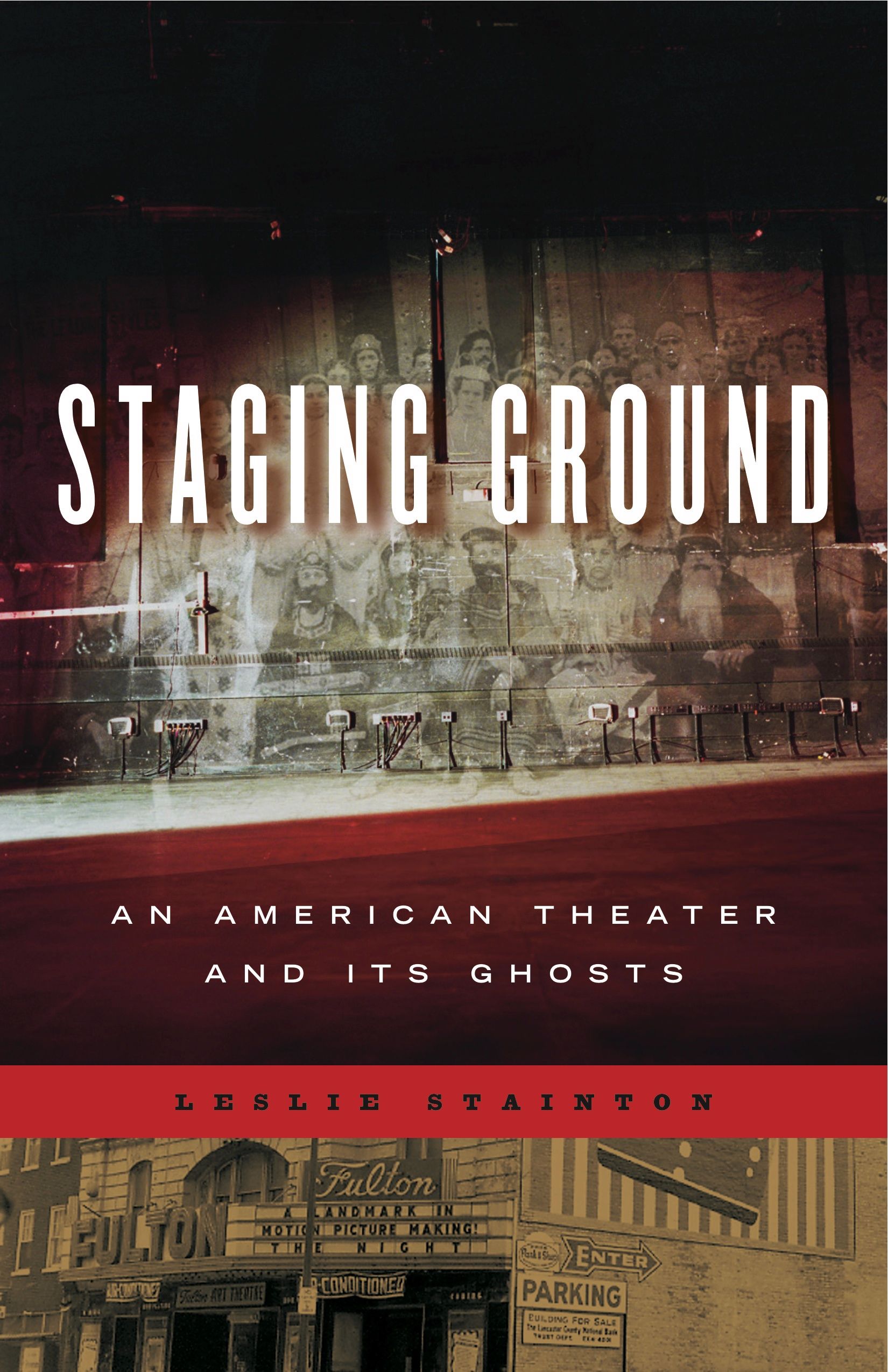
Staging Ground
In this poignant and personal history of one of America’s oldest theaters, Leslie Stainton captures the story not just of an extraordinary building but of a nation’s tumultuous struggle to invent itself. Built in 1852 and in use ever since, the Fulton Theatre in Lancaster, Pennsylvania, is uniquely ghosted. Its foundations were once the walls of a colonial jail that in 1763 witnessed the massacre of the last surviving Conestoga Indians. Those same walls later served to incarcerate fugitive slaves. Staging Ground explores these tragic events and their enduring resonance in a building that later became a town hall, theater, and movie house—the site of minstrel shows, productions of Uncle Tom’s Cabin, oratory by the likes of Thaddeus Stevens and Mark Twain, performances by Buffalo Bill and his troupe of “Wild Indians,” Hollywood Westerns, and twenty-first-century musicals. Interweaving past and present, private anecdote and public record, Stainton unfolds the story of this emblematic space, where for more than 250 years Americans scripted and rescripted their history. Staging Ground sheds light on issues that continue to form us as a people: the evolution of American culture and faith, the immigrant experience, the growth of cities, the emergence of women in art and society, the spread of advertising, the flowering of transportation and technology, and the abiding paradox of a nation founded on the principle of equality for “all men,” yet engaged in the slave trade and in the systematic oppression of the American Indian.
eBook

Provocative eloquence : theater, violence, and antislavery speech in the antebellum United States
\"In the mid-19th century, rhetoric surrounding slavery was permeated by violence. Slavery's defenders often used brute force to suppress opponents, and even those abolitionists dedicated to pacifism drew upon visions of widespread destruction. Provocative Eloquence recounts how the theater, long an arena for heightened eloquence and physical contest, proved terribly relevant in the lead up to the Civil War. As antislavery speech and open conflict intertwined, the nation became a stage. The book brings together notions of intertextuality and interperformativity to understand how the confluence of oratorical and theatrical practices in the antebellum period reflected the conflict over slavery and deeply influenced the language that barely contained that conflict. The book draws on a wide range of work in performance studies, theater history, black performance theory, oratorical studies, and literature and law to provide a new narrative of the interaction of oratorical, theatrical, and literary histories of the nineteenth-century U.S.\"-- Provided by publisher.
Book

Blue-Collar Broadway
Behind the scenes of New York City's Great White Way, virtuosos of stagecraft have built the scenery, costumes, lights, and other components of theatrical productions for more than a hundred years. But like a good magician who refuses to reveal secrets, they have left few clues about their work. Blue-Collar Broadway recovers the history of those people and the neighborhood in which their undersung labor occurred.Timothy R. White begins his history of the theater industry with the dispersed pre-Broadway era, when components such as costumes, lights, and scenery were built and stored nationwide. Subsequently, the majority of backstage operations and storage were consolidated in New York City during what is now known as the golden age of musical theater. Toward the latter half of the twentieth century, decentralization and deindustrialization brought the emergence of nationally distributed regional theaters and performing arts centers. The resulting collapse of New York's theater craft economy rocked the theater district, leaving abandoned buildings and criminal activity in place of studios and workshops. But new technologies ushered in a new age of tourism and business for the area. The Broadway we know today is a global destination and a glittering showroom for vetted products.Featuring case studies of iconic productions such as Oklahoma! (1943) and Evita (1979), and an exploration of the craftwork of radio, television, and film production around Times Square, Blue-Collar Broadway tells a rich story of the history of craft and industry in American theater nationwide. In addition, White examines the role of theater in urban deindustrialization and in the revival of downtowns throughout the Sunbelt.
eBook