
Catalogue Search | MBRL


Are you sure you want to remove the book from the shelf?

{{itemTitle}}
52,438
result(s) for
"Theater in literature"
Sort by:

Real theatre : essays in experience
\"Theatre is often said to offer unique insights into the nature of reality, but this obscures the reality of theatre itself. In Real Theatre, Paul Rae takes a joined-up approach to the realities of theatre to explain why performances take the forms they do, and what effects they have. Drawing on examples ranging from Phantom of the Opera and Danny Boyle's Frankenstein, to the performances of the Wooster Group and arthouse director Tsai Ming-liang, he shows how apparently discrete theatrical events emerge from dynamic and often unpredictable social, technical and institutional assemblages. These events then enter a process of cultural circulation that, as Rae explains, takes many forms: fleeting conversations, the mercurial careers of theatrical characters and the composite personae of actors, and high-profile products like Hollywood movie Birdman. The result is a real theatre that speaks of and to the idiosyncratic and cumulative experience of every theatre participant\"-- Provided by publisher.
Book

Drawing the Curtain
Miguel de Cervantes’s experimentation with theatricality is frequently tied to the notion of revelation and disclosure of hidden truths. Drawing the Curtain showcases the elements of theatricality that characterize Cervantes’s prose and analyses the ways in which he uses theatricality in his own literary production.
Bringing together the works of well-known scholars, who draw from a variety of disciplines and theoretical approaches, this collection demonstrates how Cervantes exploits revelation and disclosure to create dynamic dramatic moments that surprise and engage observers and readers. Hewing closely to Peter Brook’s notion of the bare or empty stage, Esther Fernández and Adrienne L. Martín argue that Cervantes’s omnipresent concern with theatricality manifests not only in his drama but also in the myriad metatheatrical instances dispersed throughout his prose works. In doing so, Drawing the Curtain sheds light on the ways in which Cervantes forces his readers to engage with themes that are central to his life and works, including love, freedom, truth, confinement, and otherness.
eBook


The Gothic Novel and the Stage: Romantic Appropriations
In this ground-breaking study Saggini explores the relationship between the late eighteenth-century novel and the theatre, arguing that the implicit theatricality of the Gothic novel made it an obvious source from which dramatists could take ideas. Similarly, elements of the theatre provided inspiration to novelists.
eBook

Rape on the contemporary stage
\"This volume investigates the representation of rape in British and Irish theatre since the second wave of the Women's Movement. Mainly focusing on the period from the 1990s to the present, it identifies key feminist debates on rape and gender, and introduces a set of ideas about the function of rape as a form of embodied, gendered violence to the analysis of dramaturgical and performance strategies used in a range of important and/or controversial works\"-- Provided by publisher.
Book
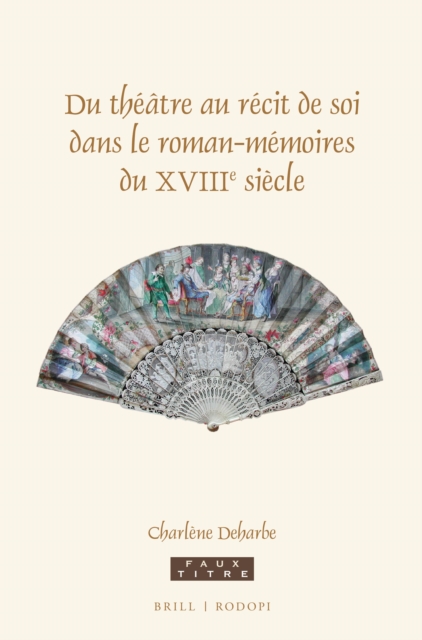
Du theatre au recit de soi dans le roman-memoires du XVIIIe siecle
Tout semble opposer le théâtre au récit de soi. Le premier se rattache aux arts du spectacle, tandis que le second relève de l'intime. Genre littéraire emblématique du XVIIIe siècle, le roman-mémoires invite à dépasser cette opposition. S'il place l'expérience vécue au coeur de son écriture, il s'approprie également le langage de la scène comique ou tragique au profit d'une fiction de l'intériorité. Ce livre montre ce que le roman-mémoires doit au théâtre, en étudiant comment son écriture s'élabore à partir de différents emprunts et procédés caractéristiques de la scène. En s'inventant au sein d'une culture dominée par le goût du spectacle, ce genre lègue ainsi à la littérature à venir les éléments constitutifs d'un langage de l'intime.Theatre and fictional memoir are supposedly opposites: the former has to do with the performing arts, while the latter focuses on the intimate side of life. A literary genre emblematic of the eighteenth century, fictional memoir invites readers to move beyond this assumption. Although lived experience is at the heart of the memoir, such fiction also appropriates the language of comedy or tragedy for the benefit of a novel of interiority. This book highlights fictional memoir's debt to the theatre, while examining how its writing developed based on various borrowings and processes characteristic of the stage. By self-inventing within a culture dominated by enthusiasm for stage performance, this genre thereby endowed future literature with the constitutive elements of a language of the intimate.
eBook


Apuleius and Drama
This book discusses the use of drama as an intertext in the work of the 2nd century Latin author Apuleius, who wrote the only complete extant Latin novel, the Metamorphoses, in which a young man is turned into a donkey by magic. Apuleius uses drama, especially comedy, as a basic underlying texture, and invites his readers to use their knowledge of contemporary drama in interpreting the fate of his protagonist and the often comic or tragic situations in which he finds himself. This book employs a close study of the Latin text and detailed comparison with the corpus of dramatic texts from antiquity, as well as discussion of stock features of ancient drama, especially of comedy, in order to explain some features of the novel which have so far baffled Apuleian scholarship, including the enigmatic ending. All Latin and Greek has been translated into English.
eBook

