Catalogue Search | MBRL


Are you sure you want to remove the book from the shelf?

{{itemTitle}}
1,539
result(s) for
"Thebes"
Sort by:

Caesar in the city of Amun : Egyptian temple construction and theology in Roman Thebes
Thebes (modern Luxor) was a popular tourist destination during the Roman Period, receiving the likes of Strabo, Germanicus, and Hadrian. Yet while its international fame rested on its royal tombs and the Memnon colossus, Thebes was also a vibrant religious center with over a dozen active temples. The purposefully archaizing inscriptions and architecture attracted both Egyptians and Romans in search of ancient traditions and millennial wisdom, influencing intercultural and multilingual texts produced in the region, including Gnostic, Hermetic, and magical writings. This book surveys epigraphic and archaeological evidence for temple construction and renovation throughout the Theban nome during the Roman Period, studying the new inscriptions within their ritual and theological contexts. It also contains the first comprehensive treatment of the greater Theban Pantheon during the Graeco-Roman era, cataloguing over fifty local divinities and establishing their roles in various cosmogonies and mythological traditions. The concluding chapter reconstructs the religious life of the district, tracking annual festival processions which united the multiple temples and their communities.
BOOK

Social Memory in Athenian Public Discourse
Prompted by the abundant historical allusions in Athenian political and diplomatic discourse, Bernd Steinbock analyzes the uses and meanings of the past in fourth-century Athens, using Thebes' role in Athenian memory as a case study. This examination is based upon the premise that Athenian social memory, that is, the shared and often idealized and distorted image of the past, should not be viewed as an unreliable counterpart of history but as an invaluable key to the Athenians' mentality. Against the tendency to view the orators' references to the past as empty rhetorical phrases or propagandistic cover-ups forRealpolitik,it argues that the past constituted important political capital in its own right. Drawing upon theories of social memory, it contextualizes the orators' historical allusions within the complex net of remembrances and beliefs held by the audience and thus tries to gauge their ideological and emotive power.Integrating literary, epigraphic, and archaeological evidence with recent scholarship on memory, identity, rhetoric, and international relations,Social Memory in Athenian Public Discourse: Uses and Meanings of the Pastenhances our understanding of both the function of memory in Athenian public discourse and the history of Athenian-Theban relations. It should be of interest not only to students of Greek history and oratory but to everybody interested in memory studies, Athenian democracy, and political decision making.
eBook
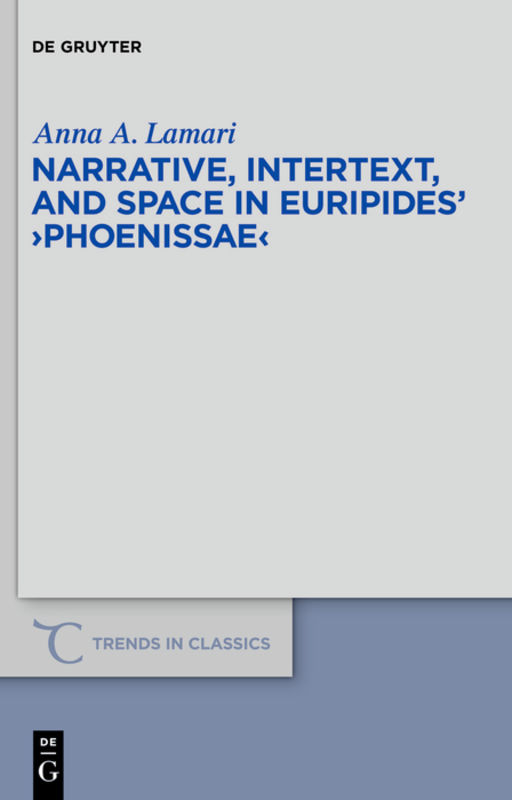
Narrative, Intertext, and Space in Euripides' \Phoenissae\
Euripides' Phoenissae bears one of the richest tragic plots: multiple narrative levels are interwoven by means of various anachronies, focalizers offer different and often challenging points of view, while a complex mythical matrix is deftly employed as the backdrop against which the exploration of the mechanics of tragic narrative takes place. After providing a critical perspective on the ongoing scholarly dialogue regarding narratology and drama, this book uses the former as a working tool for the study and interpretation of the latter. The Phoenissae is approached as a coherent narrative unit and issues like the use of myth, narrators, intertext, time and space are discussed in detail. It is within these contexts that the play is seen as a Theban mythical 'thesaurus' both exploring previous mythical ramifications and making new additions. The result is rewarding: Euripides constructs a handbook of the Theban saga that was informative for those mythically untrained, fascinating for those theatrically demanding, but also dexterously open upon each one's reception.
eBook

Architectural Landscape. A New Interpretation of the Sloping Ceiling of Rekhmire’s Tomb Chapel (TT 100)
The tomb TT 100, belonging to the vizier Rekhmire, in the Theban necropolis (Luxor, Egypt), one of the best examples of funerary architecture of the Egyptian New Kingdom, has been widely studied since the beginning of the 20th century from the iconographic, historical and archaeological points of view. However, it has an anomalous structural feature for the classic Theban tomb typology of this period: a longitudinal corridor with a sloping ceiling ending in a combination of false stela and niche for a funerary statue. The anomaly, widely noted in classical literature, has been vaguely explained and often forgotten due to the celebrated decorative program that occupies the tomb. This study aims to offer a reinterpretation of this architectural feature of the tomb based on a landscape archaeology approach. According to this methodology, the ancestral landscape of the necropolis, and the architectural and artistic features of the tomb of his relative and predecessor in the vizierate Useramun are significant elements for the interpretation of this element. The main result is Rekhmire’s clear intention to emulate and replicate Useramun’s double funerary structure, not only from the artistic point of view (already demonstrated in previous studies) but also from the spatial point of view, copying the phenomenological experience of space and landscape in the architectural development of his tomb. An example of how landscape archaeology can be useful in the study of the art of this ancient culture.
Journal Article

Tombs of the South Asasif Necropolis : new discoveries and research 2012-14
[v.1] is a joint publication of the members of the American-Egyptian mission South Asasif Conservation Project, working under the auspices of the State Ministry for Antiquities and Supreme Council of Antiquities, and directed by the editor. The Project is dedicated to the clearing, restoration, and reconstruction of the tombs of Karabasken (TT 391) and Karakhamun (TT 223) of the Twenty-fifth Dynasty, and the tomb of Irtieru (TT 390) of the Twenty-sixth Dynasty, on the West Bank of Luxor. These tombs, located in the South Asasif necropolis, were considered almost completely ruined by floods and constant re-usage. Therefore, when the project was initiated in 2006, the team was uncertain of the condition of the tombs and the amount of original material still remaining in the ruins and debris. The results of the first few years of work surpassed the most optimistic prognoses, of which there were not many. The tombs, as damaged as they are, have proved to be reconstructible, based on the thousands of fragments of the original decoration found during the clearing of the remains of the architectural features.
BOOK
The Medieval Tradition of Thebes
First Published in 2004. Routledge is an imprint of Taylor & Francis, an informa company.
Dominique Battles received her Ph.D. in English from the University of Virginia. She is currently Assistant Professor of English at Hanover College
eBook