
Catalogue Search | MBRL


Are you sure you want to remove the book from the shelf?

{{itemTitle}}
25
result(s) for
"Themistius"
Sort by:
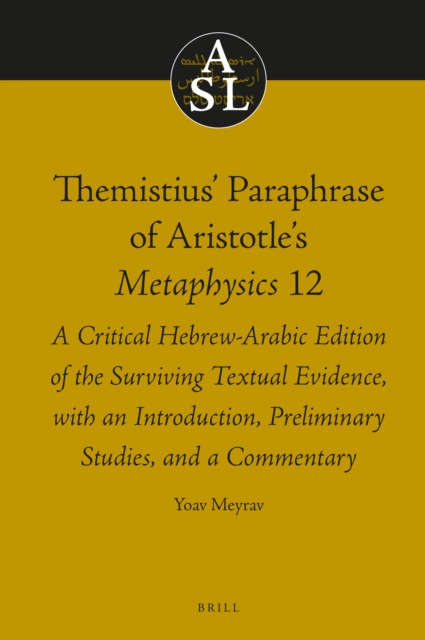
Themistius' paraphrase of Aristotle's Metaphysics 12 : a critical Hebrew-Arabic edition of the surviving textual evidence, with an introduction, preliminary studies, and a commentary
In Themistius' Paraphrase of Aristotle's Metaphysics 12, Yoav Meyrav offers a new critical edition and study of the Hebrew text and the Arabic fragments of Themistius' 4th century paraphrase, whose original Greek is lost.
eBook

Themistius, Julian, and Greek Political Theory under Rome
Themistius' close relationship with Christian emperors from Constantius to Theodosius makes him one of the most important political thinkers and politicians of the later fourth century, and his dealings with Julian the Apostate have recently attracted much speculation. This volume presents a new critical edition, translation and analysis of Themistius' letter to Julian about kingship and government, which survives mainly in Arabic, together with texts, translations and analyses of Julian's Letter to Themistius and Sopater's Letter to Himerius. The volume is completed with a text, translation and analysis of the other genuine work of Greek political theory to survive in Arabic, the Letter of Aristotle to Alexander, which dates from an earlier period and throws into relief the particular concerns of Themistius, Julian, and the rulers of the fourth-century Roman world.
eBook

THEMISTIUS AGAINST PORPHYRY (?) ON ‘WHY WE DO NOT REMEMBER’
This article sheds new light on Themistius’ argument in what is philosophically the most original (and historically the most influential) section of his extant work, namely On Aristotle's On the Soul 100.16–109.3: here, Themistius offers a systematic interpretation of Aristotle's ‘agent’ intellect and its ‘potential’ and ‘passive’ counterparts. A solution to two textual difficulties at 101.36–102.2 is proposed, supported by the Arabic translation. This allows us to see that Themistius engages at length with a Platonizing reading of the enigmatic final lines of De anima III.5, where Aristotle explains ‘why we do not remember’ (without specifying when and what). This Platonizing reading (probably inspired by Aristotle's early dialogue Eudemus) can be safely identified with the one developed in a fragmentary text extant only in Arabic under the title Porphyry's treatise On the soul. While Themistius rejects this reading, he turns out to be heavily influenced by the author's interpretation of the ‘agent’, ‘potential’ and ‘passive’ intellect. These findings offer us a new glimpse into Themistius’ philosophical programme: he is searching for an alternative to both the austere (and, by Themistius’ lights, distorted) Aristotelianism of Alexander of Aphrodisias and the all too Platonizing reading of Aristotle adopted by thinkers such as Porphyry.
Journal Article
A Factory of Magnificence: Themistius, Thucydides, and Constantinople
In Themistius’ orations there are many clear and direct references to the Greek literature of the 5th and 4th centuries BCE. However, there are also more subtle references to these classical texts. In this paper, two references to classical Greek historiography are identified in Themistius’ Oration 18. As we shall see, in order to praise the refashioning of Constantinople by Theodosius the Great, Themistius subtly quoted a passage by Xenophon. In order to highlight the splendour of the city of Constantinople, he also used as a reference one of the most eminent classical encomia of cities, that is, Pericles’ funeral oration from the second book of Thucydides’ History. Both references served to enhance Themistius’ already good relations with Theodosius I, who had recently renovated Constantinople with new monuments. This research thus stresses the relevance of quotations in Themistius’ orations when studying his political agenda, including quotations that are less obvious and less easily identifiable.
Journal Article

The School of Libanius in Late Antique Antioch
This book is a study of the fourth-century sophist Libanius, a major intellectual figure who ran one of the most prestigious schools of rhetoric in the later Roman Empire. He was a tenacious adherent of pagan religion and a friend of the emperor Julian, but also taught leaders of the early Christian church like St. John Chrysostom and St. Basil the Great. Raffaella Cribiore examines Libanius's training and personality, showing him to be a vibrant educator, though somewhat gloomy and anxious by nature. She traces how he cultivated a wide network of friends and former pupils and courted powerful officials to recruit top students. Cribiore describes his school in Antioch--how students applied, how they were evaluated and trained, and how Libanius reported progress to their families. She details the professional opportunities that a thorough training in rhetoric opened up for young men of the day. Also included here are translations of 200 of Libanius's most important letters on education, almost none of which have appeared in English before.
Cribiore casts into striking relief the importance of rhetoric in late antiquity and its influence not only on pagan intellectuals but also on prominent Christian figures. She gives a balanced view of Libanius and his circle against the far-flung panorama of the Greek East.
eBook

Violence at Constantinople in A.D. 341–2 and Themistius, Oration 1
This article argues that Oration 1 by Themistius was prompted by violence at Constantinople in 341–2, and that the likeliest date for the speech is as early as March 342. Detailed arguments are presented in support of this correlation, which contrasts with the usual assignment of Themistius' speech to either 347/348 or 350/351. The wider significance of these arguments is also highlighted. In particular, there are implications for our understanding of the chronology and overall trajectory of Themistius' early career; and implications for the development of imperial ideology in the 340s.
Journal Article
IAMBLICHUS’ EPISTLES, FOURTH-CENTURY PHILOSOPHICAL AND POLITICAL EPISTOLOGRAPHY AND THE NEOPLATONIC CURRICULA AT ATHENS AND ALEXANDRIA
As a literary genre and practice, philosophical and political epistolography seems to have been alive and well in the fourth-century Roman empire. We have fragments of twenty letters of the late third- and early fourth-century c.e. Platonist (Neoplatonist to us) philosopher Iamblichus of Chalcis (which are preserved in the early fifth-century Ioannes Stobaeus’ Anthologium [ = Flor.]) to former students and other contemporaries, some of whom appear to have been imperial officeholders (see Appendix); the Epistle to Himerius of Sopater the Younger (which is partially preserved in Stobaeus, 4.5.51–60, in sequential extracts; this Sopater is the homonymous son of the philosopher who had been Iamblichus’ student) to his brother Himerius on the latter's assumption of an unknown governorship (ἡγεμονία) in the East, probably sometime in the 340s or 350s (and so under the Emperor Constantius II); the Emperor Julian's Epistle to Themistius, which was likely written and published c.December 361/early 362; and the Epistle to Julian of the Aristotelian philosopher Themistius on proper rule (preserved in two Arabic manuscripts from the eleventh and fourteenth/fifteenth centuries), which seems to have been a response, in part, to Julian's Epistle to Themistius and perhaps was written to the emperor when both men likely resided in Constantinople at the same time. These philosophical and political letters are but a few examples from this period. All four authors mentioned above, who are representative of intellectual life in the East during the fourth century, produced epistles which reflect Greek political theory in a Roman imperial context.
Journal Article

Ancient Antioch
This study incorporates findings of the 1932-1939 excavations.
Originally published in 1962.
The Princeton Legacy Library uses the latest print-on-demand technology to again make available previously out-of-print books from the distinguished backlist of Princeton University Press. These editions preserve the original texts of these important books while presenting them in durable paperback and hardcover editions. The goal of the Princeton Legacy Library is to vastly increase access to the rich scholarly heritage found in the thousands of books published by Princeton University Press since its founding in 1905.
eBook

The Age of Palladas
In recent articles and contributions, Kevin W. Wilkinson has identified some clues, in the text of several epigrams by Palladas of Alexandria, which, in his view, enable us to date this epigrammatic poet back to the age of Constantine. By analysing a number of passages, Wilkinson backdates Palladas by about sixty years, possibly as far back as a century. He tries to prove this new chronological reconstruction with the help of a new papyrus find, which he himself has published and which he would like to attribute to Palladas. There is no evidence that the Yale Papyrus (P. Ct. ybr Inv. 4000) is really a codex with epigrams by Palladas. As a result, its dating is still uncertain and the traditional date ascribed to Palladas (between the end of the 4th and the beginning of the 5th century ad) is still the most logical, and is confirmed by a long series of epigrams attributed to the Alexandrian poet in the Greek Anthology.
Journal Article

Benedetto Varchi on the Soul: Vernacular Aristotelianism between Reason and Faith
In this paper, I wish to present the first full-fledged investigation of Benedetto Varchi’s manuscript writings on psychology, which show the depth of his familiarity with philosophy and his originality as a thinker. In particular, I wish to show that Varchi was not an Averroist. Rather in the manuscript Varchi rejects Averroistic doctrines and seeks to reconcile Aristotelian psychology with the truth of religion. In so doing, Varchi appropriates Themistius’s interpretation of Aristotle through the filter of Marcantonio Zimara’s writings, which allows him to support the immortality and indivisibility of the human soul while safeguarding the doctrines of Christian faith.
Journal Article