
Catalogue Search | MBRL


Are you sure you want to remove the book from the shelf?

{{itemTitle}}
15,796
result(s) for
"Theologians"
Sort by:

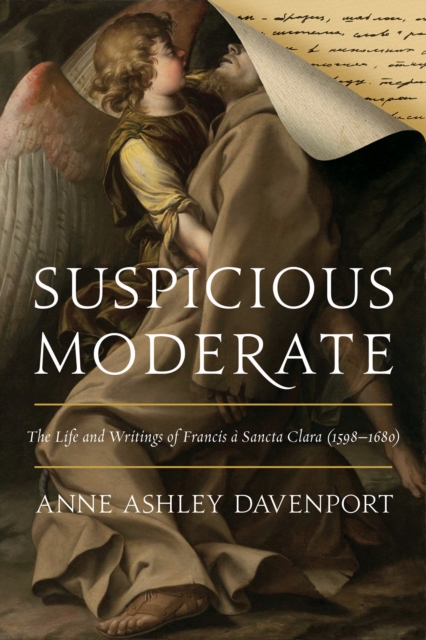
Suspicious moderate: the life and writings of Francis áa Sancta Clara (1598-1680)
The historiography of English Catholicism has grown enormously in the last generation, led by scholars such as Peter Lake, Michael Questier, Stefania Tutino, and others. In Suspicious Moderate, Anne Ashley Davenport makes a significant contribution to that literature by presenting a long overdue intellectual biography of the influential English Catholic theologian Francis à Sancta Clara (1598-1680). Born into a Protestant family in Coventry at the end of the sixteenth century, Sancta Clara joined the Franciscan order in 1617. He played key roles in reviving the English Franciscan province and in the efforts that were sponsored by Charles I to reunite the Church of England with Rome. In his voluminous Latin writings, he defended moderate Anglican doctrines, championed the separation of church and state, and called for state protection of freedom of conscience. Suspicious Moderate offers the first detailed analysis of Sancta Clara's works. In addition to his notorious Deus, natura, gratia (1634), Sancta Clara wrote a comprehensive defense of episcopacy (1640), a monumental treatise on ecumenical councils (1649), and a treatise on natural philosophy and miracles (1662). By carefully examining the context of Sancta Clara's ideas, Davenport argues that he aimed at educating English Roman Catholics into a depoliticized and capacious Catholicism suited to personal moral reasoning in a pluralistic world. In the course of her research, Davenport also discovered that \"Philip Scot,\" the author of the earliest English discussions of Hobbes (a treatise published in 1650), was none other than Sancta Clara. Davenport demonstrates how Sancta Clara joined the effort to fight Hobbes's Erastianism by carefully reflecting on Hobbes's pioneering ideas and by attempting to find common ground with him, no matter how slight.
eBook

Feminine Imagery in Gnostic-Christian Literature
This thesis investigates the use of feminine as an intellectual category in Gnostic mythologies. In particular, it shows what aspects of God Gnostic theologians intended to convey through feminine imagery. In Part I, I discuss the methodology employed in the textual analyses and the difficulties proper to the study of Gnosticism, starting with the elusive definition of Gnosticism and of its manifold movements. Parts II and III focus on Ophite, Sethian and Barbeloite Gnostics and on Valentinian Gnostics respectively. In analysing a selection of primary and heresiological sources, I explore three different aspects of the Gnostic feminine imagery: the intra-pleromatic feminine, the fallen feminine and the incarnated feminine. In this way, I isolate the most important features of Gnostic feminine imagery, thus underlining their similarities and differences. In part IV, the value of the previous investigation is demonstrated by applying my discoveries to understudied Gnostic texts that have not yet been classified under a specific Gnostic movement or are not even considered Gnostic – though, as Part IV demonstrates, they should be. In particular, I present three case-studies: Helena in Simonian gnosis, the Book of Baruch of the Gnostic teacher Justin and the Nag Hammadi treatise entitled The Exegesis of the Soul. In all these cases, feminine imagery is essential to understand the Gnostic features of the texts. Thus, this thesis contributes to scholarship by adding new elements to numerous debates. On the one hand, it demonstrates that the study of feminine imagery brings new knowledge about Gnosticism and its development. On the other hand, it proves that the use of feminine imagery conveys pivotal soteriological and ecclesiological aspects of the Gnostic God, some of which will be even absorbed by subsequent Christian theologians.
Dissertation

A Field the Lord Hath Blessed : the Person, Works, Life and Polemical Ecclesiology of Richard Field, Dd, 1561-1616
Richard Field, DD, 1561-1616, has been described in modern times as 'one of the most stupendously learned' amongst theologians of his age; in his own time he was hugely admired too, by King James, by protestant (and some Roman Catholic) academic theologians and by neighbours and family. He wrote one published work, Of the Church, Five Bookes, a substantial systematic ecclesiology of 700,000 words. He preached many sermons, but only one was ever printed. He was overlooked for preferment until too late. But attention to him in the scholarly world has been comparatively minimal. Until recently no major study has been made of him, although numerous scholars have mined his work piecemeal for quotations on various doctrines, or, occasionally, aspects of his ecclesiology. Only in this century has there appeared a substantial study prior to this one, and it also is devoted substantially to certain aspects of Field's doctrinal understanding rather than to his ecclesiology as a whole. This study attempts to redress further this lack of attention to the ecclesiology of this largely forgotten divine. Field the scholar-churchman is introduced with a brief biography and assessment of his erudition, and then an examination of his worth in relation to two of his predecessors. Then the second section of the study analyses his one published sermon, and then his systematic ecclesiology. Particular attention is given to Field's protestant 'notes' of the church, defended in contrast to the notes of Cardinal Bellarmine, and to his conception of ministerial orders and bishops. Following this, in the third section of the study, Field is set in the context of his own time, analysing a sample of how Field was received in his own day, and latterly. The conclusion of the study is that Field is of substantial importance, and warrants continued study today.
Dissertation

Albert Schweitzer : a biography
This biography provides a versatile insight into the life, work, and thought of Albert Schweitzer (1875-1965). Nils Ole Oermann offers a detailed account of the multifaceted life of Albert Schweitzer who was a theologian, organist, philosopher, physician, and medical missionary. Schweitzer's life was not a straight path from the parsonage in Alsace to the University of Strasbourg, then on to the hospital in Lambarene, and ending with the Nobel Peace Prize in Oslo. In every life there are highs and lows, victories and defeats, and Schweitzer's life was no exception. These ups and downs, however, are barely discernible in Schweitzer's 1931 autobiography, Out of my Life and Thought, where he presents his life as an enormous, purposefully constructed edifice, the cornerstone of which was the principle of Reverence for Life, and the almost inevitable outcome of which was the Nobel Peace Prize. To date, biographers, journalists, and hagiographers have told and retold the story of Schweitzer following this basic pattern with relatively little critical modification. Their Schweitzer was a man whose demeanour and charisma set him apart from other intellectual giants of his time. But not everything Schweitzer records in his autobiography corresponds with what is found in the archives and in his unpublished writings. It is on the basis of these historical sources and more recent publications that Oermann attempts to sketch a more realistic picture of Albert Schweitzer. Oermann draws on newly uncovered personal papers which shed light on Schweitzer's dealings with the East German authorities and his role in the anti-nuclear movement. He also builds on a number of interviews from those associated with Schweitzer, most notably his daughter.
Book


MODERNITY AND GOD-TALK
Henri de Lubac was convinced that the reason fascism took control of French Catholic hearts and minds in the years leading up to the Second World War was that people had become accustomed to living etsi Deus non daretur. The title of his forthcoming book, Against the Machine: On the Unmaking of Humanity, suggests that Paul Kingsnorth is animated by a similar concern. ANDREW RADDE-GALLWITZ PINPOINTS the theological problem in his book Basil of Caesarea, Gregory of Nyssa, and the Transformation of Divine Simplicity. From our human point of view, so the thesis goes, we may distinguish numerous characteristics or attributes in God-wisdom, justice, kindness, and so on. Ironically, this same perspective yields a view of the eschaton, the final consummation of all things, that threatens to collapse the difference between creator and creature.
Journal Article