
Catalogue Search | MBRL


Are you sure you want to remove the book from the shelf?

{{itemTitle}}
65,356
result(s) for
"Theoretical mathematics"
Sort by:
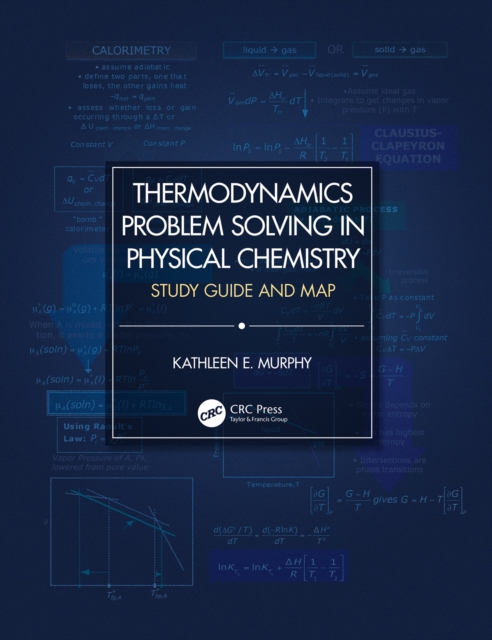
Thermodynamics Problem Solving in Physical Chemistry
Thermodynamics Problem-Solving in Physical Chemistry: Study Guide and Map is an innovative and unique workbook that guides physical chemistry students through the decision-making process to assess a problem situation, create appropriate solutions, and gain confidence through practice in solving physical chemistry problems.
The workbook includes six major sections with 20-30 solved problems in each section that span from easy, single-objective questions to difficult, multistep analysis problems. Each section of the workbook contains key points that highlight major features of the topic, to remind students of what they need to apply to solve problems in the topic area.
Key Features:
Includes a visual map that shows how all the \"equations\" used in thermodynamics are connected and how they are derived from the three major energy laws.
Acts as a guide in deriving the correct solution to a problem.
Illustrates the questions students should ask themselves about the critical features of the concepts to solve problems in physical chemistry
Can be used as a stand-alone product for review of thermodynamics questions for major tests.
eBook

A Feynman integral via higher normal functions
We study the Feynman integral for the three-banana graph defined as the scalar two-point self-energy at three-loop order. The Feynman integral is evaluated for all identical internal masses in two space-time dimensions. Two calculations are given for the Feynman integral: one based on an interpretation of the integral as an inhomogeneous solution of a classical Picard–Fuchs differential equation, and the other using arithmetic algebraic geometry, motivic cohomology, and Eisenstein series. Both methods use the rather special fact that the Feynman integral is a family of regulator periods associated to a family of $K3$ surfaces. We show that the integral is given by a sum of elliptic trilogarithms evaluated at sixth roots of unity. This elliptic trilogarithm value is related to the regulator of a class in the motivic cohomology of the $K3$ family. We prove a conjecture by David Broadhurst which states that at a special kinematical point the Feynman integral is given by a critical value of the Hasse–Weil $L$-function of the $K3$ surface. This result is shown to be a particular case of Deligne’s conjectures relating values of $L$-functions inside the critical strip to periods.
Journal Article

Mathematical analysis of variational isogeometric methods
This review paper collects several results that form part of the theoretical foundation of isogeometric methods. We analyse variational techniques for the numerical resolution of PDEs based on splines or NURBS and we provide optimal approximation and error estimates in several cases of interest. The theory presented also includes estimates for T-splines, which are an extension of splines allowing for local refinement. In particular, we focus our attention on elliptic and saddle point problems, and we define spline edge and face elements. Our theoretical results are demonstrated by a rich set of numerical examples. Finally, we discuss implementation and efficiency together with preconditioning issues for the final linear system.
Journal Article

Multiple Imputation
Multiple imputation is a straightforward method for handling missing data in a principled fashion. This paper presents an overview of multiple imputation, including important theoretical results and their practical implications for generating and using multiple imputations. A review of strategies for generating imputations follows, including recent developments in flexible joint modeling and sequential regression/chained equations/fully conditional specification approaches. Finally, we compare and contrast different methods for generating imputations on a range of criteria before identifying promising avenues for future research.
Journal Article
To Explain or to Predict?
Statistical modeling is a powerful tool for developing and testing theories by way of causal explanation, prediction, and description. In many disciplines there is near-exclusive use of statistical modeling for causal explanation and the assumption that models with high explanatory power are inherently of high predictive power. Conflation between explanation and prediction is common, yet the distinction must be understood for progressing scientific knowledge. While this distinction has been recognized in the philosophy of science, the statistical literature lacks a thorough discussion of the many differences that arise in the process of modeling for an explanatory versus a predictive goal. The purpose of this article is to clarify the distinction between explanatory and predictive modeling, to discuss its sources, and to reveal the practical implications of the distinction to each step in the modeling process.
Journal Article

STABILITY OF MARTINGALE OPTIMAL TRANSPORT AND WEAK OPTIMAL TRANSPORT
Under mild regularity assumptions, the transport problem is stable in the following sense: if a sequence of optimal transport plans π¹, π², . . . converges weakly to a transport plan π, then π is also optimal (between its marginals).
Alfonsi, Corbetta and Jourdain (Ann. Inst. Henri Poincaré Probab. Stat. 56 (2020) 1706–1729) asked whether the same property is true for the martingale transport problem. This question seems particularly pressing since martingale transport is motivated by robust finance where data is naturally noisy. On a technical level, stability in the martingale case appears more intricate than for classical transport since martingale optimal transport plans are not characterized by a “monotonicity”-property of their supports.
In this paper we give a positive answer and establish stability of the martingale transport problem. As a particular case, this recovers the stability of the left curtain coupling established by Juillet (In Séminaire de Probabilités XLVIII (2016) 13–32 Springer). An important auxiliary tool is an unconventional topology which takes the temporal structure of martingales into account. Our techniques also apply to the the weak transport problem introduced by Gozlan, Roberto, Samson and Tetali.
Journal Article

IMPACT OF REGULARIZATION ON SPECTRAL CLUSTERING
The performance of spectral clustering can be considerably improved via regularization, as demonstrated empirically in Amini et al. [Ann. Statist. 41 (2013) 2097-2122]. Here, we provide an attempt at quantifying this improvement through theoretical analysis. Under the stochastic block model (SBM), and its extensions, previous results on spectral clustering relied on the minimum degree of the graph being sufficiently large for its good performance. By examining the scenario where the regularization parameter τ is large, we show that the minimum degree assumption can potentially be removed. As a special case, for an SBM with two blocks, the results require the maximum degree to be large (grow faster than log n) as opposed to the minimum degree. More importantly, we show the usefulness of regularization in situations where not all nodes belong to well-defined clusters. Our results rely on a 'bias-variance' -like trade-off that arises from understanding the concentration of the sample Laplacian and the eigengap as a function of the regularization parameter. As a byproduct of our bounds, we propose a data-driven technique DKest (standing for estimated Davis–Kahan bounds) for choosing the regularization parameter. This technique is shown to work well through simulations and on a real data set.
Journal Article
Geometry of shrinking Ricci solitons
The main purpose of this paper is to investigate the curvature behavior of four-dimensional shrinking gradient Ricci solitons. For such a soliton $M$ with bounded scalar curvature $S$, it is shown that the curvature operator $\\text{Rm}$ of $M$ satisfies the estimate $|\\text{Rm}|\\leqslant cS$ for some constant $c$. Moreover, the curvature operator $\\text{Rm}$ is asymptotically nonnegative at infinity and admits a lower bound $\\text{Rm}\\geqslant -c(\\ln (r+1))^{-1/4}$, where $r$ is the distance function to a fixed point in $M$. As an application, we prove that if the scalar curvature converges to zero at infinity, then the soliton must be asymptotically conical. As a separate issue, a diameter upper bound for compact shrinking gradient Ricci solitons of arbitrary dimension is derived in terms of the injectivity radius.
Journal Article

Quasi-Einstein Metrics and Homogeneous Conformally Einstein Manifolds
This thesis investigates a classic question in Riemannian geometry: What is the best metric to put on a Riemannian manifold? It combines two projects that explore different aspects of this question.The first project studies nilpotent and unimodular solvable Lie groups that admit m-quasi-Einstein metrics (M, g, X) with X a left-invariant vector field, which we call totally left-invariant quasi-Einstein metrics. We give a complete classification of nilpotent Lie groups admitting such metrics, showing that this occurs if and only if the group is isomorphic to Heisenberg Lie group. For unimodular solvable Lie groups S, we prove that the existence of a non-flat totally left-invariant quasi-Einstein metric forces the center of S to be one-dimensional. Furthermore, under the additional assumption that the adjoint action ada of the Lie algebra s of S is a normal derivation, we obtain a full classification: s is standard, and its nilradical must be isomorphic to Heisenberg Lie algebra. As an application, we show that the only near-horizon geometries on a compact nilmanifold are of the form Γ where Hn is the n-dimensional Heisenberg Lie group.The second project completes the structure theory of homogeneous conformally Einstein manifolds by resolving the final open case left by Petersen–Wylie: one-dimensional extensions of homogeneous spaces that admit a conformally Einstein metric. On such spaces, the conformally Einstein metric is in fact a gradient m-quasi-Einstein metric with m = 2 − n. We prove that if a one-dimensional extension of a homogeneous space admits a gradient m-quasi-Einstein metric, then the base is a Ricci soliton when λ ̸= 0, and flat when λ = 0. This establishes that every simply-connected homogeneous non-trivial conformally Einstein manifold is isometric to either a constant curvature space, a product of Einstein space and constant curvature space, or a solvmanifold. Moreover, the classification of which homogeneous space admit a non-trivial conformally Einstein metric is reduced to classifying the nilsoliton metrics. Our proof adapts Lafuente’s geometric invariant theory approach in [26]. As an application, we completely classify simply connected, irreducible, non-trivial conformally Einstein spaces in dimension five.
Dissertation

The K-Stability and K-Moduli of Casagrande-Druel Varieties
In this thesis we investigate the K-stability of a class of Fano varieties known as Casagrande-Druel varieties. These varieties have certain rich geometric properties, such as admitting a conic bundle structure map to a base Fano manifold of one dimension less, and have appeared in recent attempts, such as [10], to further the classification of higher-dimensional Fano manifolds.We relate the K-stability of a certain subclass of Casagrande-Druel varieties to that of a log Fano pair consisting of the base of the conic bundle structure and the discriminant divisor of the conic bundle structure. This is achieved by considering the Gm-equivariant geometry of these Casagrande-Druel varieties and applying an equivariant version of Abban-Zhuang theory (developed in [1]). In doing so we confirm a conjecture of [12] which initiated the study of the K-stability of Casagrande-Druel varieties.The nature of this result readily suggests an improvement to the level of K-moduli spaces. Towards this end, we define a wider class of singular Casagrande-Druel varieties and extend our K-stability results to this larger class. We end with discussion of preliminary work in the direction of upgrading this result on the K-stability of Casagrande-Druel varieties to a statement on their K-moduli.
Dissertation